The good news is that these problems are largely preventable when design starts with the right questions. This guide covers the two primary lab types, the core design elements that determine whether a food testing lab actually works — zoning, surfaces, MEP systems, and compliance infrastructure — and how to build in flexibility so the lab doesn't need a costly overhaul every time testing methods evolve.
Key Takeaways
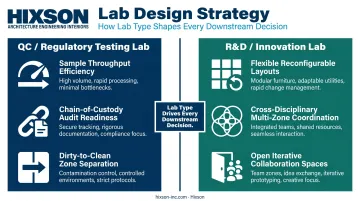
- Lab type — QC/regulatory vs. R&D/innovation — is the first decision and drives every downstream design choice
- Map sample flow before drawing the floor plan — zones follow function, not available space
- MEP systems (ventilation, plumbing, electrical, gases) are contamination control tools, not background systems
- ISO 17025, GLP, FSMA, and USDA requirements carry spatial implications — build them in from day one
- Modular infrastructure and pre-planned utility access cut retrofit costs when testing technologies evolve
Understanding the Two Types of Food Testing Laboratories
Before a floor plan is considered, one question has to be answered: what is this lab designed to do?
Quality Control and Regulatory Testing Labs
These labs exist to verify safety — detecting pathogens and contaminants, confirming nutritional label claims, and satisfying requirements from agencies like the FDA and USDA. They operate either as in-plant labs integrated within a food manufacturing facility, or as third-party commercial labs like those operating under FDA's Laboratory Accreditation for Analyses of Foods (LAAF) program, codified at 21 CFR Part 1, Subpart R.
Design priorities for QC/regulatory labs:
- Moves samples efficiently from intake to result, eliminating bottlenecks at every handoff
- Supports documented chain of custody, calibration records, and secure storage for audit readiness
- Physically separates dirty intake areas from clean analytical zones to prevent cross-contamination
R&D and Food Science Innovation Labs
These labs support product development, formulation work, sensory evaluation, and shelf-life studies. They require flexible, multi-zone layouts that accommodate both analytical instrumentation and experimental kitchen or pilot-scale processing areas.
Design priorities for R&D/innovation labs:
- Layouts that shift as project types evolve, without requiring structural renovation
- Sensory panels, pilot equipment, and analytical benches positioned for coordinated, cross-disciplinary use
- Open zones designed for iterative, team-based work rather than siloed single-function spaces
Why This Is the First Design Decision
The lab's function drives everything downstream: equipment selection, zone separation strategy, the applicable regulatory framework, MEP sizing, and documentation infrastructure.
Designing without this clarity produces misaligned spaces. A lab built purely for throughput often can't support flexible experimentation. An R&D space that never addressed containment requirements will struggle through its first accreditation audit. Getting the lab type right from the start keeps every downstream decision on solid ground.
Core Design Considerations: Zoning, Workflow & Contamination Control
Lab Zoning and Sample Flow
Start with the sample, not the floor plan. The best practice is to map the complete sample journey — from intake and receiving through preparation, analysis, data capture, and waste disposal — before any layout work begins. This approach, supported by workflow optimization frameworks, identifies travel inefficiencies that compromise both accuracy and throughput.
Dirty-to-clean zoning is non-negotiable. Sample intake and receiving areas must be physically separated from clean analytical zones. Common solutions include:
- Airlocks between receiving and analysis areas
- Pass-through chambers for sample transfer without personnel crossover
- Controlled-access doors with logged entry
Personnel traffic flow follows the same directional logic: staff move from clean zones into dirty zones, never the reverse. Even without a procedural lapse, reverse movement alone can reintroduce contamination.
Contamination Control and Surface Selection
Surface materials are contamination control tools, not cosmetic selections. Porous or jointed surfaces harbor pathogens and defeat sanitation protocols regardless of how thorough the cleaning program is.
Recommended specifications for food testing labs:
- Work surfaces: Stainless steel or epoxy resin countertops with chemical resistance verified against actual reagents and sanitizers used (evaluated per SEFA 3 standards)
- Flooring: Epoxy resin with coved base transitions — no seams at the floor-wall junction where contamination accumulates
- Walls: Non-porous, chemical-resistant panels that can withstand wash-down
- Ceilings: Cleanable systems without exposed ledges or recesses
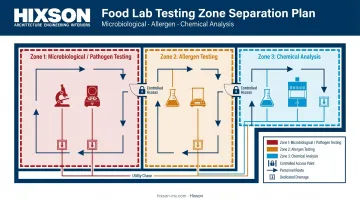
Microbiological/pathogen testing, allergen testing, and chemical analysis each require physically separated areas. Cross-contamination between these zones can invalidate results and create regulatory liability.
Key design details for each separation boundary:
- Dedicated equipment sets assigned to each zone (no shared instruments)
- Separate drainage to prevent cross-zone liquid transfer
- Clearly directed personnel routes that avoid crossover between high-risk areas
Environmental Stability for Analytical Precision
Analytical instruments need stable conditions to produce reproducible results. Temperature swings, humidity fluctuations, and vibration all affect instrument performance and data integrity — and ISO/IEC 17025:2017 requires that environmental conditions be monitored and recorded where they can affect the validity of results.
Design decisions that directly affect instrument performance:
- Window placement — direct solar exposure creates temperature gradients near sensitive instruments
- HVAC zoning — analytical areas need tighter temperature and humidity control than support spaces
- Insulation — exterior wall labs require more robust thermal envelopes
- Vibration isolation — mass spectrometers and other precision instruments may need isolated benching or floor systems
All of these decisions belong in the design phase, not the construction phase. That's why Hixson integrates mechanical and electrical engineers at the start of programming — before zones are committed to drawings and coordination becomes costly.
MEP Systems and Critical Infrastructure
Ventilation and HVAC Design
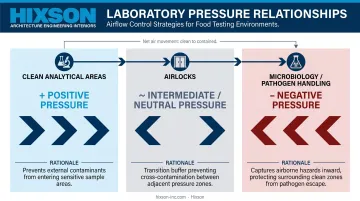
HVAC in a food testing lab is a contamination control system — it just happens to also regulate temperature and humidity. Treating it as anything less leads to pressure relationships that don't hold, airflow patterns that carry contaminants across zones, and energy costs that run unnecessarily high.
Pressure relationships by zone:
| Zone | Pressure Relationship | Rationale |
|---|---|---|
| Clean analytical areas | Positive | Prevents contamination ingress from adjacent spaces |
| Microbiology/pathogen handling | Negative or directional inward | Contains aerosols and biological hazards |
| Airlocks between zones | Intermediate | Buffer between pressure differentials |
For work with moderate-hazard biological agents, CDC/NIH BMBL guidance supports biosafety cabinets and directional airflow as primary containment measures. Tie HEPA filtration requirements to the specific organism risk and procedure rather than applying them as a blanket standard across all food microbiology spaces.
Fume hood placement must account for room airflow patterns, occupant circulation, and makeup air supply to maintain effective face velocity. Variable air volume (VAV) fume hood systems merit specification for labs running extended hours. NREL's 2024 lab decarbonization guidance identifies VAV hoods as a meaningful energy reduction strategy, though actual savings depend on project-specific operating conditions and sash use patterns.
Plumbing, Utilities, and Lab Gases
Food testing labs need differentiated water systems — not a single supply line serving all needs:
- Deionized (DI) or reverse osmosis (RO) water for analytical work, with water quality matched to method requirements per ASTM D1193
- Process water for general cleaning
- Hot water for sanitation protocols
Drainage must handle both chemical and food waste streams with separate routing. Mixing these streams creates cross-contamination risk and complicates waste disposal compliance. Wash-down areas need sloped floors and indirect drain connections — design these into the structural slab, not after the fact.
Laboratory-grade compressed air, natural gas drops for instrumentation, and specialty gases (nitrogen, CO2) must be routed safely to analytical equipment. Late-stage changes to gas distribution are among the more expensive field modifications in lab construction, which makes early coordination between process engineering and MEP disciplines critical.
Hixson structures plumbing, process, and mechanical engineers to work in parallel from day one — resolving these conflicts in design rather than through field RFIs.
Electrical and Data Infrastructure
Analytical instruments — chromatography systems, PCR equipment, mass spectrometers — require:
- Dedicated circuits sized to equipment specifications
- Stable voltage to protect sensitive electronics
- Uninterruptible power supply (UPS) protection to prevent data loss and instrument damage during power events
Where flammable solvents are used, hazardous area classification must be evaluated by a qualified electrical engineer. Hixson's electrical engineering capabilities explicitly include electrically hazardous area classification as a specialty area — this is not a generic electrical design task.
Data infrastructure placement follows a straightforward rule: instrument control workstations belong outside sample-handling areas. This reduces contamination risk, preserves bench space, and keeps analysts from crossing between zones to log data.
Data ports, network access points, and LIMS workstation locations should be coordinated with zone layouts during design. Pulling cable to wherever it happens to reach after installation is a correctable mistake — but an avoidable one.
Designing for Regulatory Compliance
Compliance in a food testing lab isn't primarily about paperwork — it's about spatial decisions that make compliant operations physically possible.
The Compliance Landscape
Key frameworks applicable to food testing labs:
- ISO/IEC 17025 — accreditation standard for testing and calibration labs; requires environmental monitoring records, controlled access, and documented chain of custody
- FDA GLP (21 CFR Part 58) — applies to nonclinical studies supporting FDA submissions; mandates separated study functions and archive/record storage
- FDA FSMA / 21 CFR Part 117 — governs preventive controls for human food; verification activities can include product testing and environmental monitoring
- USDA FSIS Accredited Laboratory Program — requires adequate facilities, sample control, records management, and documented testing workflows
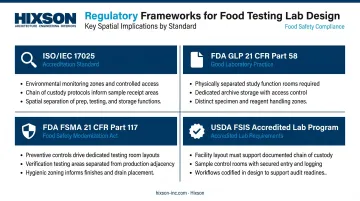
Each framework has spatial implications. ISO 17025, for example, requires that environmental conditions be monitored where they affect result validity — which means sensor infrastructure needs to be built into the design, not retrofitted once construction is complete.
Chain of Custody Is a Spatial Problem
Sample integrity from reception to reporting requires physical design solutions, not just procedural ones:
- Secure, logged sample intake rooms with controlled access
- Segregated sample storage with temperature monitoring integrated into the room design
- Locked refrigerators and freezers with backup systems and alarm connections
- Clearly defined handoff points between lab zones, built into the floor plan
When these elements are managed procedurally rather than physically, they create audit vulnerabilities that procedures alone can't fix.
Documentation Zones and Integrated Design
Dedicated areas for data recording, equipment calibration staging, and record-keeping must be adjacent to — but separated from — analytical benches. Analysts should be able to enter data without carrying contamination risk from the bench to the workstation.
Compliance failures in lab design most often arise from disconnected decision-making, where architecture, MEP, and process engineering are specified independently. The result shows up in audits: a drainage system that wasn't coordinated with zone separation, or insulation materials that don't meet GMP standards for the space they're installed in.
Hixson encountered this on three separate construction administration projects: contractors had installed standard fiberglass insulation instead of the specified polyisocyanurate insulation in GMP spaces. Fiberglass absorbs moisture and can create harborage points for bacterial growth — invisible to cleaning crews and QA inspectors. The problem was caught because Hixson's CA was on-site throughout construction. Without that continuity, it surfaces during an audit instead.
That's the practical argument for integrated design. When architecture, MEP, process engineering, and controls are coordinated by the same team throughout design and construction, compliance gaps get resolved before they're built in — not after.
Flexibility, Modularity, and Future-Proofing
Modular Casework and Movable Infrastructure
Testing methods change, new instruments get introduced, and throughput requirements increase — a lab built with fixed casework and hard-plumbed bench positions becomes a renovation project the moment any of those shifts arrive.
Modular laboratory casework, adjustable shelving, and mobile bench systems allow reconfiguration without disruptive or expensive construction. In food-sensitive environments, mobile furniture also simplifies sanitation — benches that move can be cleaned underneath.
The trade-off is planning: modular systems require more deliberate utility access point design so that connections are available where benches might move, not just where they start.
Pre-Planned Utility Access Points
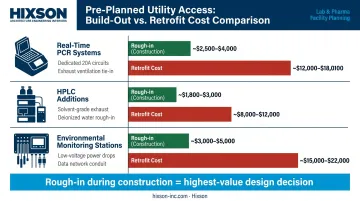
The incremental spend during build-out is modest; the cost of breaking into finished walls and ceilings to add a gas drop or a 20-amp circuit for a new PCR system is not. Roughing in additional electrical circuits, plumbing connections, gas drops, and data ports during initial construction is one of the highest-value decisions made during design.
Emerging analytical technologies worth planning for:
- Real-time PCR systems — specific power, HVAC, and bench vibration requirements
- High-performance liquid chromatography (HPLC) additions — solvent handling, ventilation, and chemical storage implications
- Environmental monitoring stations — capacity for expansion as testing programs grow
Digital Integration
As food testing labs become more data-driven, the physical environment needs to support it:
- LIMS integration — LIMS platforms centralize sample tracking, instrument data, and regulatory documentation; workstation and data port placement must be coordinated with the LIMS layout during design
- Conduit routing — design conduit runs during construction rather than surface-mounting cable trays after the fact
- Cable management — structured cable systems that can handle future instrument additions without disrupting existing connections
Getting these decisions right during design — before walls are closed and ceilings are finished — is where firms like Hixson focus early coordination between architecture, MEP engineering, and controls teams.
Frequently Asked Questions
What are the factors to consider when designing a food laboratory?
Start by defining the lab type and primary function, then map sample flow before fixing any zone layout. From there, design decisions follow: surface and material selection for contamination control, MEP infrastructure sized to the actual test menu, regulatory compliance requirements built into the spatial design, and modular infrastructure for future flexibility.
What are the two types of food laboratory?
The two main types are quality control and regulatory testing labs — focused on safety verification, pathogen detection, and compliance with FDA/USDA standards — and R&D/food science innovation labs, focused on product development, sensory evaluation, and formulation work. Zone layout, flexibility requirements, and regulatory infrastructure differ significantly between them.
What is the difference between a food testing lab and a food R&D lab?
Food testing labs are designed around sample throughput, containment, and auditability for regulatory compliance. Food R&D labs prioritize experimental flexibility, cross-disciplinary collaboration, and sensory evaluation spaces — and often incorporate pilot-scale processing areas alongside analytical zones that QC labs don't require.
What HVAC requirements are specific to food testing laboratories?
Clean analytical areas require positive pressure; microbiology and pathogen handling zones require directional inward airflow to contain aerosols. HEPA filtration applies where biosafety cabinet use and organism risk warrant it — not as a blanket standard. Fume hood exhaust must be sized for effective face velocity, with the full system engineered around contamination control rather than occupant comfort.
How do you design a food testing lab for regulatory compliance?
Build chain-of-custody pathways into the floor plan: secure intake rooms, segregated temperature-monitored storage, and documented handoff points. Specify cleanable, chemically resistant surfaces meeting GLP and ISO 17025 requirements, and integrate environmental monitoring infrastructure at the design stage. Architecture, MEP, and process engineering decisions need to be coordinated together — not sequentially.
What materials are best for food testing laboratory surfaces and finishes?
Stainless steel countertops for work surfaces, epoxy resin flooring with coved base transitions for seamless sanitation, non-porous chemical-resistant wall panels, and powder-coated or stainless steel casework. Material selection in food testing labs is a contamination control and compliance decision — SEFA 3 provides the chemical-stain-resistance testing benchmark for evaluating work surface performance against actual reagents and sanitizers used.