Introduction
Hot water recirculation is one of those systems that gets specified early and questioned rarely — until something goes wrong. In food processing plants, pharmaceutical facilities, and laboratories, "something going wrong" means failed sanitation audits, Legionella risk, or fixtures that run cold when they should run hot.
The problem isn't that recirculation is a bad solution. It's that it's frequently treated as a checkbox rather than an engineered system. Common failures include:
- Poorly balanced loops that leave remote fixture zones cold
- Undersized pumps that can't overcome pressure drop across the index circuit
- Inadequate temperature management that creates the stagnant-water conditions recirculation is supposed to prevent
This guide walks through how recirculation systems work, the three-step design sequence that determines whether a system performs, the key factors shaping design decisions, and the situations where recirculation may not be the right answer at all.
It's written for engineers, facility managers, and project leads in commercial and industrial buildings — particularly food and beverage, pharmaceutical manufacturing, and laboratory environments where hot water delivery is directly tied to regulatory compliance.
Key Takeaways
- A recirculation system keeps hot water moving through supply piping so it's immediately available at any fixture — no purging, no wait time.
- Design requires three core calculations: pipe heat loss (BTU/hr), recirculation flow rate (GPM), and total system pressure drop.
- Balancing across all return loops is the most commonly skipped step — and the one most likely to leave remote zones cold.
- CDC guidance requires storing hot water above 140°F and keeping circulating water above 120°F to control Legionella.
- Recirculation isn't always the right solution; building size, fixture density, and demand patterns all determine whether it's warranted.
What Is a Hot Water Recirculation System?
A hot water recirculation system is a closed supply-side loop. A pump continuously moves hot water from the water heater through the distribution piping and back via a return line, maintaining temperature throughout the system whether or not any fixture is actively drawing water.
Two Primary Configurations
Dedicated-loop systems run a separate return line alongside the supply piping, bringing cooled water back to the heater inlet. This is the standard in commercial and industrial facilities.
Integrated (bypass valve) systems use the existing cold water line as the return. Common in residential retrofits, they're rarely used in commercial applications. The reason is straightforward: warm water showing up at cold fixtures is an operational problem in any facility with sanitation requirements.
How This Differs from a Dead-Leg System
Without recirculation, hot water sits stationary in supply branches between use events. It loses heat to the surrounding space. When a user opens a fixture, they have to purge that cooled water before hot water arrives.
In a small office, that's a minor inconvenience. In a large food processing plant or multi-story pharmaceutical campus, dead-leg distances can be substantial. The consequences are real:
- Unacceptable wait times at remote fixtures
- Significant potable water waste from purging
- Stagnant water zones where Legionella can proliferate
As ASPE notes, a poorly designed hot water maintenance system wastes energy and potable water while creating fixture delays — even when recirculation is present but engineered incorrectly.
Why Hot Water Recirculation System Design Matters
Operational Stakes in Regulated Environments
In food processing, pharmaceutical manufacturing, and laboratory facilities, hot water is an operational utility. Hand hygiene compliance, CIP (clean-in-place) operations, and process sanitation all depend on consistent delivery at the required temperature and flow rate. A recirculation system that undersupplies certain fixture zones directly compromises those outcomes.
Hixson's Plumbing Systems and Fire Protection Engineering team designs domestic hot water systems — including recirculation — as part of integrated building utility packages across food and beverage, pharmaceutical, and laboratory projects throughout North America. Those systems must meet both operational requirements and regulatory compliance from day one.
The Regulatory Landscape
Code requirements for hot water temperature maintenance vary by jurisdiction. Key provisions to confirm before design:
- The 2024 IPC requires an approved pressure-reducing valve where building water pressure exceeds 80 psi (552 kPa)
- New York City's Administrative Code limits developed hot water piping length from source to fixture to 20 feet before requiring a temperature-maintenance method
- Other jurisdictions set that threshold at 100 feet
Always verify the adopted local code edition — there is no universal trigger distance.
ASHRAE 90.1-2019 Addendum aq (approved July 2022) establishes minimum piping insulation requirements for service water heating systems — including 1.0 inch minimum for pipes smaller than 1.5 inches carrying water at 105°F to 140°F.
Legionella Temperature Requirements
Temperature management has direct consequences for pathogen control. CDC guidance sets clear thresholds:
- Store hot water above 140°F (60°C)
- Maintain circulating hot water above 120°F (49°C)
- ASHRAE guidance also recommends delivery at or above 124°F (51°C)
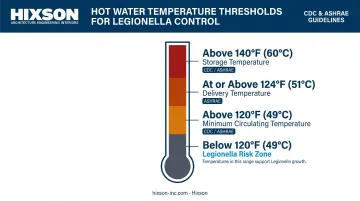
Recirculation helps — but only when the system maintains those temperatures throughout the loop. Return-line temperature drop is where many designs fall short: a pump that's running without verified return-line temperatures provides no real protection.
Energy Cost of Loop Heat Loss
The DOE's commercial water-heating energy conservation rule analysis accounts for recirculation-loop heat losses when calculating building hot-water loads. Loop heat loss isn't just a comfort issue — it's an energy cost that compounds continuously in 24/7 operations. Under-insulated piping accelerates this, driving more frequent water heater cycling and higher flow rates to compensate.
How a Hot Water Recirculation System Works
The water heater produces hot water at the set supply temperature. The circulation pump draws that water through main supply piping and branch risers. When no fixture is drawing water, cooled water at the end of each branch loop returns via the return line to the water heater inlet. The pump runs continuously or on a control schedule, keeping the loop temperature within the acceptable range.
The pump must provide enough head pressure to overcome friction across the entire supply-and-return circuit. That friction peaks along the index circuit (the longest or most restrictive path through the system). Sizing the pump correctly begins with knowing exactly how much heat the piping loses — which is where the design process starts.
Step 1: Calculate Heat Loss and Required Flow Rate
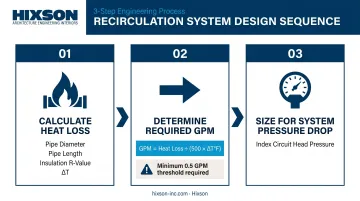
Every design begins with heat loss. The total BTU/hr lost across all insulated supply piping is calculated using:
- Pipe diameter and length (mains, risers, branch runouts)
- Insulation R-value (per ASHRAE 90.1 Table 7.4)
- Temperature differential between supply water and ambient space temperature
Once total heat loss is established, the required recirculation flow rate follows from the ASPE-verified formula:
GPM = system heat loss (BTU/hr) ÷ (500 × temperature drop °F)
The temperature drop (ΔT) is the acceptable temperature decrease at the farthest fixture. Ten degrees Fahrenheit is a common design assumption; some designers use 5°F where tighter temperature control is required. Neither is universally mandated — the project basis determines the appropriate value.
One critical check: balancing valves don't function accurately below 0.5 GPM, per ASPE guidance. If calculated branch flows fall below that threshold, the design needs to be reconsidered.
Step 2: Design the Return Piping Layout and Pressure Zones
Each supply branch or floor riser needs a corresponding return connection. In a correctly configured system, cooled water from every branch has a path back to the heater.
In high-rise or large-footprint facilities, static head from building height creates a pressure management problem. Without zoning, pressure at lower floors can far exceed the 80 psi fixture limit even while the top floors barely meet minimum supply pressure.
Pressure zone solutions include:
- Dedicated heat exchangers at zone boundaries
- Separate zone pumps for each pressure zone
- PRVs on cold water makeup or dead-leg branches — not on recirculation return lines
That last point is critical. Installing PRVs directly on the recirculation return creates disproportionate resistance in that loop, which unbalances the entire system. ASPE's pressure-zone guidance also notes that hot water should not be circulated through PRVs, as high pressure and velocity can damage valve seats.
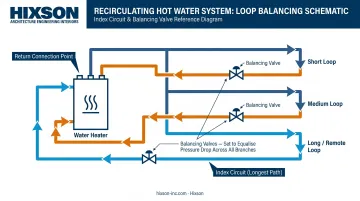
Step 3: Balance the System Across All Return Loops
This is the step most frequently skipped, and the one that determines whether remote fixture zones actually receive hot water.
Water follows the path of least resistance. Without balancing, flow concentrates in the shortest or largest-diameter loops. Remote branches with higher resistance receive little or no recirculation flow and remain cold.
Balancing valves (manual or automatic) are installed on each return branch and set to create equivalent effective resistance across all loops. For each valve, the engineer determines the required setting based on:
- The calculated pressure differential for that loop
- Its resistance relative to the index circuit
- Whether the branch flow rate exceeds the 0.5 GPM minimum threshold
A system with a correctly sized pump and properly insulated piping will still underperform if the balancing step is treated as a field commissioning task rather than a design deliverable.
Key Factors That Affect Hot Water Recirculation System Design
Pipe Insulation and Heat Loss Inputs
Insulation thickness directly controls how much BTU/hr is lost, which in turn determines how large the recirculation pump needs to be. ASHRAE 90.1 sets minimum values, but under-insulated or uninsulated pipe — a common finding in older facilities — can increase heat loss dramatically. The result: higher required pump flow rates or more frequent water heater cycling.
Operating Temperatures and Legionella Management
The engineer must select supply temperature and acceptable ΔT to satisfy both user requirements and Legionella control simultaneously. In food and beverage and pharmaceutical facilities, this also requires coordinating:
- Process-use temperatures and sanitation cycle requirements
- Tempered water delivery via thermostatic mixing valves (ASSE 1017) at fixtures
- A facility Water Management Plan per ASHRAE Standard 188-2021
ASHRAE 188 identifies risk criteria including buildings over 10 stories, centralized potable water systems in multi-unit buildings, and healthcare facilities — but the underlying principle applies to any facility where water system conditions could support Legionella growth.
Pump Selection and DOE Efficiency Requirements
The pump must operate at the correct duty point: the intersection of the pump curve and the system curve (total head vs. GPM). A pump curve that's too steep causes flow imbalances across zones.
One regulatory note: the DOE's final rule on circulator pump energy conservation standards requires compliance on and after May 22, 2028. Specifying high-efficiency circulators now — rather than waiting for the deadline — avoids retrofits and aligns with where most commercial specifications are already headed.
Pipe Materials and Standards Compliance
| Material | Common Application | Key Standard |
|---|---|---|
| Type L Copper | Most commercial construction | ASTM B88 |
| Stainless Steel | Pharmaceutical, food processing | ASME BPE-2024 |
| CPVC | Lower-temperature or cost-sensitive | — |
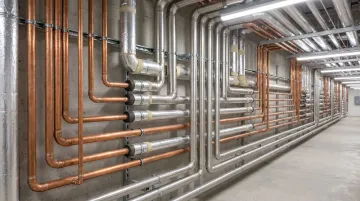
All materials in contact with potable water must comply with NSF/ANSI/CAN 61. In pharmaceutical and bioprocess environments, stainless steel is preferred for corrosion resistance and cleanability — not as a premium option, but as a functional requirement.
Zoning and Control Strategy
Large facilities benefit from zone-based design: separate pump-and-return circuits serving different wings, floors, or process areas. This allows independent control, maintenance, and shutdown without affecting the rest of the hot water system.
Control options and their tradeoffs:
- Continuous pump: Required for most 24-hour food and pharma operations
- Thermostat-controlled: Activates pump when return temperature drops below setpoint — balances energy use with temperature maintenance
- Timer-based: Appropriate for predictable single-shift operations; not suitable for 24-hour facilities
- Demand-activated: May work for low-traffic areas; can leave return lines cooler than desired
Common Mistakes in Hot Water Recirculation System Design
Mistake #1: Sizing the Pump for GPM Only
The recirculation pump must be sized for both flow rate and total system pressure drop across the index circuit. A pump that delivers the required GPM but lacks the head pressure to push through the highest-resistance return loop leaves remote branches cold — regardless of whether it's running.
Mistake #2: Installing PRVs on the Recirculation Main
This is a common retrofit error. Adding a PRV to manage zone pressure on the recirculation riser creates a high-resistance restriction in that loop. Some branches over-circulate; others stall. Pressure zones need dedicated zone systems — not restrictions inserted into the return circuit.
Mistake #3: Assuming Recirculation Eliminates Legionella Risk
A circulating system reduces stagnant zones but doesn't automatically prevent colonization. Return line temperatures matter as much as supply temperatures. Research published in Water Research found that 55°C was significantly more effective than 50°C at reducing Legionella colonization — that 5°C difference isn't trivial.
Low-flow dead-leg branches not connected to the return loop remain a risk even when the main recirculation loop is operating correctly.
When a Hot Water Recirculation System May Not Be the Right Choice
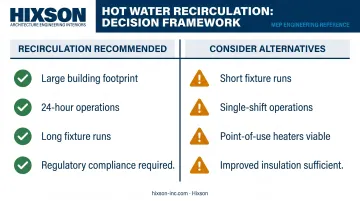
Recirculation gets specified by default on many projects. That's a mistake in certain situations.
Where recirculation is unnecessary:
- Small buildings where the longest fixture run from the water heater is short enough that dead-leg wait time is acceptable
- Facilities where point-of-use or instantaneous water heaters at each fixture group eliminate the need for a central distribution loop
- Multi-tenant buildings where individual unit water heaters achieve equivalent results without the capital cost and balancing complexity
Warning signs that recirculation is being over-specified:
- It's included because it was used on a previous project, without evaluating fixture layout or demand profile
- The facility has extended periods of zero hot water demand (single-shift operations) — continuous recirculation in this scenario wastes energy and accelerates pump wear
- Improved pipe insulation alone could reduce heat loss enough to make recirculation unnecessary for marginal cases
DOE research confirms that recirculation-loop heat losses represent a real, ongoing energy cost in commercial buildings. Peer-reviewed studies note that continuously heating circulating water drives up electricity costs and worsens building energy performance — which matters when deciding between a recirculation loop and point-of-use alternatives.
Where recirculation is the right answer, correct design determines whether it delivers. That means sizing, balancing, and controlling the system based on actual heat loss calculations, measured fixture demand patterns, and applicable regulatory requirements — not assumptions carried over from prior projects.
Hixson's plumbing and mechanical engineering team applies this project-specific evaluation across food and beverage, pharmaceutical, laboratory, and workplace facilities throughout North America.
Frequently Asked Questions
How does a hot water recirculation system work?
A circulation pump continuously moves hot water from the water heater through supply piping and back via a return line. This keeps water in the loop at temperature so that when a fixture is opened, hot water is available immediately (no purging of cooled water required).
What are the different types of hot water recirculating systems?
Dedicated-loop systems run a separate return line back to the heater and are standard in commercial and industrial applications. Integrated (bypass valve) systems use the cold water line as the return path, which is common in residential retrofits but rarely appropriate for commercial facilities — warm water at cold outlets creates real operational problems.
Does a hot water recirculating pump need a return line?
In a dedicated-loop system, yes — one is required. In a bypass valve system, the cold water line serves as the return, though this approach can cause warm water at cold water outlets. Commercial facilities almost always use dedicated return lines for this reason.
What is the difference between open-loop and closed-loop hot water systems?
A closed-loop system (typical in hydronic heating) circulates the same water continuously without introducing fresh water and uses cast iron pumps. An open-loop system, used in domestic hot water recirculation, connects to the potable water supply and requires bronze or stainless steel pumps to resist corrosion from fresh, oxygenated water.
Are hot water recirculation systems worth it?
In commercial and industrial facilities, recirculation is typically a code and operational requirement, not a preference. The key is correct design (proper sizing, balancing, and control strategy) so that the energy cost of continuous recirculation is justified by water savings, compliance, and operational reliability.
What material is used for hot water recirculation pipes?
Type L copper is most common in commercial construction (per ASTM B88). Stainless steel is preferred in pharmaceutical and food processing environments for corrosion resistance and cleanability. CPVC is used in lower-temperature applications. All materials in contact with potable water must comply with NSF/ANSI/CAN 61.