Manual case packing and palletizing that worked fine at 500 barrels a year becomes a real constraint at 5,000. Labor shortages compound the problem. Distributor pallet requirements create rework. And the throughput gains from upstream filling investments get absorbed by bottlenecks at the back of the building.
Most craft producers know end-of-line automation is coming. The mistake is waiting too long to plan for it. This guide covers what end-of-line automation actually includes, where craft producers face unique planning demands, when to invest, and how to approach facility and infrastructure decisions before—not after—equipment is specified.
Key Takeaways
- End-of-line automation covers case forming, packing, sealing, palletizing, and load stabilization—everything after filling and labeling
- Craft producers face SKU complexity, space constraints, and labor variability that make planning more demanding than at large-scale operations
- Modular and collaborative robotic systems make automation accessible at craft production volumes
- The right time to automate is earlier than most producers expect
- Successful implementation means coordinating equipment selection with facility layout, utilities, and controls before any purchases are made
What Is End-of-Line Automation in Craft Beverage Production?
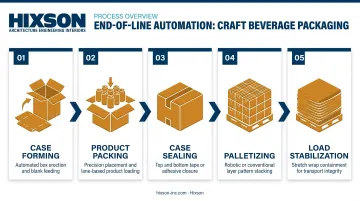
End-of-line automation covers the final stages of your packaging process—the systems that take filled, capped, and labeled containers and prepare them for distribution. It starts where your filler and labeler hand off and ends when a wrapped pallet is ready to load. The core steps include:
- Case forming
- Product packing
- Case sealing
- Palletizing
- Load stabilization
Upstream and downstream automation serve fundamentally different functions. Upstream systems (filling, capping, labeling) handle individual containers at precise speeds. End-of-line systems handle grouped products and secondary packaging at higher physical demands and variable throughput rates. When the two aren't matched—in speed, accumulation, or controls communication—bottlenecks form at the handoff point.
For craft producers, "end-of-line automation" often doesn't mean a fully integrated system from day one. Many operations start with a single automated step—robotic palletizing is the most common first step—and build from there as production volume and capital availability grow. That phased approach fits how craft businesses actually grow.
Core End-of-Line Automation Systems for Craft Beverage Producers
Most craft operations don't need every system at once. Equipment is typically added in phases, aligned with production volume and capital priorities.
Case Forming and Erecting
Case erectors automatically form flat blanks into square, ready-to-pack cases or trays. This step is easy to overlook, but inconsistent manual case forming causes downstream jams and misaligned pallet loads with surprising regularity. Both RSC (regular slotted carton) and tray-style formats appear frequently in craft beverage packing, and automating this step improves line reliability before product even enters the case.
Case Packing and Partition Insertion
Case packers place filled containers into formed cases. For glass bottle lines, partition inserters are a critical companion — they protect bottles from contact damage during transport and reduce the product loss that comes with manual glass handling across multiple SKUs.
For craft producers running 750-ml bottles alongside 12-oz cans in different pack configurations, automated partition handling cuts both breakage costs and manual sorting labor.
Case Sealing and Labeling
Case sealers close and seal packed cases using tape or hot-melt adhesive. Automated case labelers apply shipping labels with consistent placement. Consistent case presentation is now a firm requirement for craft brands pursuing wholesale and retail distribution — channels that expect standardized, scan-ready case labeling.
Robotic Palletizing
Robotic palletizing is the most commonly adopted end-of-line investment for craft producers, and for good reason. Traditional industrial palletizers are designed for high-volume, single-SKU lines running continuously, which makes them a poor fit for the moderate speeds and frequent format changes typical of craft operations.
Collaborative and modular robotic palletizers are built for exactly this environment. They handle SKU changeovers faster, fit into tighter floor footprints, and operate at speeds matched to craft production volumes. Food and consumer goods robot orders grew 40% in Q3 2024, reflecting how broadly automation has moved into general manufacturing — compact palletizing cells are a significant part of that shift.
Boulevard Brewing in Kansas City provides a useful real-world benchmark: before automating, the brewery used three workers to manually palletize 30-lb cases at 12 cases per minute — a rate that had become a measurable production constraint. After installing an automated palletizer, Honeywell documented a 100% efficiency gain for the operation.
Conveyance, Accumulation, and Stretch Wrapping
Conveyors and accumulation zones connect line segments and buffer products between stages. Stretch wrapping systems secure finished pallet loads for transport. Both are consistently underspecified in initial automation plans. The consequences are predictable:
- Insufficient accumulation: a brief upstream pause stalls the entire end of the line
- Inadequate stretch wrapping: load integrity failures in distribution can cost more than the automation saved
Unique Challenges Craft Beverage Producers Face at the End of the Line
SKU Complexity and Changeover Pressure
Large beverage operations run a single SKU at high volume for extended periods. Craft producers don't have that luxury. A typical craft brewery might run 12-oz cans, 16-oz cans, 750-ml bottles, four-packs, six-packs, and variety packs—sometimes in the same week.
The U.S. craft beer market still includes well over 35,000 active SKUs at off-premise retail. Each format change requires end-of-line systems that can accommodate quick changeovers without sacrificing throughput or consistency. Systems designed for single-format lines struggle here; flexible, programmable equipment earns its cost in reduced changeover time alone.
Floor Space Constraints
Craft facilities are often built in converted warehouses, historic buildings, or compact greenfield sites with limited linear footage. End-of-line equipment takes up real estate—and a robotic palletizing cell that works perfectly in a 15,000-square-foot production floor may not fit in a facility where that space is already occupied by fermentation tanks and a taproom.
Modular equipment configurations and thorough layout planning before purchase are not optional in these environments—skipping either typically means expensive construction after the fact.
Labor Availability and Injury Risk
Craft producers commonly rely on part-time or seasonal labor at the end of the line. That leads to inconsistent pallet builds, variable throughput, and elevated injury risk from repetitive lifting and manual stacking.
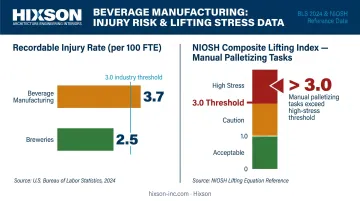
According to BLS data published in 2026, beverage manufacturing recorded 3.7 total recordable injury cases per 100 full-time employees in 2024—with breweries specifically at 2.5 per 100 FTE.
OSHA data places manual palletizing tasks in food processing environments at NIOSH Composite Lifting Indexes above 3.0, the threshold NIOSH identifies as a highly stressful lifting task.
Seasonal and Demand Variability
Craft beverage production spikes around seasonal releases and taproom events. Scaling output quickly without proportional labor increases is a recurring challenge. Right-sized automation allows producers to absorb peak demand without permanent headcount additions—and without the throughput variability that comes with pulling temporary workers onto a manual line.
When Should a Craft Beverage Producer Invest in End-of-Line Automation?
The decision comes down to specific operational signals — package format, case weight, labor costs, and distributor requirements all factor in. These are the clearest indicators that the time has come:
- Manual palletizing is limiting daily output — when your line rate is constrained by how fast workers can stack, not by your filler or labeler
- Distributor pallet build requirements are causing rework — when loads are being rejected or rebuilt because they don't meet retailer or distributor standards
- Labor availability at the end of the line is disrupting production schedules — when shift coverage gaps translate directly into throughput gaps
- A facility expansion or new build is planned — this is the most cost-effective moment to integrate end-of-line automation, because engineers can design systems in from the start rather than retrofit around an existing footprint
The Boulevard Brewing example offers a practical benchmark: at 12 cases per minute with three workers on the line, manual palletizing had become the production constraint. If your operation is approaching that combination of line speed and headcount, it's worth running the numbers.
Starting with a Single Step
Craft producers don't need to automate the entire end of the line at once. A phased approach — starting with robotic palletizing or stretch wrapping, then adding case erection and packing as volume grows — lets capital investment track with production rather than getting ahead of it. This reduces implementation risk and lets teams optimize the first phase before committing capital to the next.
Planning Your Facility for End-of-Line Automation
Equipment selection is only part of the decision. The facility itself has to be ready to support the systems being installed—and that assessment needs to happen before equipment is specified, not after it arrives.
Infrastructure Requirements to Evaluate
Key facility requirements for end-of-line automation include:
- Electrical service — integrated palletizing systems typically require 480V, 3-phase power; confirm with each vendor
- Compressed air supply — capacity and pressure requirements vary by system; specify early
- Floor load capacity — robotic systems and loaded pallets impose point loads that older or thinner slabs may not support without reinforcement
- Ceiling height clearances — some palletizer configurations require overhead clearance that not all craft facilities have
- Forklift access — automated palletizing zones need clear paths for pallet removal without creating traffic conflicts with the production floor
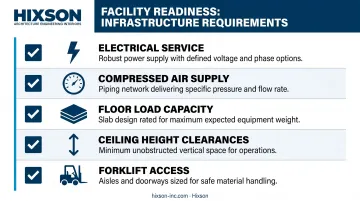
Each requirement is system-specific. Confirm the details with each vendor and review them with the engineering team responsible for the facility before any equipment is specified.
Layout and Line Flow Planning
End-of-line systems must be configured around the specific flow of upstream equipment. A change to conveyor routing affects accumulation requirements. A change to palletizer position affects forklift access and exit flow. These dependencies compound quickly when they're worked out after equipment is purchased.
This is where having architecture and engineering expertise involved early pays off. Hixson's integrated approach—bringing manufacturing engineering, controls and automation, mechanical, and electrical disciplines together from a single source—allows craft beverage producers to design end-of-line systems that fit their facility rather than retrofitting the facility around equipment. The firm's work on the Samuel Adams Cincinnati brewery expansion, which included designing infrastructure for additional canning lines alongside a new automated storage and retrieval system building, reflects that integrated approach applied at scale.
Controls and Automation Integration
End-of-line systems need to communicate with upstream equipment and, in many cases, with plant-level control systems for production monitoring and OEE tracking. Poorly integrated controls create line stoppages, data gaps, and maintenance complexity that erodes the efficiency gains the automation was meant to deliver.
Specifying controls architecture before installation is critical. That means addressing:
- Communication protocols between your filler, labeler, case packer, and palletizer
- How the system will feed data to plant monitoring platforms
- Whether the controls approach is maintainable by the operations team running the line day to day
Hixson's Controls & Automation team works across platforms including Rockwell Automation, AVEVA Wonderware, and Inductive Automation Ignition, with packaging line integration as a primary focus of the group.
What a Facility Readiness Assessment Should Cover
Before right-sizing an end-of-line investment, producers should gather and evaluate:
- Current line speed and throughput data
- Pallet build rates and labor hours at the end of the line
- Available floor area and utility capacity
- Future SKU and volume projections
- Distribution partner pallet and case labeling requirements
This assessment is the starting point for an informed investment, not a step that follows equipment selection. Hixson's Master Planning services for food and beverage producers are structured to address this evaluation—covering manufacturing capacity, utility infrastructure, line additions, and phased capital deployment aligned with growth plans.
Frequently Asked Questions
What is end-of-line automation in beverage production?
End-of-line automation refers to the final stage of packaging—case forming, packing, sealing, palletizing, and load stabilization—that prepares filled and labeled containers for distribution. It begins after filling and labeling are complete and ends when a finished pallet is ready to ship.
When should a craft brewery consider end-of-line automation?
Common triggers include manual palletizing that limits daily output, distributor pallet requirements causing rework, and inconsistent labor availability disrupting schedules. A planned facility expansion is also an ideal time to design automation in from the start rather than retrofit it later.
Can end-of-line automation work for small craft producers with limited floor space?
Yes. Modular and collaborative robotic systems are specifically designed for compact footprints. Proper layout planning by engineering professionals before equipment is purchased can fit effective automation into smaller craft facilities without requiring major construction.
What is the ROI timeline for end-of-line automation at craft production volumes?
Payback periods typically range from two to four years depending on production volume, labor costs, and automation scope. A single step like robotic palletizing often achieves faster ROI than expected once labor redeployment, injury reduction, and product damage savings are factored in.
How does end-of-line automation integrate with existing filling and labeling equipment?
Integration requires conveyance and controls coordination between upstream and end-of-line systems. Communication protocols, line speeds, and accumulation requirements should be evaluated during planning, before installation, to prevent bottlenecks at handoff points.
What infrastructure does a craft beverage facility need to support end-of-line automation?
Core infrastructure requirements include:
- Adequate electrical service (typically 480V, 3-phase for integrated palletizers)
- Compressed air supply and sufficient floor load capacity
- Ceiling height clearances and forklift access around the automated zone
All should be assessed before equipment is specified.