Introduction
Each year, approximately 48 million Americans contract foodborne illnesses, resulting in 128,000 hospitalizations and 3,000 deaths. The annual economic burden? Roughly $17.6 billion. These figures from the CDC underscore the stakes for food and beverage manufacturers: every production line, every processing step, and every facility design decision carries the potential to either prevent contamination or enable it.
HACCP — Hazard Analysis Critical Control Point — is the systematic framework food manufacturers use to prevent those failures. While the acronym is widely recognized, its operational mechanics are frequently misunderstood or inconsistently applied at the facility level.
Properly implemented, HACCP builds food safety into the production process itself — shifting control from reactive inspection after the fact to proactive hazard prevention at every step.
This article explains what HACCP is, why it's foundational to food and beverage manufacturing, how its seven principles function end-to-end, and how physical facility design plays a critical but often overlooked role in making HACCP work.
Summary
- HACCP identifies and controls biological, chemical, and physical hazards before they cause harm, using a science-based, preventive approach rather than end-product testing
- The system operates through seven structured principles, each tailored to a facility's specific products, processes, and layout
- HACCP is mandated or strongly expected across most US food production categories and forms the foundation for global standards like ISO 22000, SQF, and BRCGS
- Effective implementation requires trained personnel, real-time monitoring, and facility design that actively supports hazard control
What Is HACCP?
HACCP is a systematic, preventive approach to food safety that identifies potential hazards at specific points in a production process and establishes controls to prevent, eliminate, or reduce those hazards to acceptable levels. Unlike traditional quality inspection, which relies on testing finished products to detect problems after they occur, HACCP builds safety into the process itself.
The system originated in the 1960s when NASA asked the Pillsbury Company to design safe food for the space program. Dr. Howard Bauman of Pillsbury led the team that developed the HACCP approach, modeled after the U.S. Army Natick Laboratories' quality assurance methods. Pillsbury first presented the concept publicly at the 1971 National Conference on Food Protection.
From there, the framework gained international recognition. The Codex Alimentarius Commission (FAO/WHO) codified all seven HACCP principles in the General Principles of Food Hygiene, establishing the global reference standard for food safety management.
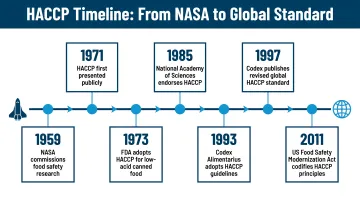
As FDA/NACMCF states, "An effective HACCP system requires little end-product testing, since sufficient validated safeguards are built in early in the process."
Why HACCP Is Essential for Food and Beverage Manufacturing
Regulatory Mandates
HACCP isn't optional for many food manufacturers. The FDA mandates HACCP for juice processors (21 CFR Part 120) and seafood processors (21 CFR Part 123). USDA FSIS requires written HACCP plans for meat and poultry establishments under 9 CFR Part 417. All three regulations demand facility-specific, product-specific plans developed by individuals trained in HACCP principles.
While the broader shift toward Hazard Analysis and Risk-Based Preventive Controls (HARPC) under the Food Safety Modernization Act (FSMA) has extended preventive logic to virtually all registered food facilities, HARPC is described as a "necessary upgrade" to HACCP, not a replacement. Understanding HACCP remains foundational regardless of exact regulatory category.
Business Risk Management
Regulatory compliance is only part of the picture. The financial consequences of inadequate hazard control extend far beyond penalties: the Grocery Manufacturers Association and Food Marketing Institute estimate the average direct cost of a food recall at approximately $10 million, with severe recalls erasing over $100 million in shareholder value. That math doesn't include litigation, lost customer trust, or long-term brand damage — costs that can outlast the recall itself.
HACCP-based prevention costs a fraction of what reactive recall management demands.
Global Market Access
HACCP serves as the core engine within larger food safety management systems. Every major GFSI-recognized certification scheme explicitly builds on Codex HACCP principles, including:
- ISO 22000 — international food safety management standard
- SQF (Safe Quality Food) — widely required by major retailers
- BRCGS — global standard for consumer goods safety
- FSSC 22000 — recognized by the Global Food Safety Initiative
Manufacturers pursuing global market access need HACCP competency whether domestic regulations require it or not. Without it as a foundation, certification under any of these standards becomes impossible.
The 7 Principles of HACCP Explained
The seven HACCP principles are applied sequentially, but only after completing five essential preliminary tasks:
- Assemble a HACCP team
- Describe the food and its distribution
- Identify intended consumers
- Develop a process flow diagram
- Verify that diagram on-site
These aren't optional steps. They establish the context that makes the seven principles meaningful.
Principle 1: Conduct a Hazard Analysis
Hazard analysis involves two stages:
- Identify all potential hazards at each process step — biological (Salmonella, E. coli, Listeria), chemical (pesticides, allergens, cleaning agent residues), and physical (metal fragments, glass, bone, plastic).
- Evaluate each hazard based on severity of health consequences and likelihood of occurrence to determine which are significant enough to require control measures in the HACCP plan.
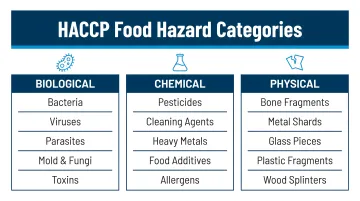
Not every hazard identified will make it into the final plan. The analysis prioritizes those that pose real risk under actual operating conditions.
Principles 2 and 3: Identify CCPs and Establish Critical Limits
A Critical Control Point (CCP) is a specific step where a control measure can be applied to prevent, eliminate, or reduce a significant hazard. Not every process step qualifies as a CCP. A decision tree is commonly used to identify them accurately, though it's a facilitation tool, not a regulatory mandate.
Each CCP requires a defined critical limit — a measurable maximum or minimum value (temperature, pH, time, water activity) that distinguishes safe from unsafe conditions. These limits must be scientifically justified.
Examples of critical limits:
- All poultry (whole, parts, ground): 165°F (73.9°C)
- Ground meats (beef, pork, lamb): 160°F (71.1°C)
- Beef patties: 155°F for 16 seconds
Critical limits cannot be guessed or assumed. They must be validated through scientific literature, regulatory guidance, or experimental studies.
Principle 4: Establish Monitoring Procedures
Monitoring means conducting planned, documented observations or measurements at each CCP to confirm that critical limits are being met in real time. Physical and chemical measurements — temperature probes, pH meters, belt speed sensors — are preferred over microbiological testing.
The reason is speed. As FDA/NACMCF confirms, microbiological testing is "seldom effective" for CCP monitoring because by the time lab results arrive, unsafe product may have already been released.
Principle 5: Establish Corrective Actions
Corrective actions are pre-defined procedures that activate when monitoring shows a CCP has deviated from its critical limit. They must address two things:
- Immediate product disposition (hold, rework, or destroy affected product)
- Root cause of the deviation to prevent recurrence
Every corrective action must be documented. The plan must specify who does what, when, and how the deviation is resolved — responses like "retrain staff" or "investigate" don't meet that bar.
Principles 6 and 7: Verification and Record-Keeping
Verification confirms the HACCP system is actually working, not just being followed on paper. Core verification activities include:
- Reviewing CCP monitoring records
- Validating that critical limits are scientifically defensible
- Conducting periodic audits of the full system
Record-keeping provides the complete documentation trail regulators and auditors expect:
- Hazard analysis and HACCP plan
- CCP monitoring logs
- Corrective action records
- Verification reports
Without complete records, a well-run HACCP system is nearly impossible to defend during an inspection or recall investigation.
How Facility Design Supports HACCP Compliance
Layout Influences Hazard Control
The physical layout of a food manufacturing facility directly influences where hazards can be controlled or introduced. Traffic flow patterns, separation of raw and ready-to-eat zones, positioning of handwashing stations, and routing of equipment and personnel all create or eliminate cross-contamination risks.
These design decisions, made at the blueprint stage, become embedded food safety outcomes. A facility not designed to support HACCP forces the HACCP team to work around structural limitations rather than leveraging the built environment as a control layer.
Hixson addresses this by building HACCP compliance into the design process from the start — incorporating process flow analysis, zone separation, sanitary construction details, and equipment selection before a single wall goes up.
Hygienic Design Principles
Hygienic design for equipment and surfaces includes:
- Non-porous, corrosion-resistant materials (stainless steel grades 1.4301 and 1.4404, which meet both EHEDG and 3-A Sanitary Standards used across North American food manufacturing)
- Equipment designed without harborage points for bacteria (welded seams, rounded corners, smooth surfaces)
- Drainage placement that prevents pooling and microbial growth
- Adequate spacing for cleaning access
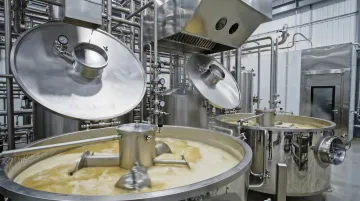
These aren't just best practices. They're prerequisite program requirements that the built environment must enable. Inadequate facility design creates preventive gaps that no monitoring procedure can fully compensate for.
Prerequisite Programs as Foundation
Hygienic surfaces and equipment only work when the broader operational environment supports them. That's where prerequisite programs come in.
FAO/Codex states clearly: "Pre-requisite programmes such as GAP, GMP and GHP must be working effectively within a commodity system before HACCP is applied. If these pre-requisite programmes are not functioning effectively then the introduction of HACCP will be complicated, resulting in a cumbersome, over-documented system."
Prerequisite programs — GMPs, sanitation procedures, pest control, supplier control, temperature management — must be functional before HACCP analysis can do its job. Each of these programs depends on the facility itself to operate correctly.
Building systems engineering capabilities (MEP, drainage, ventilation) play a critical role in supporting these prerequisite programs:
- Plumbing and drainage systems sized for high-pressure rinse operations, effective waste removal, and thorough cleaning access
- Custom HVAC with hydronic cooling/heating and humidity control maintaining precise conditions in temperature-sensitive zones
- Site grading, drainage design, and ventilation placement that eliminate water pooling and block common contaminant entry points
When these building systems are engineered with food safety in mind from the start, prerequisite programs have the physical infrastructure to function — and HACCP has a reliable foundation to build on.
Common HACCP Misconceptions and Implementation Pitfalls
HACCP Does Not Replace GMPs
The most common misconception: that HACCP replaces Good Manufacturing Practices and other prerequisite programs. It doesn't. GMPs and sanitation procedures are the foundation HACCP is built on. Without functioning prerequisite programs, a HACCP plan cannot be effective regardless of how well it's written.
FSIS Directive 5000.1 documents a recurring failure: establishments lacking adequate prerequisite program documentation to support hazard analysis decisions. When PRPs are weak, the HACCP plan either becomes bloated or contains unsupported assumptions.
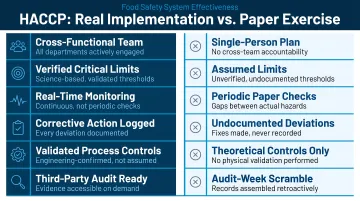
HACCP Is Not a Paper Exercise
Many operations treat HACCP as documentation to satisfy auditors rather than a live operational tool. Effective HACCP requires:
- Trained personnel who understand their role at each CCP
- Real-time monitoring that triggers actual corrective responses
- Regular verification that the system is performing as designed
- Monitoring performed at specified frequency — not just logged after the fact
- Records showing actual measured values, not check marks
- Corrective actions that address root causes, not symptoms
Generic Plans Don't Work
Each HACCP plan must reflect the unique conditions of the facility it governs. CCPs, critical limits, and significant hazards all depend on the specific mix of ingredients, process steps, equipment, facility layout, and intended consumers. No two facilities share the same risk profile.
A plan developed for one operation cannot simply be adopted by another. Attempting to use a borrowed plan creates a system that looks compliant on paper but fails to address actual risks.
Avoiding these pitfalls requires treating HACCP as a living system — one grounded in facility-specific analysis, not generic templates or documentation formalities.
Conclusion
HACCP is a disciplined, preventive system that shifts food safety from reactive inspection to proactive control. A well-executed HACCP plan protects consumers, reduces the risk of costly recalls, and positions food manufacturers to meet both regulatory requirements and the expectations of global supply chain partners.
Effective HACCP isn't just about having the right documentation. In practice, it depends on three interconnected foundations:
- Organizational commitment — leadership that treats food safety as a priority, not a compliance checkbox
- Trained, cross-functional teams — people who understand hazards, monitor CCPs, and respond to deviations
- A facility built to support it — layouts, surfaces, airflow, and drainage that make hazard control achievable at every step
Facility design decisions made at the blueprint stage directly determine whether HACCP functions as a living system or collapses into a documentation exercise. For food manufacturers, engaging experienced facility designers who understand hygienic design principles — such as Hixson's food and beverage team — early in the process is one of the most consequential investments a HACCP program can make.
Frequently Asked Questions
What is a Hazard Analysis and Critical Control Point (HACCP) system?
HACCP is a systematic, science-based food safety management approach focused on identifying and controlling biological, chemical, and physical hazards throughout the production process — from raw material receipt to finished product distribution. It prevents problems rather than detecting them after they occur.
What are the steps or principles of Hazard Analysis Critical Control Point (HACCP)?
There are seven HACCP principles, applied in sequence:
- Conduct a hazard analysis
- Identify Critical Control Points (CCPs)
- Establish critical limits
- Establish monitoring procedures
- Establish corrective actions
- Establish verification procedures
- Establish record-keeping and documentation procedures
These seven principles follow five preliminary tasks that set the foundation for the plan.
What are the types of food hazards?
HACCP addresses three hazard categories, each requiring different control strategies:
- Biological: Pathogens such as Salmonella, E. coli, and Listeria
- Chemical: Pesticides, allergens, and cleaning agent residues
- Physical: Metal fragments, glass, bone, and plastic
What is included in a hazard analysis?
A hazard analysis involves two stages. First, all potential hazards are identified at each process step. Then each hazard is evaluated by severity and likelihood to determine whether it is significant enough to require a control measure. Only significant hazards are carried into the HACCP plan.
Does the FDA approve HACCP plans?
No — the FDA does not pre-approve HACCP plans. Each facility develops and validates its own plan. During inspections, FDA reviewers assess conformance with applicable regulations rather than granting prior approval.
What is an example of a Critical Control Point (CCP) in a HACCP plan?
The cooking step in a meat or poultry process is a classic CCP. For example, poultry must reach an internal temperature of 165°F (73.9°C) to eliminate pathogens like Salmonella. This critical limit is monitored at that specific step to ensure safety.