Site selection for F&B manufacturers is fundamentally different from general industrial real estate decisions. Food and beverage operations face uniquely layered regulatory requirements—FDA cGMP grounds standards, EPA wastewater pretreatment for discharge levels that can reach 30,000 mg/L, and OSHA/EPA compliance for ammonia refrigeration systems above 10,000 pounds. Add the energy intensity of modern automation and the labor demands of round-the-clock production, and the margin for error shrinks considerably.
This guide provides a comprehensive site selection checklist for food and beverage manufacturers evaluating greenfield builds, facility expansions, or relocations. It covers six critical dimensions: strategic planning through a Basis of Selection framework, location and transportation infrastructure, utility capacity and reliability, workforce availability, regulatory and environmental compliance, and long-term scalability.
Summary
- Site selection requires structured analysis across six dimensions — strategic planning, location access, utilities, workforce, compliance, and scalability — before committing to any property
- A Basis of Selection (BOS) document aligns stakeholders and defines success criteria before touring any sites
- Automation has pushed power and water demands well beyond what older utility infrastructure was built to handle — confirm capacity before shortlisting sites
- Labor availability is the most underestimated constraint in site selection
- Bringing in an integrated A&E partner during the BOS phase catches infrastructure and compliance gaps before they become expensive mid-project problems
Start With a Strategy: Define Your Basis of Selection Before Touring Sites
The BOS Framework
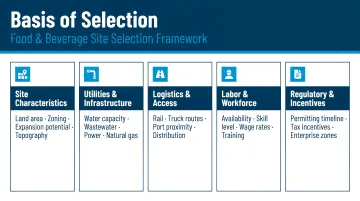
A Basis of Selection (BOS) document is a strategic framework built from input across operations, supply chain, finance, HR, and legal that defines what "success" looks like for your facility before evaluating any properties. Without a BOS, site selection becomes reactive—a broker's incentive pitch or an attractive tax package can pull your team toward a site that doesn't fit your operational reality.
The BOS should include:
- A SWOT analysis of current operations to surface pain points and real constraints
- Production goals for the next 3 years and a 10-20 year growth horizon
- Required facility size and layout, including land for truck staging, employee parking, and security buffers
- Technology requirements: automation level, cold chain infrastructure, robotics, and ASRS systems
- Known regulatory constraints, including GMP/cGMP requirements and environmental permits
Rank and Prioritize Criteria
Group similar factors together and rank by operational impact. Separate criteria into two categories:
Non-negotiables (deal breakers):
- Minimum utility capacity thresholds
- Required transportation access (rail, interstate proximity)
- Regulatory/zoning compatibility with food manufacturing
Trade-off items:
- Proximity to distribution centers
- Incentive package value
- Labor market wage rates
- Land cost per acre
Ranking criteria this way keeps attractive secondary factors from crowding out the site requirements that will shape operations for decades. Once your criteria are locked in, the next question is whether the site can grow with you.
Account for Long-Term Scalability
Your BOS must account for 10-20 year production growth scenarios. Most food processing plants operate for 20-30 years — your site decision locks in capital and operational costs for the long run.
Critical scalability factors:
- Land footprint for building additions — plan for at least 30-50% expansion capacity
- Utility expansion capacity to support additional production lines and automation
- Flexibility for new product lines, format changes, or technology upgrades
- Transportation infrastructure that can handle increased truck or rail volumes
Engage Integrated A&E Partners Early
Bringing an architecture and engineering firm into the BOS stage — before you commit to any site — means facility design constraints surface when you can still act on them, not after contracts are signed. Firms with integrated in-house disciplines across architecture, civil, mechanical, electrical, process engineering, and controls can identify site-specific risks that a real estate broker simply won't catch.
Research from the Construction Industry Institute shows that investing approximately 2.5% of total project cost in front-end planning delivers 10% cost savings, 7% shorter schedules, and 5% fewer project changes. For a $100 million facility, that means $10 million in savings from strategic planning.
Location, Access, and Transportation Infrastructure
Site Characteristics and Ingress/Egress
Raw land characteristics directly shape operational costs, GMP compliance, and your capacity to expand.
Acreage and land use:
- Size the site to accommodate security fencing, truck staging, employee parking, stormwater management, and future expansion — not just the building footprint
- Poor drainage creates GMP compliance problems and drives up site preparation costs before construction begins
- Rural, suburban, and industrial park sites each involve different trade-offs in security control, traffic management, and zoning flexibility
Ingress/egress checklist:
- Can trucks enter and exit from multiple routes to avoid bottlenecks?
- Are there separate designated entry points for employees, vendors, and freight?
- Can the local road network handle heavy truck traffic without requiring municipal infrastructure upgrades the municipality will require you to fund?
- What is the distance to the nearest interstate or major freight corridor?
Once you've confirmed site access works for daily operations, the next question is how well the broader region supports your supply chain.
Supply Chain and Logistics Infrastructure
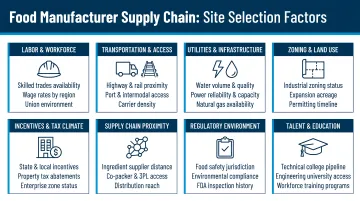
Transportation costs typically represent 5% of COGS or roughly 3% of sales for food manufacturers. Site proximity to raw material sources and distribution markets directly reduces these operating costs.
Key considerations:
- Perishable ingredient sourcing depends on transit time — the farther from suppliers, the greater the quality and cost risk
- Evaluate highway proximity, rail spur availability, and access to intermodal facilities before committing to a site
- Map distance to key consumer markets and major distribution hubs to assess speed-to-market impact
- For refrigerated and frozen products, verify that temperature-controlled logistics partners and cold storage facilities exist in the region
Site logistics and supply chain efficiency are table stakes, but food and beverage facilities carry an additional infrastructure requirement that many site searches underweight: emergency response capability.
Emergency Services and Hazmat Response
Food and beverage facilities often use ammonia refrigeration systems and other industrial chemicals. Facilities storing more than 10,000 pounds of anhydrous ammonia trigger both OSHA PSM and EPA RMP compliance requirements — and those that do typically fall under Program 3, the most stringent category.
Checklist items:
- What is the response time for local fire, EMS, and hazmat teams?
- Does the local fire department have ammonia response training and equipment?
- For rural sites, confirm regional hazmat team availability and response protocols
- Evaluate insurance implications of emergency response gaps
Utilities: Power, Water, and Wastewater for F&B Operations
Food and beverage manufacturing is among the most energy- and water-intensive industrial categories. The sector spent $12.4 billion on purchased energy in 2022, consuming 9% of all U.S. manufacturing offsite-produced fuel. Modern, automation-heavy facilities operate at demands that outpace the utility assumptions built into older site selection models.
Electrical Power Requirements
The incorporation of automation, robotics, electronic controls, and ASRS systems has dramatically increased power demand and sensitivity to power quality. Power disruptions are costly—average unplanned downtime costs $169,889 per hour across industrial sectors, with 44% of leaders reporting monthly equipment-related stoppages.
Power capacity checklist:
- What is the available power capacity at the site, and can the local utility support future expansion?
- What is the regional grid reliability record?
- What are the costs for redundant power feeds or on-site backup generation?
- Does the site support options for on-site cogeneration or renewable energy?
- What are the long-term utility rate structures and escalation trends?
Water and Wastewater Infrastructure
Water is especially critical for beverage manufacturers. Producing one liter of finished beverage requires 2-4 liters of water when accounting for cleaning, cooling, and processing.
Water supply checklist:
- What is the municipal water supply capacity and reliability?
- What is the water quality baseline, and will treatment be required?
- Are there seasonal availability constraints or drought risk?
- Does the site support stormwater capture systems for non-potable water use?
Wastewater checklist:
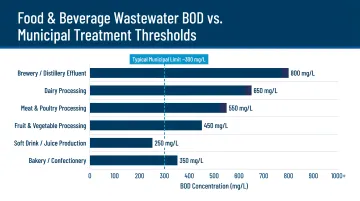
- What are the municipal wastewater discharge limits?
- Does the site require pretreatment systems? (Food industry wastewater typically carries BOD of 3,000–30,000 mg/L — well above what most municipal systems can handle without pretreatment)
- What are the costs for connecting to municipal systems versus on-site treatment?
- Are there future discharge capacity constraints that could limit production?
Natural Gas and Energy Resiliency
Beyond electricity and water, natural gas availability and pricing directly affect operating costs for facilities with high thermal loads — cooking, pasteurization, and CIP systems among them. Evaluating resiliency early prevents expensive retrofits later. Key questions include:
- On-site cogeneration or combined heat and power systems
- Backup generation capacity
- Energy storage options
- Renewable energy integration potential
Workforce Availability and Labor Market Analysis
A site can check every infrastructure box and still fail if the local labor market can't supply the volume, skill mix, and retention rates a food manufacturing operation requires. Workforce is routinely the most underestimated variable in site selection.
Food manufacturing employs 1.78 million workers across 43,243 establishments, with food processing equipment worker roles projected to grow 5% from 2024–2034, outpacing the all-occupation average.
Labor Market Analysis Checklist
Population and commute radius:
- What is the population within a 45-minute drive-time radius?
- Does the analysis account for rush-hour travel times and geographic barriers (bridges, tunnels)?
- Are there multiple population centers within the radius to reduce dependence on a single community?
Labor market conditions:
- What are current unemployment rates in the region?
- What are prevailing wages for production, packaging, and quality control roles?
- Who else in the region competes for the same workforce (other food manufacturers, distribution centers, etc.)?
- What is the local labor force participation rate and demographic trends?
Workforce development infrastructure:
- Are there community colleges or technical schools offering food science or manufacturing programs?
- What workforce training grants or programs are available?
- Are there partnerships between local economic development agencies and educational institutions?
Union Environment
Labor relations climate is another dimension of workforce risk that deserves dedicated analysis. The union membership rate for nondurable goods manufacturing was 8.2% in 2025 — but the regional picture can vary sharply from national averages. Key questions to address:
- What is the union membership rate and organizing history in the target region?
- Are there active campaigns or recent elections at comparable facilities nearby?
- How do prevailing labor agreements in the area affect wage structures and work rules?
- What is the local labor relations culture, and how does it compare to your current operations?
Regulatory, Environmental, and Food Safety Compliance
Layered Regulatory Environment
Three separate regulatory bodies govern food manufacturing facilities — and each applies at a different level of the project:
- FDA regulates processes inside the plant (GMP/cGMP requirements under 21 CFR Part 117)
- EPA governs emissions, wastewater discharge, and environmental impact
- State and municipal bodies control zoning, permitting, and land use
The FDA's cGMP regulations at 21 CFR 117.20(a) require that grounds surrounding a food plant be maintained to protect against contamination—including proper drainage, waste storage, pest control, and protection from adjacent operations. Sites that skip this evaluation often face remediation costs or design rework after construction has already begun.
Environmental Risk Factors
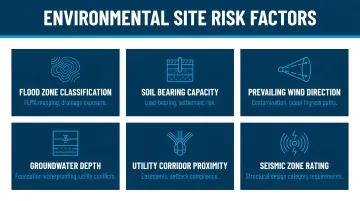
Each of the following conditions can affect construction timelines, insurance costs, or long-term regulatory standing:
- Flood zones: FEMA flood zone designations affect insurance costs and construction requirements
- Proximity to water bodies: Attracts pests and creates GMP control challenges
- Seismic activity: Affects structural design requirements and insurance
- Hurricane/tornado corridors: Increases building hardening costs and business interruption risk
- Drought-prone regions: Constrains water availability for high-volume operations
- Existing soil contamination: Requires Phase I and Phase II Environmental Site Assessments
Permitting and Community Engagement
Environmental findings from the previous step feed directly into permitting obligations. Permitting complexity varies widely by jurisdiction — some sites require multi-agency approval, community hearings, and land-use negotiations that add months or years to project timelines.
Permitting checklist:
- What are the local zoning requirements—is the site already zoned for food manufacturing or will a variance be required?
- What environmental site assessments are needed? (Phase I ESAs have a 180-day shelf life under ASTM E1527-21)
- What are typical permitting timelines for industrial projects in this jurisdiction?
- Has this jurisdiction seen community pushback on industrial development?
- What stormwater, air quality, and wastewater permits will be required?
Economic Incentives and Tax Benefits
Approximately $59.2 billion in economic incentives were awarded across U.S. industries in 2024. For food and beverage projects, the most common mechanisms are property tax abatements, infrastructure assistance grants, and workforce training grants.
Incentive evaluation checklist:
- Which jurisdictions offer the most competitive incentive packages for food manufacturing?
- What are the performance requirements (job creation, capital investment thresholds)?
- What is the incentive recapture risk if production or employment targets aren't met?
- How do incentives affect the project's overall financial return versus operating cost differences between sites?
Frequently Asked Questions
What factors should food and beverage companies consider when selecting an ideal site?
Site selection spans six core dimensions:
- Strategic planning and BOS alignment
- Location and transportation access
- Utility capacity (power, water, wastewater)
- Workforce availability within commute radius
- Regulatory and environmental compliance
- Long-term scalability for future growth and automation
What are the different types of site selection for food and beverage companies?
Site selection falls into four categories: greenfield builds (new construction on undeveloped land), brownfield redevelopment (repurposing existing industrial sites), facility expansions at current locations, and acquisitions of existing food-grade facilities. Each type has different evaluation priorities and risk profiles.
How early in the project timeline should site selection begin?
Site selection should begin as early as possible—ideally concurrent with business case development. Site constraints dramatically affect facility design, budget, and schedule. Experienced companies start 18-36 months before a target operational date.
What regulatory bodies are most involved in F&B facility site selection?
The EPA governs environmental compliance (air, water, waste), the FDA enforces GMP/cGMP requirements that influence site characteristics, and state/local zoning and permitting authorities control land use approvals. The specific mix depends on product type and location.
How do utilities affect long-term operating costs for food manufacturing facilities?
Electricity and water costs rank among the largest ongoing operating expenses for F&B facilities. Rate structures, reliability, and capacity constraints identified during site selection directly determine cost competitiveness over a facility's 20-30 year lifespan.