Introduction
Most offices aren't designed — they accumulate. Desks get added, teams expand into hallways, and meeting rooms get claimed as storage. The result is a workplace that works against the people in it.
Office space planning is the process of intentionally organizing a workplace's layout, furniture, and supporting systems to support productivity, employee well-being, and space efficiency — aligned with business goals and building requirements.
Poor planning has real business consequences. Research from the COGfx Study found cognitive performance scores averaged 101% higher in buildings with enhanced ventilation and indoor environmental quality compared to conventional office conditions. Physical workspace conditions directly shape how well people think and work — and a 101% gap in cognitive performance is hard to ignore.
This guide covers the full planning process: conducting a space audit, setting objectives, designing effective zones, avoiding common mistakes, planning for hybrid work models, and knowing when to bring in professional help.
Key Takeaways
- Effective office space planning aligns layout decisions with workflows, technology, compliance, and growth—not just furniture placement.
- Start with a space audit and clear objectives before any design work begins.
- Strong plans treat zone-based layouts, ergonomics, acoustics, natural light, and building systems as one integrated whole.
- Common mistakes—ignoring acoustics, skipping employee input, designing rigid layouts—lead to costly rework.
- Complex projects benefit significantly from engaging an integrated architecture and engineering firm early.
How to Start: Conducting a Space Audit and Setting Clear Objectives
Before any design decisions are made, you need an accurate picture of how your current space actually functions—not how you think it does.
What a Space Audit Involves
A space audit is a structured assessment of your existing floor plan, looking for:
- Underused areas — conference rooms booked but empty, storage rooms consuming prime square footage
- Traffic flow friction — bottlenecks at printers, elevators, or shared amenities
- Noise complaints — which teams are disrupting adjacent areas
- Meeting space shortfalls — how often people are forced to improvise because rooms are unavailable
- Circulation path conflicts — routes that cut through focus areas
Document these findings systematically. Observation is more reliable than assumption—what employees say about the space and how they actually use it often differ.
Data to Collect Before Design Begins
The audit's physical observations need to be paired with operational data:
- Current and projected headcount (3–5 year horizon)
- Department-specific workflows and adjacency needs
- Peak occupancy periods vs. average daily utilization
- Storage, equipment, and technology requirements by team
- Hybrid attendance patterns and in-office frequency
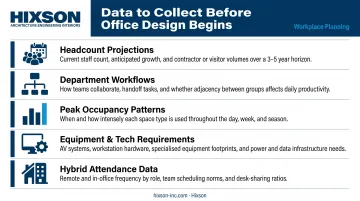
This data forms the foundation for every downstream design decision. Without it, space allocations are educated guesses at best.
Calculating Space Requirements
Once you've gathered that data, you can translate it into actual square footage targets. The commonly cited planning range is 125–250 sq ft per person, but context matters. The GSA uses a 150 usable sq ft per person design requirement for federal and leased office space, while JLL reports a current market average of 165 sq ft per person, trending toward a target of 132 sq ft as hybrid work matures.
Work style and role type push those numbers in both directions:
- Heads-down analytical roles need more individual space
- Primarily collaborative teams can function with less assigned square footage
- Executive suites, lab-adjacent offices, and ADA-accessible workstations require their own calculations
Setting Measurable Objectives
Translate audit findings into specific goals. Examples:
- Reduce meeting room shortfall from 40% peak unavailability to under 15%
- Accommodate 20% headcount growth without a lease expansion
- Achieve a target space utilization rate of 70%+ during peak days
- Add three focus booths per floor to address noise complaints
Vague goals produce vague designs. Specific, numeric targets give every downstream decision — from partition placement to furniture selection — a clear benchmark to test against.
Involve Stakeholders Early
Only 21% of global office workers who recently had an office update felt meaningfully included in decision-making, according to Gensler's 2025 research. Leesman's analysis of 447 post-occupancy workplace evaluations found 55% failed to deliver an outstanding workplace experience. The correlation is hard to ignore.
Gather input from leadership, HR, IT, and employees through surveys or cross-departmental workshops before design begins. Issues that never appear in floor plan data — team friction, technology gaps, workflow bottlenecks — consistently emerge through direct conversation, and they're exactly the kind of problems that derail a finished design after move-in.
Key Elements of an Effective Office Space Plan
Five planning dimensions must be addressed together, not in isolation, for a space plan to hold up over time.
Zone-Based Layout Design
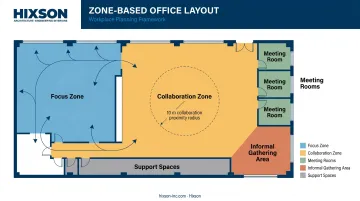
Zone-based planning divides the office into distinct functional areas:
- Focus zones — quiet, low-traffic areas for individual work
- Collaborative spaces — open team areas designed for interaction
- Meeting rooms — enclosed spaces for structured sessions
- Informal gathering areas — casual spots for spontaneous conversation
- Support spaces — storage, printing, wellness rooms, phone booths
Placement of these zones relative to each other drives both workflow efficiency and noise management. High-traffic areas (kitchens, printers, main entrances) belong away from focus zones. Collaborative areas should be accessible without being acoustically disruptive.
Proximity matters more than most planners account for. MIT research on the Allen Curve found that basic conversations are much less likely among workers situated more than 10 meters apart, and researchers in the same workspace were more than 3x as likely to collaborate as those 400 meters apart. That 10-meter threshold is a practical guide for team clustering decisions.
Ergonomics, Furniture, and Acoustics
CDC data shows office workers spend 65–75% of their workday sitting, with a significant portion in uninterrupted bouts of 20 minutes or more. Poor workstation setup contributes directly to musculoskeletal disorders — one of the most frequently reported causes of lost or restricted work time, according to OSHA.
Adjustable desks, chairs with proper lumbar support, and correct monitor positioning are baseline requirements, not optional upgrades.
Open-plan offices amplify noise in ways that damage both satisfaction and concentration. Oxford Economics found 1 in 5 employees say office noise negatively affects job satisfaction, yet 54% of executives believed employees had adequate tools to address noise — while fewer than one-third of employees agreed. That gap in perception is a planning failure.
Acoustic solutions to integrate from the start:
- Sound-absorbing panels on ceilings and walls
- Strategic placement of loud teams (sales, call center) away from focus-intensive roles
- Physical partitioning between collaborative and quiet zones
- Enclosed phone booths or focus rooms for private calls
Retrofitting acoustic solutions after move-in is expensive and disruptive. Design for it upfront.
Building Systems and Infrastructure
Every layout decision has a downstream effect on the building's mechanical, electrical, and plumbing (MEP) systems. Partition changes, headcount density increases, or zone reconfigurations can trigger:
- HVAC redistribution to meet ventilation requirements (ASHRAE Standard 62.1 specifies 5 cfm per person plus 0.06 cfm/sq ft for office spaces)
- Lighting zone adjustments
- Revised power and data outlet placement
- Fire suppression system modifications
Technology infrastructure needs its own planning track:
- Adequate power distribution across all workstation types
- Wi-Fi coverage verified across all zones, including conference rooms
- Video conferencing capability built into meeting spaces from day one
- Cable management systems that accommodate future changes
Hixson's approach illustrates why integration matters here: all building engineering disciplines — Mechanical, Electrical, Plumbing, Structural, and Civil — are co-located within the firm, and engineers are brought into workplace projects from the earliest design phases. That coordination prevents MEP conflicts from becoming costly construction change orders later.
Natural Light, Wellness, and Compliance
Getting MEP and infrastructure right sets the physical conditions for work. Natural light takes the human side further. Cornell-linked research found an 84% drop in eyestrain, headaches, and blurred vision symptoms in daylit office environments. A Northwestern/Journal of Clinical Sleep Medicine study found workers with window access slept an average of 46 minutes more per night than those in windowless environments.
Layout decisions — desk placement near windows, use of glass partitions, avoiding solid walls that block daylight — have measurable effects on both well-being and performance.
Compliance requirements are non-negotiable and must be resolved before furniture or layout decisions are finalized:
- ADA accessibility — Common-use circulation paths in employee work areas of 1,000 sq ft or more must be accessible; accessible routes require a minimum 36-inch continuous clear width
- Fire egress — Clear, unobstructed paths to exits must be maintained regardless of furniture configuration
- Ventilation — ASHRAE 62.1-2022 outdoor air rate requirements apply to occupancy density
- Local building codes — Minimum space-per-person and occupancy load limits vary by jurisdiction
Common Office Space Planning Mistakes
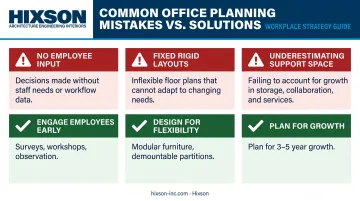
Designing Without Employee Input
Generic layouts built without direct input from the people who will use them tend to miss actual workflows. Gensler's research links inclusion in design decisions to higher workplace performance scores — yet most employees never get asked. Practical tools for surfacing real needs before design begins include:
- Employee surveys and space utilization studies
- Observation sessions to document how teams actually move and work
- Cross-departmental workshops to capture needs across functions
Over-Committing to Fixed Layouts
Rigid, non-modular designs become obsolete quickly. Teams restructure, headcount shifts, and hybrid policies evolve. Designs locked into fixed configurations require construction work to adapt — a costly outcome for what is often a foreseeable need.
Solutions that build in flexibility:
- Modular furniture systems that reconfigure without tools
- Demountable partitions instead of permanent walls
- Multi-purpose spaces with movable dividers
- Power and data access distributed broadly, not concentrated at fixed stations
Underestimating Support Space and Growth
Plans often allocate space generously for workstations while neglecting the infrastructure that makes them functional. Storage, printing stations, wellness rooms, and circulation paths are routinely undersized—leading to cluttered, congested environments within months of move-in.
Plan for 3–5 year headcount growth as a baseline assumption, not an afterthought. U.S. office fit-out hard costs ranged from $108 to $219 per sq ft as of 2024, according to Cushman & Wakefield. Mid-cycle renovations at those rates make better upfront planning a clear financial priority.
Planning for the Modern, Hybrid Workplace
Hybrid work has reshaped how space should be allocated. According to JLL's occupancy benchmark research, global office utilization hovers around 56%—meaning most offices sit occupied just over half the time, even as hybrid programs now operate at 80% of organizations.
Rethinking Space Ratios
When employees split time between home and office, the traditional 1:1 desk-to-employee ratio stops making sense. CoreNet's survey of 500+ corporate real estate professionals found that nearly 65% expected to need 20–50% less space because of hybrid work. That reduction should translate into:
- Desk hoteling and hot-desking systems with booking platforms
- More collaboration zones and meeting rooms relative to traditional assigned seating
- Focus booths and video-ready spaces for employees who come in to collaborate or focus
Using Data to Right-Size Allocations
Occupancy sensors, utilization analytics, and booking data are more reliable than assumptions about how employees use the office. Base space allocation decisions on actual patterns: not pre-pandemic norms or idealized attendance projections.
Smart building technology also reduces operating costs. DOE Better Buildings data shows occupancy-sensor lighting controls can cut energy use by 5–35% in open offices and 20–65% in conference rooms.
Designing for Choice Within the Office
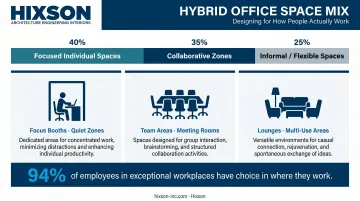
Gensler's 2024 Global Workplace Survey found that 94% of employees in exceptional workplaces have a choice in where they work within the office. A hybrid office that offers only open workstations misses this. Effective hybrid designs provide a visible mix of focused spaces, collaborative areas, and informal zones—so employees come in because the office offers something their home setup doesn't.
When to Partner with a Professional Architecture and Engineering Firm
DIY space planning and furniture-vendor-led layouts work for simple, single-floor refreshes with no MEP implications. They fall short when:
- MEP coordination is required — partition changes affect HVAC zones, power distribution, or fire suppression
- Compliance requirements are complex — ADA upgrades, fire egress reconfiguration, ventilation for high-density areas
- The footprint spans multiple floors or sites — coordination across locations requires integrated project management
- Structural modifications are involved — removing walls or adding load requires engineering review
- Capital investment is significant — where the cost of errors far exceeds the cost of professional guidance
Hixson's Workplace practice engages at the strategy phase, offering space audits, programming, utilization studies, and real estate optimization before a single layout is drawn. That upstream involvement surfaces constraints early — before decisions become expensive to reverse.
For a 40,000 SF corporate headquarters renovation for Paycor, Hixson's integrated team incorporated individual workstations, large and small collaboration areas, a customer experience suite, and assembly space for up to 500 people, coordinating architecture, interior design, and all building systems engineering under one project structure.
With MEP, structural, and civil disciplines in-house, layout decisions are evaluated against building system realities from the earliest design phases. That means fewer surprises during construction, faster resolution of system conflicts, and a team whose average tenure exceeds 10 years — so the engineers who designed your HVAC zoning are the same ones reviewing your partition plan.
Frequently Asked Questions
What are the best practices in office space planning?
Start with a space audit and measurable objectives, use zone-based layouts that separate focus and collaborative areas, involve employees through surveys or workshops before design begins, plan for flexibility and 3–5 year growth, and address acoustics and compliance from the start—not as afterthoughts.
How many people can fit in a 1,000 sq ft office?
At the planning benchmark of 125–250 sq ft per person, a 1,000 sq ft office typically accommodates 4–8 people. The actual number depends on layout type, furniture density, required support spaces, and local occupancy regulations.
What is the difference between office space planning and office design?
Space planning is the strategic process of determining how space is allocated and organized to meet operational needs. Office design encompasses the aesthetic, material, and experiential elements. Effective workplace projects integrate both disciplines from the start. Treating them as separate phases is a common source of costly rework.
How do I calculate how much office space I need?
Multiply projected headcount by the appropriate square footage per person for your work style—typically 125–250 sq ft, with the GSA using 150 usable sq ft as a benchmark. Then add space for meeting rooms, common areas, storage, and circulation based on your program requirements and local code minimums.
When should a business hire a professional architect or engineer for office space planning?
Professional A&E involvement is warranted when a project involves structural changes, MEP system modifications, ADA or fire code compliance, multi-floor footprints, or significant capital investment. In those cases, the cost of errors or rework will far exceed the cost of professional guidance upfront.