Introduction
Managing a complex facility portfolio without a structured plan is expensive. Capital gets spent reactively, competing priorities go unresolved, and infrastructure investments drift out of alignment with where the organization is actually headed. For food and beverage manufacturers, pharmaceutical sites, research laboratories, and corporate campuses alike, these gaps compound over time.
A facilities master plan is the document that closes those gaps. It translates an organization's strategic goals into a long-range roadmap for capital investment, infrastructure improvement, and facility development. The result is a defensible, data-driven framework that replaces gut-feel prioritization with evidence-backed decision-making.
This guide covers:
- What a facilities master plan includes
- Why technical facilities require additional layers of analysis
- How the planning process works from start to finish
- When to revisit the plan as conditions change
Key Takeaways
- A facilities master plan aligns physical infrastructure with long-term organizational strategy across a multi-year horizon
- Every complete plan includes five components: vision and goals, existing conditions assessment, infrastructure and systems analysis, improvement identification, and a phased budget roadmap
- Food plants, pharma sites, and labs require process and utility systems analysis beyond standard building assessments
- IFMA recommends a 4–5 year review rotation, while most institutional plans look 10 years forward
- Multi-discipline A/E firms capture both building and systems conditions in one coordinated effort
What Is a Facilities Master Plan?
IFMA defines a facility master plan as a "detailed long- or mid-term set of specifications and schedule for implementing elements of a strategic facility plan"—one that often contains scenarios, meaning site-specific options tied to business-driven decisions.
That definition draws a clear boundary around what a master plan is not:
- Not a capital budget — a master plan informs budget decisions but doesn't replace the appropriation or authorization process
- Not a feasibility study — a feasibility study evaluates a specific project; a master plan evaluates an entire portfolio across a multi-year horizon
- Not a building assessment — condition data is an input, not the output
Who Uses Facilities Master Plans?
K-12 schools and universities are among the most common users, but the planning tool applies wherever significant building stock or capital investment is involved:
- Food and beverage manufacturers planning capacity expansions or line additions
- Pharmaceutical and biotech companies managing cGMP infrastructure growth
- Research laboratories balancing bench space, equipment density, and compliance requirements
- Corporate campuses evaluating consolidation, expansion, or repositioning
Each sector brings different technical constraints to the process. What a food plant master plan addresses—throughput capacity, food safety zoning, utility headroom—differs substantially from what a pharma or lab environment requires. The components covered in this guide reflect that range.
What Does a Facilities Master Plan Include?
Most well-developed facilities master plans share five core components. The depth of each varies by sector complexity and organizational scale, but the structure is consistent.
Vision and Goals
This is the planning foundation. Before any assessment begins, the master plan needs to capture where the organization is going—not just where it currently stands.
The vision component documents:
- Mission alignment and strategic growth targets
- Facility-related priorities (capacity expansion, sustainability, safety compliance, operational efficiency)
- Decision-making principles that guide trade-offs later in the process
This content comes from structured stakeholder engagement: leadership interviews, visioning workshops, and alignment sessions that draw input from across departments—not just facilities management.
Hixson centers this work on interactive visioning sessions with senior leadership, surfacing strategic direction around people, processes, places, and long-term organizational goals. Without that cross-functional input, plans tend to reflect facilities priorities rather than business priorities.
Existing Facility Assessment and Space Utilization
Once goals are established, the plan needs an honest baseline of current conditions.
Facility condition assessment covers:
- Structural integrity and building age
- Code compliance status
- Functional layout effectiveness
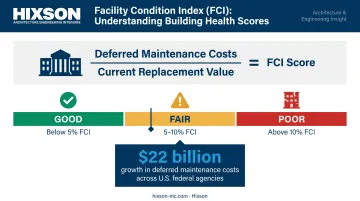
- Overall condition rating—often expressed as a Facility Condition Index (FCI)
The FCI formula, as defined by APPA, is straightforward: deferred maintenance costs divided by current replacement value. APPA thresholds place buildings in good condition below 5% FCI, fair between 5–10%, and poor above 10%. These benchmarks matter—GAO reported that deferred maintenance across four federal agencies grew by roughly $22 billion (83%) between fiscal years 2017 and 2022, underscoring how quickly deferred work accumulates without a structured baseline.
Space utilization analysis goes deeper than condition ratings. It examines:
- Which areas are underutilized or overcrowded
- Whether existing footprints can be reconfigured before triggering expansion
- Workflow patterns and operational adjacencies
Hixson builds this picture through site visits, vision walks, block plans, and operational workflow reviews—grounding future projections in how space is actually being used today.
Infrastructure and Systems Analysis
Square footage is rarely the binding constraint in an expansion or renovation. For most facilities—whether a food processing plant adding a production line or a pharma facility scaling up a cGMP suite—the real limits are the systems underneath the building envelope.
A thorough infrastructure and systems analysis evaluates:
- HVAC and mechanical systems — cooling and heating capacity, humidity control, air handling
- Electrical distribution — medium and low voltage systems, emergency power, load capacity
- Plumbing and fire protection — water supply, drainage, fire suppression
- Civil and site infrastructure — stormwater, paving, site utilities, access
Capacity gaps identified here—insufficient electrical load for new equipment, undersized compressed air headers, inadequate sanitary drainage—directly determine which infrastructure upgrades must precede any expansion. A food plant that skips this step often discovers mid-design that the existing electrical service can't support the new processing line, forcing expensive redesigns and schedule delays.
Improvement Identification and Project Scoping
With the baseline established, this component synthesizes findings into a consolidated project list. Every item gets documented with:
- Project description and approximate scope
- Order-of-magnitude cost range
- The strategic goal it addresses
The project list typically spans deferred maintenance items, code compliance upgrades, operational improvements, capacity expansions, and potential new construction. Framing each project against a strategic goal creates the transparent, defensible case for capital investment that boards and leadership teams need to evaluate trade-offs.
Prioritization, Phasing, and Budget
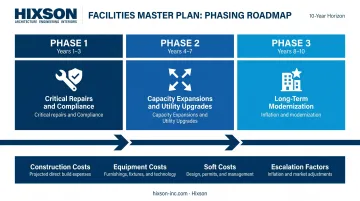
The final component organizes all identified projects into a multi-year roadmap. Projects are grouped by:
- Urgency — critical repairs vs. capacity expansions vs. long-term modernization
- Interdependency — which projects must precede others (utility upgrades before line additions, for example)
- Funding windows — grant availability, bond cycles, operating budget constraints
The phasing plan includes a cost model covering construction, equipment, soft costs, and escalation factors. Hixson's in-house Cost Estimating team draws on historical cost data, industry references, and a national contractor network to build these models—giving clients realistic capital budgets and the ability to evaluate alternative funding scenarios.
Special Considerations for Technical Facilities
Standard architectural assessments capture a lot—but not everything that matters in a food plant, pharmaceutical site, or research laboratory. These environments have compliance layers and process infrastructure requirements that fundamentally shape what's possible in any renovation or expansion.
Regulatory and Compliance Requirements
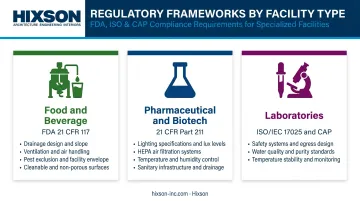
Technical facilities carry regulatory constraints that must be embedded in the master plan from the start. Each sector operates under distinct standards with direct implications for space programming, construction methods, and cost:
- Food and beverage: FDA food cGMP (21 CFR 117) requires plants to be suitable in size and design for sanitary operations, covering drainage, ventilation, plumbing, and pest exclusion. Codex hygiene principles add cleanable surfaces, cross-contamination separation, and drainage slopes.
- Pharmaceutical and biotech: 21 CFR Part 211 governs building suitability and defined operational areas, covering lighting, ventilation, air filtration, temperature control, and sanitary infrastructure.
- Laboratories: ISO/IEC 17025 covers testing and calibration lab competence; CAP accreditation checklists address physical facilities, safety, water quality, and temperature control.
These aren't downstream design constraints—they're planning inputs. A master plan that doesn't account for cGMP zone boundaries, cleanroom classifications, or hygienic zoning will produce inaccurate space programs and cost estimates that miss the mark.
Hixson brings dedicated hygienic design expertise to this work, incorporating 3-A Sanitary Standards, BISSC, EHEDG, and FDA/USDA requirements into planning—including hygienic zoning and segregation, sanitary piping, slope-to-drain design, and CIP-ability review.
Process and Utility Systems Integration
In food and beverage and pharma facilities, production capacity and utility demand are central planning inputs, not items to address later in design.
Key systems that require analysis and right-sizing in the master plan:
- Steam and hot water production
- Compressed air systems
- Industrial refrigeration
- Process water and clean utilities (WFI, clean steam, pure gases)
- Sanitary and process drainage
- Industrial wastewater
Food Engineering has reported that growth-ready facility planning for food manufacturers uses utility phasing playbooks for centralized systems—modular headers, right-sized equipment, structural knockouts—specifically to avoid costly retrofits when capacity expansions arrive.
For pharma facilities, continuous manufacturing changes utility profiles in ways that standard building assessments miss entirely: compressed air demand, cooling loads around dense equipment, and clean utility qualification all require early planning attention.
The Multi-Discipline Requirement
Architecture alone can't capture all of this. Food and beverage and pharma master plans require coordinated input across multiple disciplines—evaluated simultaneously, not handed off one at a time.
Hixson's 20 integrated in-house disciplines include:
- Architecture, civil, and structural engineering
- Mechanical, electrical, plumbing, and fire protection
- Refrigeration and industrial wastewater
- Process engineering, manufacturing engineering, and process layout
- Process utilities, controls and automation, and project management
All disciplines are co-located, enabling true parallel coordination rather than sequential handoffs. For the Milo's Tea Company greenfield facility in Moore, South Carolina, this approach allowed the 460,000+ sq. ft. site to be master planned for up to 12 future production lines from day one, while the initial build supported four lines with built-in expansion provisions.
How the Facilities Master Planning Process Works
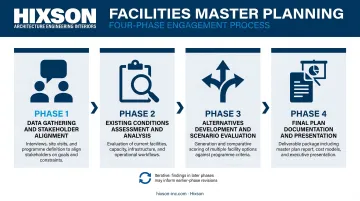
A master planning engagement moves through four broad phases—but the process is iterative, not linear. Client collaboration happens at every stage.
- Data gathering and stakeholder alignment — Visioning sessions with leadership, facility tours, operational interviews, and document collection establish the planning foundation
- Existing conditions assessment and analysis — Field assessments, systems evaluations, FCI scoring, and space utilization analysis produce the baseline
- Alternatives development and scenario evaluation — Multiple planning scenarios are developed at differing scopes, phasing sequences, or investment levels; each is evaluated against the guiding principles from the vision phase
- Final plan documentation and presentation — Deliverables are compiled and presented to leadership
What to Expect as Final Deliverables
Each phase feeds the next, and the finished plan reflects that accumulated work. A complete master plan engagement typically produces:
- Facility assessment summary with condition findings
- Planning guidelines and site/campus development diagrams
- Departmental space programs
- Prioritized project list with order-of-magnitude budgets
- Phasing schedule tied to funding windows
- Supporting engineering studies as needed—stormwater, structural, parking, infrastructure capacity
Hixson's civil engineering team contributes stormwater management, site grading, site utility analysis, and traffic flow studies directly within the master planning engagement. Structural evaluation informs expansion feasibility before schematic design begins. Having these disciplines in-house means findings are coordinated in real time—not retrofitted once the plan is already drafted.
How Often Should You Revisit Your Facilities Master Plan?
Most master plans look 10 years forward—Saint Paul Public Schools' plan covers a 10-year vision for 73 buildings; Purchase College's 2024–2034 plan guides capital funding requests over the same horizon. But the document isn't meant to sit on a shelf.
IFMA recommends a 4–5 year review rotation to capture what milestones have been completed and what conditions have changed. GSA uses a rolling 5-year planning cycle for federal space needs. That cadence makes sense: regulations shift, strategies change, and completed projects alter the baseline you're planning from.
Triggers for an Unscheduled Review
Some changes warrant an earlier look regardless of the regular cycle:
- Merger, acquisition, or significant organizational restructuring
- Major capacity expansion decision or new product line launch
- Significant regulatory change affecting facility requirements
- Capital event such as a bond referendum or large grant opportunity
- Completion of a major phase that substantially changes the facility baseline
The review cadence should have a clear owner — typically the facilities director or capital planning lead — with a standing agenda item to assess whether conditions have shifted enough to warrant an update. That discipline is what keeps the plan useful when capital decisions actually land.
Frequently Asked Questions
What should a facility master plan include?
A complete facility master plan includes a vision and goals statement, an existing conditions and space utilization assessment, an infrastructure and systems analysis, a prioritized list of identified improvements with order-of-magnitude costs, and a phased budget roadmap. Technical facilities also require process and utility systems analysis.
What is facility master planning?
Facility master planning is the process of evaluating an organization's current physical assets, identifying future facility needs, and developing a long-range capital roadmap. It combines stakeholder input, field assessments, and scenario development to give leadership a structured path forward.
What is the purpose of a facility master plan?
The purpose is to replace reactive, ad-hoc capital spending with a proactive, data-driven framework. A master plan gives leadership a structured basis for prioritizing investments, sequencing projects, and allocating budget across a multi-year horizon.
What does a facilities planner do?
A facilities planner assesses building and systems conditions, gathers stakeholder input, and translates findings into prioritized project plans and capital budgets. In technical facilities, the role also covers compliance and process systems analysis.
What are the pillars of facility management?
As defined by ISO and adopted by IFMA, facility management integrates people, place, and process within the built environment. A facilities master plan addresses all three: occupant needs and safety, the physical infrastructure, and operational efficiency across the facility lifecycle.