Introduction
Sustainability used to be a selling point. In 2026, it's a baseline requirement.
Across commercial, industrial, and science sectors, clients now expect their architecture and engineering partners to deliver measurable reductions in energy use, water consumption, and greenhouse gas emissions — not just LEED plaques. According to the USGBC's 2025 Impact Report, there are now over 197,000 LEED projects worldwide, with 2.6 million square feet of space becoming LEED-certified daily. The market has moved.
But LEED certification alone doesn't tell you whether a firm can reduce Scope 1 emissions from a food processing line or optimize a pharmaceutical facility's water systems from day one of design. For clients in technically complex sectors, the distinction can determine whether a facility hits its efficiency targets or falls short.
What follows is a sector-by-sector look at five firms that have translated environmental commitments into verifiable project outcomes — evaluated on credentials, depth of specialization, and documented performance across the full design process.
Key Takeaways
- Sustainable A&E in 2026 means embedding environmental goals into every phase, from site planning to MEP and process engineering.
- Firms here were selected on sustainability credentials, sector expertise, and recognition from ENR, Architizer A+Awards, and Interior Design magazine.
- Leading firms hold LEED, Living Building Challenge, or equivalent credentials applied across their full discipline portfolio.
- Integrated A&E firms with in-house process, mechanical, and civil engineering consistently deliver stronger outcomes for complex facilities.
- Look beyond certification counts — sector-specific track records and measurable environmental results matter most.
What Makes an Architecture & Engineering Firm "Sustainable" in 2026
LEED certification matters — but it's the floor, not the ceiling, for what genuine sustainability requires in 2026.
Firms that truly deliver on sustainability embed environmental performance into every technical discipline — not just the building envelope. That means process systems, mechanical infrastructure, water treatment, electrical load management, and civil site design all working toward shared efficiency and emissions targets from the first design meeting.
Beyond the Building Skin
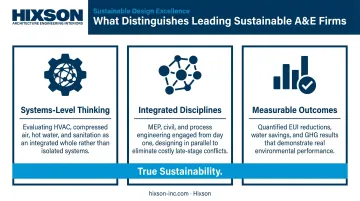
Leading sustainable A&E firms distinguish themselves in three ways:
- Systems-level thinking: energy optimization across HVAC, compressed air, hot water production, and sanitation — not just insulation values
- Integrated disciplines: in-house MEP, civil, and process engineering working collaboratively from day one, not handed off between separate teams
- Measurable outcomes: actual energy use intensity reductions, water savings, or GHG reductions reported — not just certification levels achieved
This approach is especially critical for high-intensity sectors like Food & Beverage and Pharma & Biotech, where process systems often account for the majority of a facility's energy and water consumption.
A Growing Market Demanding Depth
That depth matters in a market that's actively rewarding it. The global green building materials market was valued at $285.89 billion in 2024 and is projected to reach $458.61 billion by 2030 — an 8.5% CAGR. That growth reflects rising client expectations for environmental performance, not just new construction activity.
For decision-makers evaluating A&E partners, the question is no longer whether a firm has sustainability experience. It's whether their practice goes deep enough in your specific facility type — food production, pharmaceutical manufacturing, or lab environments — where the sustainability challenges differ sharply from standard commercial construction.
Top Sustainable Architecture & Engineering Firms in 2026
These firms were evaluated on sustainability depth, sector-specific expertise, recognized credentials, and real project outcomes — not headcount or revenue alone.
Perkins&Will
Founded in 1935 and headquartered in Chicago, Perkins&Will is consistently ranked among the most sustainability-committed design firms in the world. Their "Living Design" framework applies regenerative principles across healthcare, science, workplace, and residential typologies — firm-wide, not project-by-project.
The firm stands out for making sustainability a firm-wide operating standard, not a project-level checkbox. Key indicators include publicly available tools like the Transparency portal for materials health data, carbon forecasting services delivered to clients during design, and LEED Platinum-designed offices worldwide. The USGBC Headquarters — designed by Perkins&Will — became the first project in the world to earn triple Platinum certification across LEED, WELL, and TRUE standards simultaneously.
| Category | Details |
|---|---|
| Core Sustainability Focus | Regenerative design, carbon-reduction strategies, LEED Platinum office operations, embodied carbon tracking across project types |
| Key Credentials / Recognition | Architizer A+Awards Special Mention (Sustainable Institutional Building, 2025); LEED AP professional leadership; Transparency materials portal; AIA 2030 Commitment signatory |
| Representative Projects | Rush University Campus Transformation, Chicago (LEED Gold, 1M sq ft); USGBC Headquarters (Triple Platinum — LEED, WELL, TRUE) |
HOK
Established in 1955, HOK operates across 28 offices on three continents with approximately 1,800 professionals. The firm has committed to a carbon-neutral design portfolio by 2030 — and is ahead of schedule. HOK's 2024 designs achieved a 68% energy use intensity reduction versus baseline levels, with the firm pursuing carbon neutrality across all Scope 3 emissions on its 2030 timeline.
HOK's sustainability practice is institutional, not incidental. The firm formed an alliance with Biomimicry 3.8 in 2008, integrating nature-inspired design principles firm-wide — an unusually early and firm-wide commitment in the industry.
Notable milestones include Indianapolis International Airport (the world's first LEED-certified airport campus) and LaGuardia Airport Terminal B (the first airport terminal to achieve LEED v4 Gold certification). Across the portfolio, HOK has designed over 360 green-rated projects covering more than 100 million square feet.
| Category | Details |
|---|---|
| Core Sustainability Focus | Carbon-neutral design portfolio by 2030, biomimicry-informed strategies, high-performance building systems, net-zero energy |
| Key Credentials / Recognition | 68% energy use intensity (EUI) reduction vs. baseline (2024); 360+ green-rated projects, 100M+ sq ft; ENR No. 1 A/E firm for sustainable design (2018); consistent AIA 2030 leadership |
| Representative Projects | Indianapolis International Airport (first LEED-certified airport campus); LaGuardia Terminal B (first LEED v4 Gold airport terminal); King Abdullah University of Science and Technology (world's largest LEED Platinum project) |
ZGF Architects
Rooted in the Pacific Northwest, ZGF Architects brings 750+ staff across seven North American offices and a research-driven commitment to regenerative design. The firm specializes in healthcare, research, academic, and transportation environments — applying climate-responsive innovation to complex typologies.
ZGF's most prominent recent achievement is the Portland International Airport Main Terminal Expansion — the first major U.S. airport with a mass timber roof. The 9-acre structure uses 3.5 million board feet of wood sourced within 300 miles, with nearly 100% sustainably sourced or FSC-certified material. Results are measurable: the expansion doubled terminal capacity while cutting energy use in half, achieves 95% of heating via ground-source heat pumps, provides 60% naturally daylit space, and reduced potable water use by 58%.
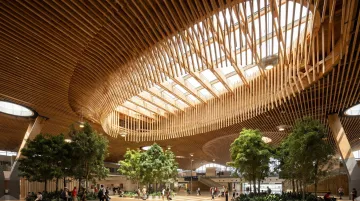
The PDX expansion and Princeton University's Central Energy Facilities together earned ZGF two Architizer A+Awards in 2025: Jury Winner for Sustainable Transportation and Popular Choice Winner for Sustainable Institutional Building.
| Category | Details |
|---|---|
| Core Sustainability Focus | Regenerative design, mass timber construction, climate-responsive infrastructure, research and healthcare facility performance |
| Key Credentials / Recognition | 2025 Architizer A+Awards: Jury Winner (Sustainable Transportation) + Popular Choice Winner (Sustainable Institutional); Pacific Northwest sustainability leadership |
| Representative Projects | Portland International Airport Main Terminal Expansion; Princeton University Central Energy Facilities; multiple LEED-certified research and healthcare campuses |
Gensler
The world's largest architecture and design firm by revenue, Gensler operates with 6,000+ professionals across 57 offices globally. The firm ranked No. 12 on ENR's 2025 Top 500 Design Firms and applies a data-driven, research-informed design philosophy that centers on environmental performance and occupant well-being.
Gensler's sustainability edge comes from scale of research. Annual Workplace and Design Forecast surveys generate proprietary data that shapes how buildings address energy efficiency, biophilic design, and climate resilience across millions of square feet annually. The Shanghai Tower — 632 meters tall and LEED Platinum certified — demonstrates this applied: wind-tunnel testing of its spiral form produced up to 24% savings in structural wind loading and cladding pressure reduction versus conventional high-rise design, contributing to approximately 21% better energy efficiency than ASHRAE 90.1 baseline.
| Category | Details |
|---|---|
| Core Sustainability Focus | Data-driven sustainability, biophilic and well-being design, energy-optimized high-rise and workplace typologies |
| Key Credentials / Recognition | ENR Top 500 No. 12 (2025); Architizer A+Awards recognition (Popular Choice, Sustainable Commercial Building, 2023); LEED Platinum and China Green Building Three Star certifications |
| Representative Projects | Shanghai Tower (LEED Platinum supertall, 632m); Fifth + Tillery (Architizer Popular Choice, Sustainable Commercial Building); multiple LEED-certified commercial and civic projects globally |
Hixson
Founded in 1948 and headquartered in Cincinnati, Hixson is a full-service architecture and engineering firm with 20 integrated, in-house technical disciplines. The firm serves clients across Food & Beverage, Pharma & Biotech, Science & Technology, and Workplace sectors throughout North America — and has spent 75+ years building specialized expertise in exactly the facility types where sustainability is hardest to achieve.
What separates Hixson in the sustainable A&E landscape is where sustainability lives in their process: inside the process systems, not just the building envelope. Warren Green, P.E. (Manager of Process Engineering) advises clients on waste reduction, energy optimization, and GHG emissions strategy — covering Scope 1 process and combustion emissions, Scope 2 purchased energy, electrification of process heat, refrigerant management, and corporate net-zero roadmaps.
That same integrated approach extends to water. The plumbing and fire protection team manages systems spanning CIP water reuse, RO concentrate recovery, condensate recovery, and closed-loop cooling. Chris Jarc, P.E., PMP, LEED AP, leads project delivery with sustainability credentials embedded at the project management level — not bolted on after design.
A notable example of this approach: modifications to Nestlé's Modesto, California dairy facility, completed in 2018, helped position the plant to become the first dairy facility in the U.S. to earn Alliance for Water Stewardship (AWS) certification. Other significant projects include the Maple Leaf Foods $772M fresh poultry facility in London, Ontario — designed with energy-efficient building features, odor control infrastructure, and wetlands protection — along with Abbott Nutrition, Milo's Tea Company, and the Samuel Adams Cincinnati brewery expansion.
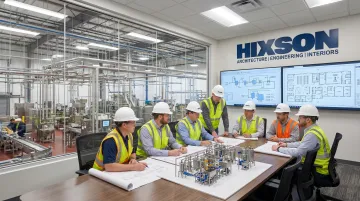
Hixson has been recognized as a Sustainability Giant by Interior Design magazine, and earned the 2026 Rising Giants designation (No. 178).
| Category | Details |
|---|---|
| Core Sustainability Focus | Process-level GHG and energy reduction, water stewardship (CIP reuse, RO recovery, AWS compliance), integrated MEP optimization for industrial and science facilities |
| Key Credentials / Recognition | Interior Design Sustainability Giant; 2026 Rising Giants No. 178; LEED AP project leadership; Great Place to Work certified; 75+ years sector-specialized A&E experience |
| Representative Projects | Maple Leaf Foods $772M production facility (London, ON); Nestlé Modesto (first U.S. dairy plant with AWS certification); Abbott Nutrition Tipp City ($400M expansion); Milo's Tea Company; Samuel Adams Cincinnati |
How We Chose the Best Sustainable A&E Firms for 2026
Firms were assessed across five criteria:
- Sustainability depth — not just certification count, but evidence of firm-wide environmental performance standards
- Sector-specific track record — demonstrated experience in the client's actual facility type
- In-house technical capabilities — whether disciplines like process, MEP, and civil engineering are integrated or outsourced
- Industry recognition — from ENR, Architizer A+Awards, Design Intelligence, and Interior Design magazine
- Measurable client outcomes — published or documented energy, water, or emissions results
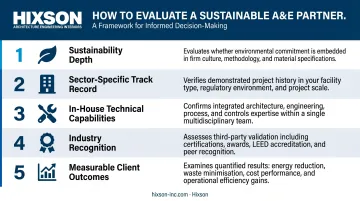
These criteria exist for a reason: the most common mistake decision-makers make is equating sustainability with LEED certification alone. A firm can hold dozens of LEED credentials and still lack the process engineering depth to meaningfully reduce a dairy plant's water consumption or a biotech facility's Scope 1 emissions.
For clients in Food & Beverage, Pharma & Biotech, and Science & Technology, facility sustainability often hinges on process systems, compressed air, sanitation loops, and utility infrastructure — not the building envelope. Integrated full-service firms consistently deliver better outcomes here than specialists who hand off MEP or process design to separate consultants.
Conclusion
The best sustainable A&E partner in 2026 is one whose sustainability practice aligns with your operational reality. For a global corporate campus, that might be Perkins&Will's regenerative design framework or HOK's carbon-neutral portfolio commitment. For a food manufacturing plant or pharmaceutical facility, it's a firm that can optimize process systems, water infrastructure, and building systems under one roof, integrated from the first day of design.
When evaluating prospective firms, focus on three questions:
- Can they demonstrate sustainability outcomes in a facility type similar to yours?
- Do they have the in-house engineering disciplines to execute — not just advise?
- Will they function as an extension of your internal team, or as a vendor?
For organizations in Food & Beverage, Pharma & Biotech, or Science & Technology seeking an A&E partner that integrates sustainability into every technical discipline, Hixson brings 75+ years of specialized facility experience and 20 integrated in-house disciplines — process engineering, MEP, civil, controls, and architecture — so sustainability decisions inform every system from the outset, not as an add-on at the end.
Frequently Asked Questions
What is a green building designer?
A green building designer is an architect or engineer who specializes in creating structures that minimize environmental impact through energy efficiency, sustainable materials, reduced water consumption, and healthier indoor environments. Most work toward formal certifications like LEED or the Living Building Challenge to validate their results.
What are the 5 basic principles of green building design?
The five core principles are energy efficiency, water conservation, sustainable site and land use, use of environmentally responsible materials, and indoor environmental quality. Leading firms integrate all five across both building design and process or mechanical systems — not just the architectural shell.
What is the green building industry?
The green building industry is the segment of the architecture, engineering, and construction sector focused on designing, building, and operating facilities that reduce environmental impact — encompassing certifying bodies (USGBC, BREEAM), A&E firms, materials manufacturers, and commissioning consultants. The global green building materials market was valued at $285.89 billion in 2024 and is projected to reach $458.61 billion by 2030.
What certifications should I look for when hiring a sustainable A&E firm?
LEED AP credentials on key staff, a documented portfolio of LEED-certified projects, and firm-level sustainability policies (such as carbon neutrality commitments) are the most common credibility indicators. For industrial or food and beverage clients, demonstrated experience reducing energy use and GHG emissions in process-intensive facilities is equally important.
How do sustainable A&E firms approach energy efficiency in industrial or food and beverage facilities?
In industrial settings, energy efficiency goes well beyond insulation or lighting — it requires coordinating process systems, compressed air, hot water production, sanitation loops, and HVAC from the earliest design phase. Firms with integrated in-house process and mechanical engineering capabilities consistently deliver stronger, more durable energy outcomes than those that outsource either discipline.
What is the difference between LEED and other green building standards?
LEED is the most widely used system globally (197,000+ projects), while BREEAM dominates in Europe (2.33 million registered buildings across 102 countries). The Living Building Challenge sets a more rigorous regenerative standard (250+ certified buildings), and WELL focuses specifically on occupant health. Project type, geography, and performance targets should drive which standard you pursue.