Introduction
Milk and dairy products are uniquely vulnerable to microbial contamination. Their nutrient-rich composition creates an ideal growth medium for pathogens including Listeria monocytogenes and Salmonella, while the wet, warm processing environments dairy operations require give these organisms exactly what they need to thrive.
The 2015 Blue Bell Creameries outbreak showed what happens when hygienic design fails. Company-commissioned root cause reports cited equipment and facility design flaws, including a drain in a room where cleaned equipment was stored that was actively emitting Listeria. The result: three deaths, 10 illnesses, full-market recalls, and temporary plant shutdowns.
Hygienic design risk management (HDRM) is the systematic process of identifying and eliminating hygiene risks through intentional facility and equipment design decisions — not patching over design flaws with operational controls after the fact. This article gives dairy facility stakeholders — plant engineers, project managers, and operations leaders — a practical framework for applying HDRM from facility concept through commissioning.
Design-stage decisions shape food safety outcomes, compliance exposure, and operational costs for the life of the facility. The average direct cost of a food recall is $10 million per event, excluding indirect costs. Resolving hygienic design risks before construction begins costs a fraction of that — retrofitting a completed facility or managing a contamination crisis costs far more.
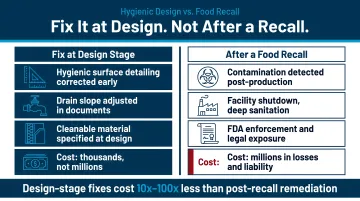
Summary
- HDRM identifies and eliminates hygiene risks through design—before they become contamination events
- Dairy processing demands higher standards due to biofilm formation, CIP complexity, and wet environments
- The HDRM framework moves through five structured steps, from defining intended use to monitoring residual risks after controls are in place
- Core design principles cover cleanability, drainability, material selection, hygienic zoning, and maintenance access
- Effective HDRM requires cross-functional teams (including A&E partners) engaged from the earliest concept stage
What Is Hygienic Design Risk Management?
Hygienic design risk management combines hygiene risk assessment with systematic risk reduction—applied across design, construction, equipment integration, and installation. Any risks that cannot be fully eliminated through design are then managed through operational procedures such as cleaning protocols and scheduled maintenance.
The goal is to build food safety into the facility itself, not layer it on afterward. In dairy processing, where pathogens like Listeria monocytogenes and Salmonella can persist in hard-to-reach areas, this distinction matters significantly.
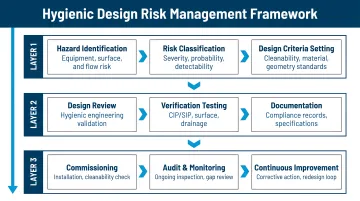
A complete hygienic design risk management approach addresses three interconnected layers:
- Risk identification: Mapping where contamination could occur across surfaces, junctions, drains, and equipment interfaces
- Risk reduction through design: Selecting materials, geometries, and finishes that resist microbial harborage and support effective cleaning
- Residual risk control: Establishing cleaning-in-place (CIP) procedures, inspection schedules, and operational controls for risks that design alone cannot eliminate