The engineering decisions made during facility design determine whether wastewater treatment becomes a manageable operating cost or a persistent liability. This article examines what makes food processing wastewater uniquely difficult to treat, the multi-stage treatment systems required, proven technologies across sub-sectors, compliance obligations under the Clean Water Act, and why integrating wastewater infrastructure into facility design from day one avoids the cost and performance penalties of retrofitting.
Summary
- Food processing wastewater contains organic loads 10 to 100 times higher than municipal wastewater, with extreme variability across production cycles
- Effective treatment uses multi-stage systems — screening, DAF for FOG removal, biological treatment for BOD/COD, and tertiary polishing — each targeting a specific contaminant class
- DAF systems achieve 74–99% removal of suspended solids and oil/grease in food processing applications when properly optimized
- U.S. facilities must meet NPDES permit limits and 40 CFR Part 403 pretreatment standards — violations carry real consequences, including a $1.15 million EPA penalty against one food processor
- Wastewater systems engineered into facility design from the start avoid layout constraints, reduce capital costs, and improve long-term performance
What Makes Food Processing Wastewater So Difficult to Treat
Food processing wastewater presents treatment challenges that dwarf those of municipal sewage. Untreated effluents can be 10 to 100 times stronger than domestic wastewater when measured by BOD₅ (biochemical oxygen demand) and COD (chemical oxygen demand)—the two primary indicators of organic pollution.
BOD₅ measures the oxygen microorganisms consume while breaking down organic matter over five days; COD measures the total oxygen required to chemically oxidize all organic compounds. Higher concentrations of both mean treatment systems must work harder, consume more energy, and handle greater biological loads.
The contaminant profile is equally challenging:
- Fats, oils, and grease (FOG) create persistent problems—they coat equipment, clog pipes, interfere with biological treatment, and can reach concentrations up to 1,000 mg/L in meat processing streams
- Suspended solids from product residues, peelings, and tissue fragments range from tens to thousands of mg/L depending on the operation
- Nitrogenous organics from protein-rich streams (meat, dairy) contribute to nutrient loading and require specialized biological treatment
- Pathogens from raw animal products demand disinfection before discharge
- Nutrients (nitrogen and phosphorus) trigger eutrophication in receiving waters and face increasingly stringent permit limits
Variability is the hardest challenge to engineer around. Unlike petrochemical or pharmaceutical operations with consistent process streams, food processing wastewater changes hourly. Production batch changes, clean-in-place (CIP) cycles, and seasonal peaks create dramatic swings in volume, organic load, pH, and temperature—all of which complicate system sizing and operation.
Wastewater Characteristics by Food Processing Sub-Sector
Different food processing operations generate fundamentally different effluent profiles, requiring tailored treatment approaches:
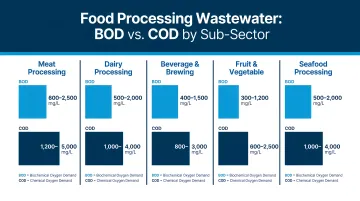
Dairy processing generates wastewater high in lactose, milk fats, and proteins. Measured concentrations include BOD₅ around 170 mg/L, COD ~1,007 mg/L, and TSS ~300 mg/L for some operations, though literature ranges for dairy span BOD from 40 to 48,000 mg/L depending on product type and water management practices.
Meat and poultry operations generate some of the highest organic loads across any food sector. Slaughterhouse wastewater can contain BOD₅ ~4,067 mg/L, COD ~10,906 mg/L, and TSS ~10,793 mg/L, with elevated nitrogen from blood and protein and significant FOG from animal fats.
Water consumption adds to the treatment burden: 6,510 liters per ton of carcass processed, or 15 to 26.5 liters per bird in poultry operations.
Beverage facilities (breweries, soft drink plants, juice processors) discharge wastewater containing sugars, yeast, and acids. Brewery effluent typically shows BOD₅ ~338 mg/L, COD ~1,118 mg/L, and relatively low nitrogen. Distilleries present extreme challenges—BOD₅ can reach 25,045 mg/L with COD ~26,907 mg/L in stillage streams.
Produce processing creates wastewater with high suspended solids from peelings and pulp, variable organic loads from sugars and starches, and potential pesticide residues requiring specialized treatment.
The table below summarizes typical parameter ranges across these sub-sectors:
| Sub-Sector | BOD₅ Range | COD Range | Primary Contaminants |
|---|---|---|---|
| Dairy | 40–48,000 mg/L | ~1,007 mg/L (varies) | Lactose, milk fats, proteins |
| Meat & Poultry | ~4,067 mg/L | ~10,906 mg/L | Blood, FOG, nitrogen, TSS |
| Brewery | ~338 mg/L | ~1,118 mg/L | Sugars, yeast, acids |
| Distillery | ~25,045 mg/L | ~26,907 mg/L | High-strength stillage |
| Produce | Variable | Variable | TSS, starches, pesticide residues |
When inadequately treated wastewater reaches natural water bodies, the consequences extend beyond regulatory penalties. Excess nitrogen and phosphorus fuel algal blooms; decomposition of algal biomass consumes dissolved oxygen, causing hypoxia and fish kills. This eutrophication damages ecosystems and creates community relations problems that can threaten a facility's operating permit.
Wastewater Treatment in Food Processing: A Stage-by-Stage Breakdown
No single technology can handle food processing wastewater effectively. Instead, facilities deploy a "treatment train"—a multi-stage sequence where each stage targets different contaminant categories. The specific combination depends on effluent characteristics, discharge destination, and permit requirements.
Preliminary Treatment
Preliminary treatment serves as the first line of defense, protecting downstream equipment and removing material that would interfere with subsequent processes. Screening systems capture large solids—product pieces, packaging debris, food particles—before they clog pumps or damage biological treatment stages. Grit removal settles out heavy inorganics like sand and bone fragments.
Flow equalization addresses another common failure point. Food processing generates highly variable wastewater—production runs create surges, while CIP cycles introduce concentrated chemical loads. Equalization tanks buffer these fluctuations, holding wastewater and releasing it at a controlled rate. This stabilizes flow and strength entering downstream treatment, preventing shock loads that would upset biological processes.
Primary Treatment
Primary treatment uses physical separation to remove suspended solids and FOG before biological treatment. Sedimentation allows heavier solids to settle by gravity, while flotation methods bring lighter materials to the surface for skimming.
Dissolved air flotation (DAF) has become the workhorse primary treatment technology in food processing. DAF works by dissolving air into water under pressure, then releasing it into the treatment tank where microscopic bubbles attach to suspended particles, floating them to the surface for removal. Field studies at poultry slaughterhouses demonstrate DAF can achieve 74% suspended solids removal and 99% oil and grease removal under optimized conditions. More recent data from poultry operations shows DAF achieving up to 99% TSS removal, 85% BOD₅ reduction, and 98% phosphate removal with proper coagulant selection and operating parameters.
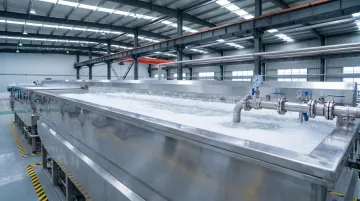
DAF's FOG removal performance makes it a go-to choice for dairy, meat, and edible oil facilities. By reducing the organic load entering biological treatment, DAF systems also lower municipal surcharge costs for facilities discharging to public sewers.
Secondary Treatment
Secondary treatment uses microorganisms to break down dissolved organic matter that physical processes cannot remove. This is where BOD and COD reduction primarily occurs.
Aerobic processes like activated sludge and sequencing batch reactors (SBRs) use oxygen-loving bacteria to consume organic compounds. Both work reliably, but aeration energy costs are substantial, and variable food processing loads demand careful process control.
Anaerobic digestion offers unique advantages for high-strength food processing streams. In oxygen-free tanks, specialized microorganisms break down organics while producing biogas—primarily methane—that can generate electricity or heat. Published data show COD removal rates of 89.8–96.5% in food processing applications, with methane yields ranging from 0.27 to 0.33 liters CH₄ per gram of COD removed.
In documented cases, biogas offsets up to 57.6% of a treatment plant's energy demand — a meaningful reduction in operating costs. For high-load streams from dairy, meat, or beverage operations, that combination of treatment performance and energy recovery makes anaerobic digestion economically attractive despite its higher capital costs.
Tertiary and Advanced Treatment
Tertiary treatment polishes effluent for facilities discharging to sensitive water bodies or pursuing water reuse. Technologies include:
Membrane bioreactors (MBR) combine biological treatment with membrane filtration in a single system. Pilot studies in beverage facilities show MBRs achieving effluent COD of 16.9 mg/L and TSS of 3.8 mg/L, with COD removal rates of 92.6%. MBRs deliver superior effluent quality in a smaller footprint than conventional systems, making them valuable where land is constrained—though capital and energy costs run higher.
Nutrient removal systems address nitrogen and phosphorus, increasingly critical as regulators tighten limits on these eutrophication drivers. Biological nutrient removal (BNR) configurations use specific bacterial populations and process conditions to convert nutrients to harmless nitrogen gas or precipitate phosphorus for removal.
Water reuse systems employing ultrafiltration, reverse osmosis, and UV disinfection can reclaim treated wastewater for non-product-contact uses—equipment cleaning, cooling towers, landscape irrigation. In water-stressed regions, reuse programs reduce freshwater intake costs and demonstrate environmental stewardship.
Zero liquid discharge (ZLD) is required in some arid regions or where discharge permits simply aren't available. The approach virtually eliminates wastewater discharge through evaporation, crystallization, and advanced filtration—but carries the highest capital and energy costs of any option on this list.
Common Treatment Technologies for Food Processing Facilities
Understanding the core technologies helps facility owners evaluate options and understand what their engineering team is proposing. These solutions range from primary separation to advanced effluent polishing — and the right combination depends on your waste stream, discharge limits, and long-term operational goals.
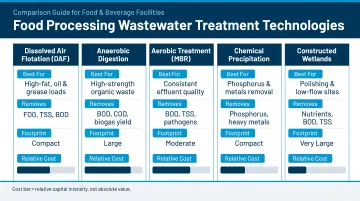
Dissolved Air Flotation (DAF) is the most widely used primary treatment technology in food processing. Its effectiveness against fats, oils, and grease (FOG) and suspended solids — combined with relatively low operating cost and tolerance for variable loads — makes it a strong fit for dairy, meat, and beverage facilities. DAF also functions as an essential pretreatment step, protecting and enhancing whatever biological processes follow.
That biological treatment often takes the form of anaerobic digestion. Anaerobic Digestion is worth prioritizing for any facility with high-strength organic waste streams. On-site biogas generation can offset electricity costs or supply process heat, and in some jurisdictions excess generation can be sold back to the grid. Systems can often be integrated into existing treatment trains without halting production, making them viable for retrofits as well as new builds.
Membrane Bioreactors (MBR) suit facilities needing high-quality effluent in limited space. Their ability to operate at higher mixed liquor suspended solids (MLSS) concentrations and produce consistently low effluent solids and BOD makes them attractive despite higher capital costs. For facilities planning water reuse or facing very tight discharge limits, the premium may be justified.
Where MBR addresses effluent quality, Biological Nutrient Removal (BNR) addresses a different compliance pressure: tightening nutrient discharge limits. Facilities in watersheds with numeric nutrient criteria or TMDL (total maximum daily load) restrictions increasingly need nitrogen and phosphorus removal capability. Dairy, poultry, and produce processors with high nutrient loads should evaluate BNR during facility design rather than retrofitting later.
Zero Liquid Discharge (ZLD) and Water Reuse represent the high end of treatment complexity and cost, but they address specific drivers: water scarcity, lack of discharge options, or binding sustainability commitments. ZLD eliminates discharge entirely but requires significant capital investment and energy input. Water reuse offers a middle ground, recovering treated wastewater for process reuse and reducing both freshwater demand and discharge volume.
To quickly compare where each technology fits within a treatment train:
| Technology | Primary Use | Best Fit |
|---|---|---|
| DAF | Primary separation (FOG, TSS) | Dairy, meat, beverage |
| Anaerobic Digestion | High-strength organic removal + energy recovery | High-BOD waste streams |
| MBR | Advanced biological + effluent polishing | Space-constrained, reuse-ready sites |
| BNR | Nutrient (N & P) removal | Dairy, poultry, produce processors |
| ZLD / Water Reuse | Eliminate or minimize discharge | Water-scarce regions, strict permit zones |
Staying Compliant with Wastewater Discharge Regulations
Regulatory compliance drives wastewater treatment requirements. The Clean Water Act governs industrial discharge through two pathways:
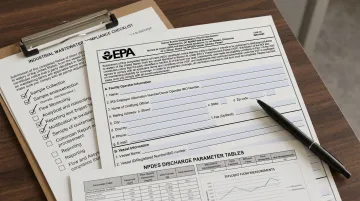
Direct dischargers releasing to surface waters require an NPDES (National Pollutant Discharge Elimination System) permit that sets facility-specific limits for BOD, COD, pH, suspended solids, nutrients, and other parameters. Key permit requirements include:
- Effluent sampling on a continuous or periodic basis
- Detailed record-keeping and discharge reporting
- Technology-based treatment minimums as the baseline
- More stringent water quality-based limits where receiving waters are impaired
Permits typically last five years.
Indirect dischargers sending wastewater to municipal treatment plants must meet pretreatment standards under 40 CFR Part 403. These regulations prevent industrial pollutants from interfering with municipal treatment processes or passing through untreated. Thresholds are commonly set at 250 mg/L for both BOD and suspended solids.
Exceed those thresholds and surcharges follow. San Antonio Water System, for example, charges $1.32 per mg/L of BOD above 250 mg/L and $3.05 per mg/L of TSS above 250 mg/L, multiplied by monthly discharge volume—costs that compound fast for facilities running high-strength wastewater.
Sector-specific effluent guidelines further define requirements. EPA has promulgated guidelines for dairy products, meat and poultry, canned fruits and vegetables, seafood, and other food processing categories, establishing baseline treatment expectations.
Non-compliance carries consequences well beyond fines. In 2025, Hanover Foods Corporation agreed to pay a $1.15 million civil penalty for over 600 NPDES permit violations—suspended solids, ammonia nitrogen, phosphorus, and temperature exceedances. Beyond the financial hit, violations can trigger:
- Permit revocation or suspension
- Mandatory production curtailment
- Long-term damage to community relationships and customer trust
IoT-enabled monitoring systems are increasingly deployed to provide real-time data on effluent quality. While EPA permits already require continuous monitoring for certain parameters like pH, advanced sensors and analytics enable faster response to exceedances before they become violations, improving compliance reliability.
Why Wastewater Infrastructure Should Be Engineered Into Your Facility Design from Day One
The single most consequential decision about wastewater treatment happens before any equipment is selected: whether to integrate wastewater infrastructure into the facility design from the planning stage or retrofit it later.
Retrofitting wastewater systems into existing facilities imposes crippling constraints. Drain locations are fixed. Floor slopes are set. Pipe routing must work around existing equipment and structure. Treatment systems must fit into leftover space rather than optimal locations. These limitations increase capital costs—requiring longer pipe runs, additional pumping, and creative but expensive workarounds—and compromise long-term operating performance through inefficient layouts and difficult-to-maintain configurations.
Facilities designed with wastewater treatment integrated from the start avoid these penalties. Critical design decisions that affect wastewater system performance include:
- Floor drainage design and slopes that separate process streams by contamination level, directing high-strength waste to appropriate pretreatment and keeping cleaner streams separate
- Grease trap and interceptor placement positioned to capture FOG at the source before it enters collection systems
- Process equipment layout relative to collection points, minimizing distance and elevation changes waste must travel
- Utility routing for treatment system power, water, and chemical feed located efficiently during initial construction rather than added later
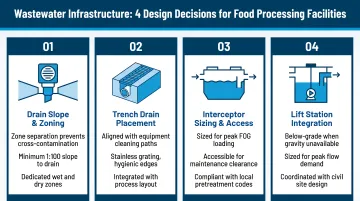
These are architectural, mechanical, and civil engineering decisions made during facility layout—yet downstream treatment performance depends on them.
For food processors planning new facilities, expansions, or major equipment upgrades, working with an architecture and engineering firm that has deep Food & Beverage sector experience ensures wastewater infrastructure is sized correctly for production volume and product mix from day one. Hixson's integrated team, spanning process, mechanical, civil, and architectural disciplines, has designed food processing facilities for clients including Maple Leaf Foods, Milo's Tea Company, and Samuel Adams—bringing the kind of cross-disciplinary operational understanding that a standalone treatment vendor working in isolation cannot provide.
This multidisciplinary integration reduces risk and improves outcomes across every phase of a project:
- Civil engineers coordinate with process engineers to optimize site grading and drainage
- Mechanical engineers route utilities to support treatment equipment placement
- Architects design interstitial spaces that facilitate maintenance and future upgrades
When all disciplines collaborate from the planning stage, wastewater systems are built to support facility operations — not work around them.
Frequently Asked Questions
What is the process of wastewater treatment in the food industry?
Food processing wastewater moves through four core stages: preliminary treatment (screening and flow equalization), primary treatment (DAF or sedimentation to remove FOG and solids), secondary treatment (aerobic or anaerobic biological processes to reduce BOD/COD), and tertiary treatment (membrane filtration, nutrient removal, or disinfection) for polishing or water reuse.
What are the 5 steps of wastewater treatment?
The five stages are:
- Preliminary: screening and grit removal
- Primary: physical removal of suspended solids and FOG
- Secondary: biological treatment to reduce dissolved organics
- Tertiary: advanced polishing such as membrane filtration or nutrient removal
- Sludge management: handling and disposal of concentrated solids
Not every facility requires all five stages. System design depends on effluent characteristics and discharge requirements.
What is the most commonly used water treatment method in the food industry?
Dissolved air flotation (DAF) is the most widely used primary treatment technology in food processing due to its effectiveness at removing FOG and suspended solids. DAF is typically followed by biological treatment (aerobic or anaerobic) as the standard secondary stage for reducing BOD and COD to meet discharge limits.
What is the difference between STP and ETP?
An STP (sewage treatment plant) treats domestic or municipal sewage with relatively low organic loads (typically <300 mg/L BOD). An ETP (effluent treatment plant) treats industrial effluent, like food processing wastewater, which contains far higher BOD, COD, FOG, and industry-specific contaminants. Food processors typically require an ETP, often with pretreatment before discharging to a municipal STP to meet pretreatment standards.
How do food processors stay compliant with wastewater discharge regulations?
Compliance requires three things: a treatment system designed to meet NPDES permit limits (direct discharge) or 40 CFR Part 403 pretreatment standards (municipal sewer discharge); routine effluent monitoring and record-keeping per permit requirements; and staying current with evolving federal and state regulations. Working with engineers who specialize in food processing facility design, like Hixson, helps facilities navigate these requirements from the start.
Can treated wastewater from food processing be reused on-site?
Yes. With appropriate tertiary treatment, such as membrane bioreactors, ultrafiltration, or reverse osmosis, treated wastewater can be reclaimed for non-product-contact uses including equipment cleaning, cooling tower makeup, or landscape irrigation. Water reuse cuts freshwater intake and operating costs, making it especially valuable in water-stressed regions and for facilities with sustainability targets.