Introduction
Lab projects fail for a specific, recurring reason: not because the people involved lack technical knowledge, but because expectations misalign early, disciplines don't coordinate well, and critical planning steps get compressed or skipped entirely.
This guide is written for facility owners, research directors, and lab managers navigating the full project lifecycle — from the first stakeholder conversation through commissioning and occupancy. It covers what distinguishes lab construction from standard commercial work, how to move through each phase without costly surprises, and the design decisions that most directly affect safety and efficiency.
It also addresses how to make the new build vs. renovation decision based on real project constraints — an evaluation most teams approach too late.
Whether you're entering planning now or already in progress, use this guide to pressure-test your approach before a recoverable issue becomes an expensive one.
Key Takeaways
- Lab projects fail in the planning phase, not the construction phase — early programming prevents costly redesigns
- Labs are 3–4× more energy-intensive than commercial buildings — HVAC is your single largest cost driver
- Hazardous materials classification and control area determination belong in schematic design, not as an afterthought
- Commissioning is not the same as construction completion — regulatory steps add real time
- Integrated A&E firms outperform fragmented consultant teams on complex lab projects
What Is Laboratory Design, Construction, and Renovation?
Laboratory design is an interdisciplinary process that translates scientific workflow requirements into a physical environment. Unlike standard commercial construction, it's governed by specialized MEP demands, hazardous materials handling, biosafety classifications, and performance standards that don't apply to office buildings or standard tenant improvements.
The NIH Design Requirements Manual treats lab facilities as regulated engineering projects with their own technical criteria, not as generic real estate. Owners who treat lab projects like conventional build-outs tend to discover the gap — usually at budget time.
Three Project Types — Different Implications
| Project Type | Starting Point | Key Considerations |
|---|---|---|
| New construction | Greenfield or brownfield site | Maximum design flexibility; highest upfront cost |
| Renovation | Existing occupied or vacant facility | Phasing complexity; legacy infrastructure constraints |
| Fit-out | Shell space pre-designed for enhanced services | Faster timeline; cost depends on shell quality |
Each path carries different cost, timeline, and design implications. A renovation of a 1970s research building may cost more per square foot than new construction once asbestos remediation, HVAC integration, and phasing constraints are factored in. A fit-out in a purpose-built life sciences shell can compress timelines significantly — but only if the shell's infrastructure matches your specific MEP requirements.
Who Initiates These Projects
These projects are typically initiated by:
- Research directors scoping new or expanded R&D capacity
- Facility managers responding to compliance or operational changes
- Pharma and biotech operations leaders managing cGMP build-outs
- Food science QA teams requiring dedicated testing environments
The consistent pattern across all of them: architecture and engineering expertise enters the conversation too late. Decisions made before the design team is engaged — about site selection, building acquisition, or budget framing — frequently constrain what's actually buildable within the numbers.
The Laboratory Design and Construction Process: Phase by Phase
Shortcutting early phases is the most common cause of costly redesigns and schedule delays. Construction Industry Institute data shows quality deviations causing rework averaged 12.4% of total installed project cost across design and construction projects — a risk that compounds in complex lab environments where systems are deeply interdependent.
Here's how a well-run lab project sequences:
Pre-Design and Programming
Programming is the foundation. Done well, it governs every subsequent decision. Done poorly — or skipped — it triggers a cascade of change orders and schedule slippage that's nearly impossible to recover from.
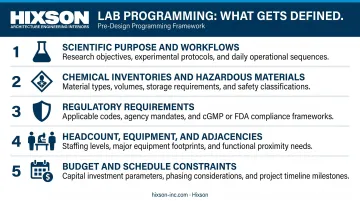
During programming, stakeholders define:
- The lab's scientific purpose and primary workflows
- Chemical inventories and hazardous materials present
- Regulatory requirements: biosafety level (BSL), ADA compliance, DEA registration, radiation safety
- Headcount, equipment list, and adjacency requirements
- Budget and schedule constraints — based on realistic input, not top-down mandates
One critical note: budget and timeline set during programming should reflect what's actually required, not what leadership hopes to spend. Labs built to inadequate budgets don't get cheaper — they get redesigned mid-construction.
Schematic Design and Design Development
Schematic design translates program requirements into physical layout: wet vs. dry lab zones, control area boundaries, fume hood locations, casework strategy (fixed vs. modular), aisle clearances, and utility routing.
This is the phase where the most consequential — and hardest to reverse — decisions are made. Chemical storage locations, ventilation strategy, and control area designations are all far more expensive to change in construction documents than they are in schematic sketches.
Bring EH&S and environmental consultants into schematic design, not after. Control area determination governed by NFPA 45, the IBC, and IFC must happen here to avoid code issues that force expensive late-stage redesigns.
Construction Documents and Permitting
The design team converts approved schematics into complete construction documents: detailed drawings, engineering specifications, equipment lists with utility connections, and code compliance documentation for building permits.
Complete CDs reduce field surprises. Vague or incomplete documents are a leading cause of change orders — and in lab projects, those changes often hit MEP systems that are already roughed in. Two things complete documents must include:
- Fully coordinated utility connections for every piece of equipment
- Code compliance documentation ready for permitting before construction starts
Construction and Quality Management
Construction requires active oversight, not passive monitoring. Lab owners should:
- Insist on a construction quality management plan from the outset
- Participate in regular site walkthroughs to catch deviations early
- Verify the general contractor has relevant experience with your specific lab type
A petrochemical testing lab differs vastly from a pharma biotech cleanroom. A contractor with strong healthcare experience but no lab background will miss things a specialized GC wouldn't.
Also plan for costs that routinely disappear from initial budgets:
- Swing space rental during renovation
- Equipment relocation and temporary storage
- Staff downtime and productivity impact
- Specialty equipment with long lead times
Commissioning and Handover
Commissioning verifies that all systems — HVAC, fume hoods, emergency systems, plumbing, electrical — perform to design specifications before occupancy. For labs, this also includes regulatory compliance assessments, biosafety verifications, and potentially accreditation reviews.
These steps are frequently omitted from initial project schedules — and the resulting go-live delays are avoidable. Write commissioning scope into owner project requirements before construction begins.
Two standards govern the process: ANSI/ASHRAE 110 covers fume hood performance testing; ASHRAE Guideline 1.1 governs broader HVAC commissioning.
Critical Laboratory Design Considerations
Safety Systems and Hazard Controls
Non-negotiable safety infrastructure includes:
- Fume hoods — ducted or ductless, positioned away from air supply diffusers and high-traffic paths. ANSI/ASHRAE 110 testing validates containment performance
- Biological safety cabinets — for labs handling infectious or biohazardous materials
- Emergency eyewash stations and safety showers — required under OSHA 29 CFR 1910.151(c) wherever injurious materials may cause splash exposure
- Egress paths — self-closing doors, adequate aisle clearances maintained throughout the space
- Chemical and waste storage segregation — incompatible chemicals cannot share storage space regardless of container size
Control area determination — governed by NFPA 45, the IBC, and IFC — must happen in the schematic phase. Finding a classification problem after construction documents are issued means redesigning the floor plan, not just editing a drawing.
Ventilation, HVAC, and Air Quality
Laboratory HVAC is the most technically complex and typically most expensive system in any lab building. According to the DOE's Better Buildings program, a typical lab uses 3 to 4 times more energy than an average commercial building and can account for up to 70% of campus energy consumption.
The NIH Design Requirements Manual sets a minimum of 6 air changes per hour for general research laboratories, with 100% outside air — no recirculation. By contrast, ASHRAE's office ventilation standard uses rates based on occupancy and floor area, typically around 5 cfm per person.
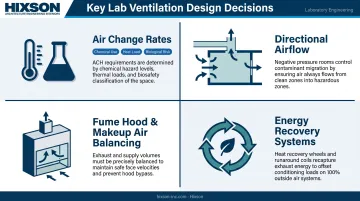
Key ventilation design decisions:
- Air change rates vary by chemical use, heat load, and biological agent risk — they're not a fixed number
- Directional airflow relative to adjacent spaces (negative pressure for containment labs)
- Fume hood exhaust sizing and makeup air balancing
- Energy recovery systems to offset operating costs
MEP Infrastructure
Labs require significantly denser MEP infrastructure than commercial buildings. That density demands accurate planning: a complete equipment list — including equipment anticipated in the next 3–5 years — is essential for right-sizing utility capacity. Underbuilt infrastructure that requires a second mobilization to upgrade is among the most expensive mistakes in lab construction.
Typical specialty systems include:
- High-density electrical distribution with emergency circuits for ULT freezers and critical instruments
- Deionized water, process water, and domestic hot water
- Acid waste neutralization
- Compressed air (instrument and utility grade)
- Specialty and hazardous gases with appropriate monitoring
- Uninterruptible power systems for sensitive instrumentation
Because lab electrical systems intersect directly with mechanical and plumbing constraints — UPS sizing, hazardous area classification, power quality — coordination across disciplines from the earliest design phase prevents costly rework. Hixson's electrical and MEP teams work within a single integrated structure, which means those conflicts surface in design, not during construction.
Layout, Workflow, and Flexibility
Core layout decisions affect both daily productivity and long-term adaptability:
- Open vs. closed lab — open promotes collaboration and reduces cost but sacrifices acoustic privacy and dedicated equipment zones
- Wet vs. dry zone separation — mixing wet chemistry and dry analytical work in the same zone creates safety and maintenance problems
- Fixed vs. modular casework — modular allows reconfiguration at lower cost when research priorities shift
- Bench-to-aisle spacing — sized for both regulatory compliance and practical workflow
Future flexibility costs relatively little at construction and saves significantly when research priorities shift. Oversizing utility stub-outs, planning for additional floor penetrations, and selecting modular casework are decisions that protect against expensive disruption down the line.
Compliance, Materials, and Cleanability
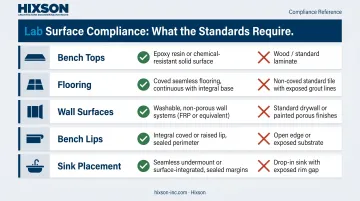
Lab surfaces must meet performance standards that standard commercial materials don't:
- Bench tops — epoxy resin, phenolic resin, or stainless steel (not wood or standard laminate)
- Flooring — seamlessly coved to eliminate grout lines that trap contaminants
- Wall surfaces — washable, resistant to disinfectants
- Bench lips — raised edges to contain spills at the bench level
- Sink placement — near egress, accessible when chemical exposure creates urgency
Integrate ADA compliance from the start. Fume hood height, aisle widths, and equipment placement all have accessibility implications that are far cheaper to address in schematic design than during construction.
New Lab Construction vs. Laboratory Renovation: How to Decide
The real question separating new construction from renovation isn't cost per square foot — it's whether the existing building can carry the load. Infrastructure capacity determines project path more than budget does.
Favor new construction when:
- The existing building cannot accommodate required MEP loads
- Hazardous materials classification requires structural upgrades
- The footprint needs to expand significantly
- The cost of bringing an aging facility to code approaches or exceeds new construction costs
Renovation looks attractive on paper, but planners routinely underestimate the added complexity:
Renovation adds complexity through:
- Phasing work around active lab operations — particularly in pharmaceutical and biotech environments where research continuity matters
- Asbestos, lead, or other legacy hazardous materials in older buildings
- Integrating new HVAC capacity into an existing structure with limited shaft space and floor-to-floor height
- Higher per-square-foot costs than new construction, precisely because of these constraints
The lab fit-out path occupies the middle ground — and often gets overlooked.
Moving into a shell space pre-designed for enhanced services (higher floor-to-ceiling height, oversized HVAC risers, reinforced floor loading) can compress timelines and narrow the gap between initial budget and final cost. CBRE's 2024 life sciences construction benchmarks tracked fit-out costs across 25 U.S. cities and found double-digit increases in most life sciences hubs. Whatever path you're evaluating, validate cost benchmarks against current market conditions before committing — project type is only part of the equation.
How Much Does It Cost to Build or Renovate a Laboratory?
Lab construction costs vary widely depending on lab type, geographic location, union vs. non-union labor, existing infrastructure, and MEP intensity. A general R&D lab, a BSL-2 biology facility, and a pharmaceutical QC lab each carry fundamentally different cost profiles — no single national benchmark applies.
Primary Cost Drivers
- HVAC and ventilation systems — 100% outside air, high air change rates, and fume hood exhaust infrastructure make lab HVAC far more expensive than commercial systems
- Specialty materials — chemically resistant surfaces, seamless flooring, and washable wall systems add cost throughout the finish package
- Compliance engineering — fire protection design, hazardous materials classification, environmental controls, and regulatory documentation all carry fees that don't appear in commercial construction budgets
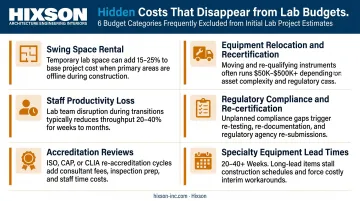
Hidden Costs That Routinely Disappear From Initial Budgets
Most lab project cost overruns trace to omissions, not miscalculations. Watch for:
- Swing space rental during renovation phases
- Equipment relocation, recertification, and temporary storage
- Lost staff productivity during active construction phases
- Regulatory compliance assessments and re-certifications post-completion
- Accreditation reviews
- Supply chain lead times on specialty lab equipment — some items run 20–40+ weeks
Build these into the project budget before the first design fee proposal is signed. Getting an experienced A/E team involved early is one of the most reliable ways to catch these omissions before they become change orders.
Choosing the Right Laboratory Design and Engineering Partner
The most expensive mistakes in lab projects originate in the design phase. That makes design quality the highest-leverage investment an owner makes — and it makes the selection of an A&E partner consequential in ways that the selection of a general contractor rarely matches.
Why Integrated Firms Outperform Fragmented Consultants
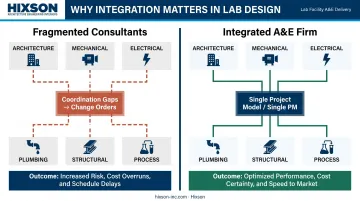
When architecture, mechanical, electrical, plumbing, structural, and process engineering operate as separate firms, coordination gaps open between disciplines. Drawings don't match. Assumptions diverge. Change orders follow.
An integrated A&E firm eliminates that gap structurally. All disciplines share a project model and are accountable to the same project manager — with daily coordination built in, not bolted on. In lab projects — where an HVAC decision affects architecture, electrical, plumbing, and process simultaneously — that coordination isn't a convenience. It's a fundamental risk control.
What to Evaluate When Selecting a Lab Design Partner
- Sector-specific experience — pharma/biotech lab expertise is not the same as food science QA lab expertise. Ask for project examples that match your lab type and scale
- Code and standard familiarity — the firm should demonstrate working knowledge of the NIH Design Requirements Manual, NFPA 45, ASHRAE commissioning guidelines, ANSI/ASHRAE 110, and relevant IBC/IFC provisions
- In-house engineering depth — ask which disciplines are in-house vs. subcontracted, and whether the same people will be on your project throughout
- Institutional knowledge — high associate turnover means project knowledge walks out the door; look for firms where senior engineers stay
Hixson's Laboratory Design Practice
Hixson checks each of those boxes. The Cincinnati-based integrated A&E firm has been designing laboratories for more than four decades — with cGMP space experience that goes back 75+ years. Their lab practice spans pharmaceuticals and biotechnology, flavors and ingredients, chemicals and solvents, personal care, and food and beverage, with completed projects for Eurofins Genomics, Medpace, Abbott Nutrition, Nestlé, and Mane, Inc.
The Eurofins Genomics project illustrates the integration advantage directly: Hixson designed and engineered a 72,000 SF greenfield facility in Louisville containing Synthesis, Applied Genomics, and Sequencing labs — with separated cGMP and RUO workstreams requiring tight coordination across architecture, MEP, process, and civil engineering.
That coordination is structural, not incidental. Hixson's 20 in-house technical disciplines include:
- Architecture, interior design, and process layout
- Structural, civil, and process engineering
- Mechanical, electrical, plumbing, and fire protection
- Refrigeration, industrial wastewater, and EH&S
- Automation/controls and process utilities
- Project management, cost estimating, and construction administration
With an average associate tenure of more than 10 years, senior engineers who designed the first project are still there for the next one — meaning clients don't re-explain their processes every engagement.
Frequently Asked Questions
What is a laboratory design?
Laboratory design is the process of planning and engineering a space to safely support scientific operations. It integrates workflow requirements, safety regulations, utility infrastructure, and code compliance across architecture and engineering disciplines — distinct from commercial construction in its MEP density, hazardous materials handling, and performance standards.
How much would it cost to build a lab?
Lab construction costs vary widely based on lab type, size, geographic location, and MEP complexity. The range between a general research lab and a specialized pharmaceutical or biosafety facility can be dramatic. Consult an experienced A&E firm with your specific program requirements for a realistic project estimate — national averages are rarely useful.
What is the difference between a new lab build and a lab renovation?
New construction starts from the ground up, offering maximum design flexibility. Renovation adapts an existing space — often at higher per-square-foot cost due to phasing constraints, legacy infrastructure, and the challenge of integrating new MEP systems into a building not originally designed for lab use.
How long does it take to design and build a laboratory?
Timeline depends on scope and complexity; most projects span from programming through occupancy across multiple phases. Commissioning, regulatory compliance assessments, and accreditation reviews are frequently omitted from initial schedules but add meaningful time — build them in from the start.
What are the most important safety considerations in laboratory design?
Key priorities include fume hood placement and exhaust performance, emergency eyewash and safety shower locations, controlled egress paths, chemical storage segregation, lab pressurization relative to adjacent spaces, and surfaces that resist chemical attack. Control area determination under NFPA 45 and the IBC should be addressed in schematic design, not resolved later.