This guide walks through R&D lab design as a four-phase process: needs assessment, layout and zoning, engineering systems, and safety with future flexibility. It's written for organizations in pharma/biotech, food & beverage, and science & technology planning a new facility or major renovation. Hixson — with 75+ years of integrated A&E experience and lab projects completed for clients including Eurofins Genomics, Abbott Nutrition, and Medpace — has informed the approach throughout.
Key Takeaways
- Start with needs assessment: Define the research mission, equipment requirements, headcount, and regulatory obligations before drawing a single floor plan.
- Zone for workflow efficiency: A well-mapped layout minimizes travel distance, separates incompatible processes, and prevents cross-contamination.
- Integrate building systems early: HVAC, electrical, plumbing, and specialty utilities must be engineered as one coordinated system.
- Phase 4 — Safety and Flexibility: Embed compliance and adaptability from the first drawing — retrofitting both is far more expensive.
What Is an R&D Lab — And Why Its Design Is Different
An R&D lab is a purpose-built environment for experimentation, prototyping, and innovation. That distinguishes it from a quality control or testing lab, where researchers follow fixed SOPs and the workflow rarely changes. In an R&D environment, the protocol evolves as the science does — which means the space has to keep up.
The Whole Building Design Guide puts a number on this: private research companies physically change an average of 25% of their labs each year. Academic institutions change 5–10% annually. No other building type demands that level of ongoing reconfiguration.
Sector Shapes Everything
What works for one sector doesn't translate to another. Each R&D environment carries its own regulatory load and spatial logic:
- Food & beverage pilot labs focus on cleanability, ingredient containment, and sensory testing workflows — not biosafety containment
- Pharma/biotech BSL-2 spaces require self-closing locked doors, handwashing sinks near exits, and sustained directional airflow from clean to potentially contaminated zones — mandated by CDC/NIH biosafety standards
- Materials science labs with high-voltage testing equipment introduce a separate layer of constraints governed by NFPA 70E
The Core Design Tension
Every R&D lab faces the same fundamental challenge: the space must work for current research while remaining adaptable for projects that don't yet exist. Resolve that tension wrong and you end up with one of two failure modes:
- Over-engineered fixed infrastructure that's expensive to modify when research priorities shift
- Under-resourced spaces that can't support the equipment, containment, or utility demands of growing research programs
Getting that balance right is a design problem — one that starts with understanding how your lab will actually be used and how that use is likely to change.
Phase 1 — Needs Assessment and Lab Programming
The biggest mistakes in R&D lab design happen before anyone picks up a pencil. Programming is the phase where you document everything the lab must do — and everything it might need to do in five years.
Start With the Research Mission
A lab programming document should capture:
- The specific research activities the lab must support
- Number of personnel, their roles, and how they move through the space
- Anticipated growth over a 5–10 year horizon
- Equipment the lab must house on day one versus equipment likely within the planning period
This document becomes the design brief. Every downstream decision (aisle widths, utility sizing, mechanical system capacity) should be tested against it.
Map Workflows Before Touching a Floor Plan
Trace the complete path of a sample, material, or data set from intake through processing, analysis, storage, and waste disposal. Flag every point where personnel, materials, or information cross paths — those intersections are where bottlenecks, contamination risks, and safety hazards cluster.
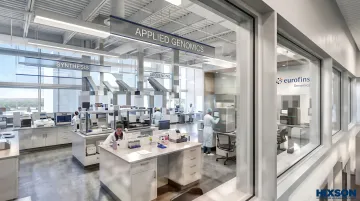
On Hixson's Eurofins Genomics project — a 72,000 SF greenfield lab in Louisville spanning Synthesis, Applied Genomics, and Sequencing — separating cGMP and Research Use Only (RUO) workstreams had to be resolved during programming. Catching it at layout would have meant expensive rework.
Common workflow intersections to flag early:
- Personnel crossing between clean and dirty zones
- Shared equipment requiring sequential access by different workstreams
- Waste disposal routes that pass through active work areas
Build the Equipment List First
Before any layout work begins, document every instrument and piece of equipment with:
- Footprint and weight
- Power requirements (voltage, amperage, phase)
- Specialty utility connections (vacuum, compressed gas, DI water, RO water)
- Vibration sensitivity
- Heat output
This list drives utility infrastructure sizing. Skipping it means your MEP engineers are guessing.
Determine Regulatory Requirements at the Outset
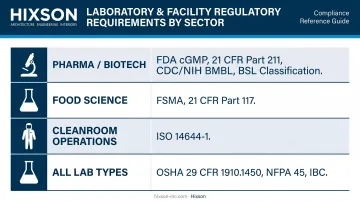
The applicable framework varies significantly by sector:
| Sector | Key Standards |
|---|---|
| Pharma/Biotech | FDA cGMP / 21 CFR Part 211, CDC/NIH BMBL, BSL classification |
| Food Science | FSMA / 21 CFR Part 117 |
| Cleanroom Operations | ISO 14644-1 classification |
| All Lab Types | OSHA 29 CFR 1910.1450, NFPA 45, IBC occupancy classification |
Involve your EHS officer and compliance team from day one — not at final design review. Hixson's approach integrates EH&S compliance and permitting with facility design from the start, specifically to address regulatory requirements during design rather than as costly retrofits.
Establish Adjacency and Separation Requirements
Before zoning begins, document which spaces must be physically close and which must be isolated:
- Must be adjacent: Sample prep and analytical instruments (sample integrity)
- Must be separated: Sterile tissue culture rooms from dirty utility areas
- Requires isolation: BSL-2 containment spaces from open collaborative areas
These constraints are non-negotiable. Documenting them before layout begins keeps them from being negotiated away under schedule pressure.
Phase 2 — Layout, Zoning, and Workflow Design
Once programming is complete, the layout phase translates research requirements into spatial organization. The three primary approaches are open plan, enclosed rooms, and hybrid — and the right answer depends on the specific demands of the research.
Most modern R&D labs land on a hybrid model: open-plan benching for collaborative wet and dry work, with enclosed rooms for processes requiring strict environmental control or BSL-level containment.
The Mane, Inc. Development Center illustrates this well. At 85,000 SF, Hixson integrated R&D labs, consumer testing, and pilot-scale production into a single facility — individual labs with separate HVAC and lighting controls co-located alongside collaborative and production spaces.
Defining Functional Zones
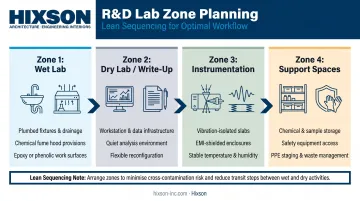
A well-organized R&D lab typically contains four core zone types:
- Wet lab areas — sinks, specialized ventilation, chemical-resistant surfaces, fume hoods
- Dry lab / write-up areas — data analysis, computation, documentation; can often be open plan
- Instrumentation zones — vibration control, stable temperature, clean power, limited foot traffic
- Support spaces — chemical storage, glasswashing, gas cylinder storage, break areas
Apply lean sequencing to zone placement: the most frequent workflow steps should require the shortest travel distances. Poor zone sequencing — sample prep at the opposite end of the building from analytical instruments, for example — increases both time-on-task and contamination risk on every single run.
Layout Mechanics and Clearances
Zone placement determines workflow logic. Physical dimensions determine whether that workflow actually functions. Aisle dimensions are not suggestions — use these as minimums:
- Working aisles between benches: 60 inches (with 57 inches as the absolute minimum per University of Arkansas research lab criteria)
- Primary circulation corridors: Wide enough for equipment carts — a 5-foot module aisle is standard per WBDG's lab module criteria
- Wet lab door openings: 42 inches minimum, 48 inches preferred for equipment movement
- ADA accessible routes: 36-inch minimum clear width, with 60-inch turning diameter per 2010 ADA Standards
The design review process moves in stages: 2D floor plans first to validate aisle clearances and zone adjacencies, then 3D models to check vertical clearance, sightlines, and the working environment. Hixson uses 3D visualization as a standard client deliverable because spatial relationships in complex lab environments are difficult to evaluate on a flat drawing.
Structured review sessions should include lab technicians, researchers, EHS officers, facilities managers, and IT personnel. Each group sees a different category of design error. Catching those errors on a drawing costs a fraction of what they cost in construction.
Phase 3 — Engineering Systems: MEP, HVAC, and Specialty Utilities
Engineering systems are typically more than 50% of total laboratory construction cost. That number alone should determine how much attention they receive during design.
HVAC and Environmental Control
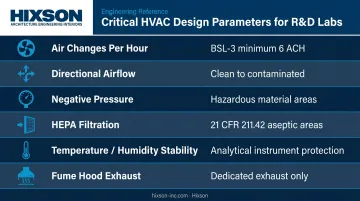
R&D labs require far more sophisticated HVAC than standard office or manufacturing spaces. Key design parameters include:
- Air changes per hour (ACH): BSL-3 labs require a minimum of 6 ACH; animal facilities typically require 10–15 outdoor ACH
- Directional airflow: BSL-3 ventilation must maintain sustained airflow from clean to potentially contaminated areas (CDC/NIH BMBL)
- Negative pressure: Required for areas handling hazardous materials
- HEPA filtration: Mandatory for pharma aseptic processing areas under 21 CFR 211.42
- Temperature and humidity stability: Critical for sensitive analytical instruments — even minor HVAC miscalculations can invalidate experimental results
- Fume hood exhaust: Dedicated exhaust systems, not mixed return air
ANSI/ASSP Z9.5-2022 provides minimum requirements for laboratory ventilation and covers safety, flexibility, energy efficiency, and redundancy — it's a useful baseline for any lab HVAC scope.
Electrical Systems
R&D labs are power-intensive. The electrical design must account for:
- Dedicated circuits sized for high-draw equipment loads
- Clean power supply — voltage regulation and harmonic mitigation — for sensitive analytical instruments
- UPS and emergency backup systems protecting critical experiments and refrigerated samples; WBDG identifies refrigerators, freezers, fume hoods, and biosafety cabinets as standard backup loads
- Hazardous area classification where flammable solvents or gases are present, addressed under NFPA 70E
Plumbing and Process Utilities
R&D labs commonly require multiple distinct water services:
- Domestic cold and hot water
- Deionized (DI) or reverse osmosis water for analytical use
- High-pressure rinse water
- Process drainage with appropriate chemical resistance
- Emergency safety plumbing: Eyewash stations and emergency drench showers must be reachable within 10 seconds (approximately 55 feet) per ANSI/ISEA Z358.1
Plumbing materials must be matched to the chemical compatibility requirements of each zone — not specified generically across the building.
Specialty Utilities
Common specialty utility systems in R&D labs include:
- Gas manifold systems: Nitrogen, argon, CO₂, and other specialty gases routed to points of use
- Vacuum systems: For filtration and analytical work
- Compressed air: For pneumatic equipment, governed by NFPA 55
Each system must be pressure-tested, labeled, and zoned to the point of use — running tubing across aisles creates both a safety hazard and a workflow bottleneck.
Why Integration Matters
HVAC ductwork, electrical conduit, plumbing, and process utilities all compete for the same ceiling and interstitial space. When these systems are designed by separate consultants working in sequence, coordination gaps accumulate — and resolving them through field RFIs and change orders is far more costly than resolving them on paper.
Hixson's 20 in-house technical disciplines, spanning architecture, mechanical, electrical, plumbing, structural, civil, process, and controls engineering, coordinate these systems during design. Conflicts get resolved before a contractor ever mobilizes on site.
Phase 4 — Safety, Compliance, and Building for the Future
Embed Safety Into the Layout
Safety infrastructure retrofitted after design is always a compromise. The right approach integrates it from the start:
- Fume hood placement: Locate away from primary circulation routes, door swings, and air supply registers that disrupt the air curtain. Fume hoods should not face each other across an aisle or occupy a single means-of-egress path.
- Exhaust stacks: Must be at least 10 feet higher than any roof line or air intake within 50 feet (OSHA OTM).
- Chemical storage: Segregate incompatibles — flammables, acids, and bases in separate listed cabinets per NFPA 45 requirements.
- Emergency equipment: Eyewash stations and safety showers at every hazard area, within the 10-second rule.
Engage your EHS officer throughout design — not just at final review.
Know Your Compliance Landscape
Safety decisions don't exist in a vacuum — they're governed by code. Non-compliance discovered post-construction can require demolition, lab closure, or failed commissioning. The regulatory framework for most R&D labs includes:
- OSHA 29 CFR 1910.1450 — the laboratory standard for hazardous chemical use
- NFPA 45 — fire protection for labs using chemicals
- IBC Group H occupancy — where hazardous material quantities exceed control area limits
- GMP, BSL, or ISO requirements specific to your sector
Map these requirements before design begins, and verify which edition is currently adopted in your jurisdiction.
Design for Future Flexibility
Meeting today's compliance baseline is necessary — but designing only for today's research needs is a costly mistake. WBDG's research shows private labs change 25% of their space annually. Building for that reality from the outset costs far less than accommodating it through renovation:
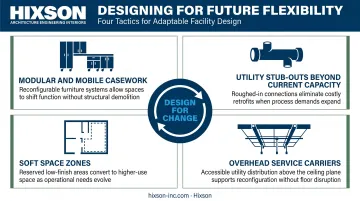
- Specify modular and mobile casework over fixed millwork wherever research workflows may evolve
- Install utility stub-outs beyond current capacity — extra gas, vacuum, and electrical rough-ins cost little at construction and a great deal after walls are closed
- Designate soft space zones with simplified finishes and flexible structural loading that can convert to new lab functions without full reconstruction
- Use overhead service carriers to keep utilities accessible and reconfigurable
The Yale Science Building, documented by Tradeline, put this directly into practice: generic flexible labs paired with highly specialized research spaces under one roof — built to serve research programs that didn't yet exist when the building was designed.
Frequently Asked Questions
What is an R&D laboratory?
An R&D laboratory is a purpose-built facility where researchers conduct experiments, develop prototypes, and test new products or processes. Unlike production or QC environments that follow fixed SOPs, R&D labs are built around exploratory workflows that must adapt as research progresses.
What is the best layout for a laboratory?
The best layout depends on the research type and safety requirements. Most modern R&D labs use a hybrid approach — open-plan benching for collaborative wet and dry work combined with enclosed rooms for processes requiring strict environmental control, containment, or BSL compliance.
What are the four types of laboratories?
The four common classifications are:
- Analytical/diagnostic labs
- Research and development labs
- Production/quality control labs
- Teaching labs
Each has distinct design requirements driven by workflow, regulatory environment, and the nature of the work performed.
What are the 7 steps of R&D?
The general stages are:
- Idea generation
- Research
- Development
- Prototyping
- Testing
- Refinement
- Scale-up or commercialization
A well-designed R&D lab supports each stage without requiring physical reconfiguration between them.
What does a research facility do?
A research facility provides controlled environments, specialized infrastructure, and dedicated resources for scientists and engineers to investigate hypotheses, develop new products or processes, and generate reproducible data that supports a company's innovation pipeline or advances a field.
How long does it take to design and build an R&D lab?
Timelines vary by scale and complexity. A small fit-out takes 3–6 months; a new-build specialized R&D facility typically requires 12–24 months from programming through commissioning. Engaging an integrated A&E firm early compresses the schedule. Tradeline data shows late change requests alone add an average of 14 weeks.