Introduction
Pharmaceutical companies plan to invest over $370 billion in U.S. manufacturing over the next five years — Merck's $3 billion Elkton, Virginia facility and AbbVie's $195 million API expansion in Chicago are just two examples. That pace reflects a broader surge: life sciences capital expenditures grew 13% annually from 2022 to 2024, with more than $150 billion in new projects slated for completion before 2030.
GMP facility construction costs vary widely based on facility type, production scale, cleanroom classification, geographic location, and whether the project is a new build, modular installation, or retrofit. A small clinical-stage pilot facility may cost $10M–$50M; a large-scale commercial biologics manufacturing plant can exceed $1 billion.
Those figures are not interchangeable. Understanding the variables that drive cost is essential to avoid underbudgeting, selecting the wrong facility configuration, and running into unexpected validation and commissioning costs mid-project.
This article covers cost ranges by facility tier, the key technical and regulatory drivers behind those ranges, a complete budget breakdown, build approach trade-offs, and common planning mistakes to avoid.
Summary
- Costs typically range from $10M–$50M for small clinical or pilot facilities to $200M–$1B+ for large-scale commercial biologics or advanced therapy manufacturing
- Primary cost drivers: cleanroom classification, sterility requirements, facility footprint, and local labor market conditions
- Lower end: clinical-stage companies, oral solid dose manufacturers, and modular facility users
- Higher end: commercial biologics, sterile injectable, and cell/gene therapy manufacturers
- Spending more is justified when regulatory requirements demand it (ISO 5 aseptic fill-finish) or when commercial volume supports purpose-built infrastructure
How Much Does It Cost to Build a GMP Facility?
GMP facility construction does not have a fixed price. Misunderstanding this leads to underbudgeting early, designing the wrong facility configuration for the product type, and facing unexpected validation and commissioning costs.
Costs vary significantly based on facility scale, product type, and regulatory complexity. The three tiers below reflect the most common investment ranges — from clinical-scale pilot facilities to large commercial operations.
Tier 1: Clinical-Scale or Pilot Facility ($10M–$50M)
This tier typically includes:
- Small cleanroom suites (100L–1,000L production capacity)
- Basic HVAC and environmental controls
- QC laboratory space
- Limited process automation
Typical use cases: Early-stage biotechs, Phase I/II clinical material production, pilot manufacturing runs, or companies entering GMP manufacturing for the first time with limited capital.
Tier 2: Commercial-Scale Small to Mid-Sized Facility ($50M–$200M)
This tier includes:
- Dedicated sterile fill-finish suites or oral solid dose commercial lines
- Validated HVAC with multiple cleanroom classifications
- Regulated utility systems (WFI, clean steam, CDA)
- Process equipment and full quality management infrastructure
The cost premium at this tier is substantial. Cushman & Wakefield's 2026 Life Sciences Fit Out Cost Guide reports an average fit-out cost of $741 per square foot across nine lab subtypes, with cGMP suites at the higher end of that range. For context, new cGMP biopharmaceutical space runs $500 to $1,400 per square foot — compared to roughly $70/SF for standard office space, that's a 7x to 20x premium.
Who builds at this tier: Established biotechs moving from clinical to commercial production, CDMOs adding a new product suite, or specialty pharma manufacturers at moderate commercial volumes.
Tier 3: Large-Scale Commercial or Advanced Therapy Facility ($200M–$1B+)
This tier includes:
- 10,000L+ bioreactor capacity or equivalent large-scale manufacturing
- Multiple ISO-classified cleanroom suites
- Highly automated filling and inspection lines
- Extensive validated utility systems and large-scale QC/QA operations
Cell and gene therapy facilities often command premium costs even at smaller footprints, driven by specialized containment and process requirements. That investment reflects a rapidly expanding market: the cell and gene therapy manufacturing sector is projected to grow from $19.3 billion in 2024 to $146.2 billion by 2032, which means facilities built today are expected to carry significant long-term production loads.
Best suited for: Large pharma companies, major CDMOs, vaccine manufacturers, and organizations with approved commercial products requiring significant production capacity.
Key Factors That Affect GMP Facility Construction Cost
GMP facility costs don't scale predictably. Technical requirements, regulatory classification, and geography all interact — and changing one variable can cascade through the entire project budget.
Facility Type and Drug Product Classification
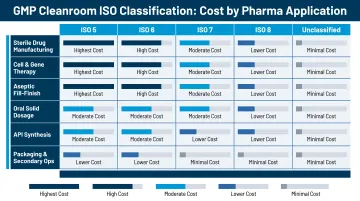
Sterile injectable and biological products require significantly more expensive cleanroom environments (ISO 5/7/8 classifications) than non-sterile oral solid dose products. This single variable can double or triple the cost per square foot.
Each product class carries distinct infrastructure demands:
- Small molecules (OSD): Basic controlled environments, lower air-change rates, simpler utility systems
- Biologics: Multiple cleanroom classifications, validated HVAC cascades, extensive utility infrastructure
- Advanced therapies (ATMP): Stringent Grade A/B requirements, specialized containment, autologous processing capabilities
Cleanroom Classification and HVAC/MEP Systems
HVAC and mechanical/electrical/plumbing systems in GMP facilities are far more complex than in standard manufacturing. They require precise pressure differentials, high air-change rates, validated temperature/humidity control, and separate utility systems (WFI, clean steam, compressed dry air, nitrogen).
HVAC systems represent 25% to 50% of cleanroom construction cost. An ISO 6 cleanroom requires HVAC capacity for more than double the air volume of an ISO 8 cleanroom — and adding temperature and humidity control increases HVAC costs by another 20–40%.
Cleanroom cost by ISO classification (fully installed):
| ISO Class | Cost Range ($/SF) | Typical Application |
|---|---|---|
| ISO 8 (Grade D) | $150–$250 | Non-sterile OSD, packaging |
| ISO 7 (Grade C) | $200–$400 | Formulation, weighing |
| ISO 6 (Grade B) | $300–$500 | Biologics support areas |
| ISO 5 (Grade A) | $400–$600+ | Sterile aseptic processing |
Facility Size and Production Capacity
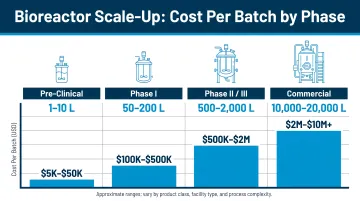
Increasing facility footprint and production scale raises costs non-linearly in GMP environments. Unlike standard manufacturing, larger GMP facilities require more extensive validation scope, more cleanroom volume to control, and more redundant utility capacity.
Manufacturing cost per batch scales non-linearly with bioreactor volume:
- Pre-clinical (500L, 2.5 g/L titer): $0.57M per batch
- Phase I/II (2,000L, 2.5 g/L titer): $1.36M per batch
- Phase III/Regulatory (6,000L, 5.0 g/L titer): $3.12M per batch
Geographic Location and Labor Market
Location affects both construction costs (material and labor rates vary significantly by market) and long-term operating costs (skilled GMP labor availability). Skilled labor wages in life sciences construction are rising 4% to 5% year-over-year, driven by persistent labor shortages and immigration policies.
Regional cost variation is significant: New York and San Francisco Bay Area command the highest construction costs, while Raleigh and Dallas remain among the lowest. Construction material costs rose 3.6% over 12 months through November 2025, the fastest rate since January 2023.
Automation and Equipment Specification
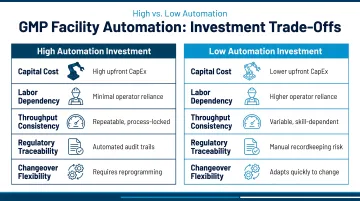
The level of process automation — from semi-manual filling operations to fully automated aseptic filling lines with automated visual inspection — has a direct and measurable effect on both upfront capital cost and long-term operating performance.
Highly automated facilities have:
- Higher upfront capital expenditures
- Lower ongoing labor costs
- Fewer human-error-related quality events
- Lower batch rejection rates and fewer FDA 483 observations
Full Cost Breakdown of a GMP Facility
Total GMP facility cost goes well beyond the construction contract itself. A complete budget must account for design, equipment, validation, and ongoing compliance.
Land, Site Preparation, and Civil Construction (One-Time)
Covers land acquisition, grading, structural shell, and general building systems. Life sciences warehouse shell/core construction costs $165 to $306 per square foot.
Architecture, Engineering, and Design Fees (One-Time)
Includes facility design across all disciplines: architecture, structural, mechanical, electrical, and process engineering. Typically 8–15% of total construction value.
GMP projects require design teams with validated design experience, not just standard A&E capability. Choosing a partner without deep GMP and pharmaceutical facility experience often leads to specification errors discovered during regulatory review, requiring expensive mid-project redesigns.
That risk is what makes integrated A&E selection so consequential. Firms like Hixson, which bring architecture, process engineering, HVAC/MEP, and GMP compliance expertise under one team, catch cost risks earlier, produce more accurate design-phase cost models, and generate fewer change orders during construction. Hixson has delivered pharma and biotech facilities for clients including Abbott Nutrition, Unither, and PETNET.
Cleanroom Fit-Out, HVAC, and Regulated Utilities (One-Time)
The most GMP-specific cost category. Covers cleanroom wall/ceiling/floor systems, full HVAC validation, WFI systems, clean steam generation, compressed gas systems, and environmental monitoring infrastructure. Often the single largest cost driver in pharmaceutical facilities.
Process Equipment Procurement, Installation, and Qualification (IQ/OQ/PQ) (One-Time)
Covers all manufacturing and laboratory equipment, installation labor, and formal qualification protocols (Installation Qualification, Operational Qualification, Performance Qualification) required for GMP compliance.
Equipment alone ranges from $5M to $100M+ depending on facility type. Qualification activities add substantial time and cost on top of equipment price. Life sciences project specialty equipment costs increased 30% to 50% from pre-pandemic levels.
Validation, Commissioning, and Regulatory Submissions (One-Time)
Covers facility commissioning activities, process validation studies, cleaning validation, and any regulatory filing or inspection costs associated with facility approval.
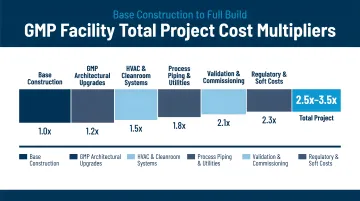
Commissioning and Qualification (C&Q) represents 5% to 10% of direct project costs as an industry standard. Best-in-class organizations using digital tools achieve 4% to 6%. When validation (IQ/OQ/PQ), equipment, and contingency are included, total project cost is typically 1.5x to 2x base construction cost.
Regulatory agencies (FDA, EMA) must inspect or accept the facility before commercial production can begin. This is one of the most underestimated budget lines.
Ongoing GMP Maintenance, Quality Systems, and Re-Validation (Recurring)
Includes annual facility maintenance to GMP standards, periodic re-validation of equipment and systems, QMS software and documentation infrastructure, internal and external audits, and staff training programs.
These recurring costs must be factored into the total cost of ownership model, not just the initial capital budget.
Build Approach: Purpose-Built vs. Modular vs. Retrofit
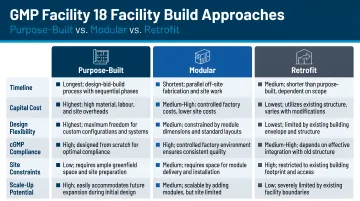
Beyond cost tier, the build approach itself is a major cost and timeline variable. The right choice depends on four factors: your development stage, available capital, speed-to-market pressure, and long-term production strategy.
Purpose-Built (Greenfield)
- Highest upfront capital investment
- Designed specifically for the product and process
- Fully scalable and engineered to regulatory standards from the ground up
- Typical construction timeline: 15 to 30 months from concept to commissioning for traditional stick-built cleanrooms
- Best for commercial-stage manufacturers with approved products and predictable long-term volume
Modular or Prefabricated GMP Platforms
- Lower initial capital cost (typically 20% to 30% less expensive than stick-built)
- Significantly faster deployment: 9 to 18 months from design start to final approval
- Flexible reconfiguration between campaigns
- Disposable component-based platforms can reduce utility infrastructure requirements
- Best for clinical-stage companies or those needing speed to market
- Trade-off: limited scalability and higher per-unit operating cost at commercial volumes
Retrofit of Existing Space
- Repurposing an existing industrial or manufacturing building into a GMP facility
- Appears least expensive upfront
- Technical complexity is high: MEP systems often require full replacement, structural changes may be needed for cleanroom loads, contamination history must be assessed
- Retrofit projects frequently encounter cost overruns of 3x to 5x more than integrating compliance from initial design
- Best for organizations with constrained capital and an existing building that meets basic structural and MEP upgrade thresholds
How to Estimate Your GMP Facility Budget (and What Most People Miss)
A realistic GMP facility budget must account for the full project lifecycle—not just the construction contract. Early, disciplined budget modeling aligned with regulatory requirements prevents costly surprises that derail projects mid-construction.
What's commonly underestimated:
- Validation and commissioning scope can equal 5–10% of total project cost and is often excluded from early capital estimates
- Impact of a 15–30 month construction timeline on project cash flow, financing costs, and time-to-revenue
What's overlooked in total cost of ownership:
- Ongoing annual GMP compliance costs—facility re-validation cycles, regulatory inspection readiness, QMS infrastructure, and environmental monitoring programs—can represent millions per year
- These must be factored into the business case alongside initial capital expenditures
A&E partner selection also shapes budget accuracy more than most owners anticipate. Choosing a partner without deep GMP experience often means specification errors surface during regulatory review—triggering expensive redesigns. An integrated A&E firm combining architecture, process engineering, HVAC/MEP, and GMP compliance expertise enables:
- Early identification of cost risks
- More accurate design-phase cost modeling
- Fewer change orders during construction
Hixson's multidisciplinary structure—spanning architecture, MEP engineering, process engineering, and controls & automation—is built around this model. Defining User Requirements Specifications (URS) early means temperature, humidity, air pressurization, and regulatory compliance requirements are locked into the design before construction begins, reducing costly revisions downstream.
Two projects illustrate the approach in practice. Hixson led a $400 million renovation and expansion at Abbott Nutrition's Tipp City, Ohio facility, adding a third aseptic processing line and expanding utilities, shipping, and employee spaces—work that helped Abbott earn Food Engineering's Food Plant of the Year. At Unither Pharmaceuticals' Rochester, NY site, Hixson transformed a 1950s-era building to house a new Blow, Fill, and Seal (BFS) manufacturing line with capacity reserved for future expansion.
Frequently Asked Questions
How much does it cost to build a GMP facility?
Total cost ranges from $10M for small clinical-scale facilities to $1B+ for large commercial biologics manufacturing plants. Costs vary widely based on facility type, cleanroom classification, production capacity, geographic location, and build approach. The cost factors section above covers these variables in detail.
How much does it cost to get GMP certified?
GMP "certification" is not a single fee — it covers validation activities, regulatory inspection preparation, and ongoing QMS infrastructure, typically representing 5–10% of direct project costs. Total compliance costs range from hundreds of thousands to several million dollars depending on facility type and target market.
How much does it cost to build a manufacturing facility?
Standard manufacturing construction costs $70–$200/SF for conventional industrial space. GMP pharmaceutical facilities cost $500–$1,400/SF due to cleanrooms, validated HVAC, regulated utilities, and extensive quality systems—a 7x to 20x premium over conventional manufacturing.
How much does it cost to build a lab?
Basic laboratories cost $200–$250/SF. GMP QC or microbiology labs within pharmaceutical facilities cost significantly more due to environmental monitoring, cleanroom interfaces, validated equipment, and regulatory compliance requirements. Expect costs in the $400–$700/SF range for GMP lab environments.
What are the requirements for a GMP facility?
Core requirements include defined cleanroom classifications, validated HVAC, regulated utilities (WFI, clean steam, CDA), documented SOPs and batch records, and a functional quality management system. Specific requirements vary by product type and target market — FDA, EMA, and WHO-GMP each carry distinct standards.
What is GMP in pharmaceutical manufacturing?
Good Manufacturing Practices (GMP) are the regulatory framework requiring pharmaceutical manufacturers to maintain consistent production quality, facility controls, documentation, and quality systems to ensure product safety and efficacy. Enforced by agencies such as the FDA (21 CFR Parts 210/211) and EMA (EudraLex Volume 4).