Introduction
Getting cGMP compliance wrong in a biologics facility doesn't just invite a Form 483 — it can halt production, trigger consent decrees, or delay a product that patients are waiting for. Unlike small-molecule drugs, biologics are derived from living systems: contamination risks are higher, batch variability is harder to control, and the manufacturing process itself is inseparable from the product quality.
That reality makes cGMP compliance for biologics more than a regulatory checkbox. It's a foundational engineering and operational challenge that starts with site selection and doesn't stop until the last batch ships.
This guide covers the governing regulations, the core compliance pillars under 21 CFR Part 211, the facility design requirements that directly determine inspection outcomes, and what FDA evaluates during pre-approval and surveillance inspections. Whether you're an engineer, quality leader, or facility planner, you'll find a practical reference here.
Key Takeaways
- Biologics cGMP is governed primarily by 21 CFR Parts 210, 211, and 600–680, enforced through FDA inspections
- Because living cell systems define product quality, the manufacturing process is the product — process changes can alter the biologic itself
- Cleanroom layout, HVAC, water systems, and material flow are permanent compliance decisions — design errors are expensive to correct post-construction
- FDA conducts pre-approval inspections (PAI) before BLA approval and surveillance inspections thereafter — both can delay or halt product release
- Inspection outcomes — NAI, VAI, or OAI — directly affect approval timelines, consent decrees, and your facility's ability to ship product
What Is cGMP and Why Does It Matter for Biologics?
Defining cGMP
cGMP regulations establish minimum quality standards for the methods, facilities, and controls used in manufacturing, processing, packing, or holding drugs — including biologics. The "current" in cGMP signals that standards must reflect current manufacturing science and technology — not a frozen historical snapshot.
Internationally, "GMP" refers to the broader concept enforced by agencies like WHO and EMA. FDA's cGMP is the U.S.-specific, legally enforceable version. The practical difference matters for manufacturers targeting multiple markets — FDA enforces through inspections without issuing a compliance certificate, while EMA issues GMP certificates following inspection.
Why Biologics Face Stricter Scrutiny
FDA describes biologics as generally derived from living material, complex in structure, and usually not fully characterizable by a single analytical method. Three regulatory consequences follow directly from that complexity:
- Product-related impurities may not be fully resolved by end-product testing alone
- Changes in manufacturing process, equipment, or facilities can change the biological product itself — potentially requiring additional clinical studies to demonstrate continued safety, identity, purity, and potency
- The clinically active component of a complex biologic may be difficult to fully identify, so the manufacturing process becomes part of the quality assurance strategy
Auditors pay close attention to every upstream processing step, not just finished product testing. A deviation in cell culture conditions or a cleaning failure in a bioreactor suite carries direct product quality implications — and potential regulatory consequences.
The Stakes of cGMP Failures
Novartis Gene Therapies received an FDA Form 483 following a January 2024 inspection — a reminder that even well-resourced manufacturers face compliance findings. cGMP breakdowns in biologics manufacturing have caused batch failures, product recalls, and documented patient harm.
The Regulatory Framework: Key CFR Parts for Biologics Facilities
Biologics manufacturers must navigate a layered regulatory structure. At the federal level, FDA's Center for Biologics Evaluation and Research (CBER) and Center for Drug Evaluation and Research (CDER) share oversight depending on product type. Biologics require a Biologics License Application (BLA) — not a standard NDA — and BLA approval requires inspection of establishments listed in the application.
Key Regulations at a Glance
| Regulation | Scope |
|---|---|
| 21 CFR Part 210 | Minimum cGMP definitions and applicability for all drugs |
| 21 CFR Part 211 | Finished pharmaceuticals: buildings, equipment, personnel, records |
| 21 CFR Parts 600–680 | Biologics-specific standards: establishment requirements, licensing, deviation reporting |
| 21 CFR Part 606 | cGMP for blood and blood components |
| 21 CFR Part 820 | Quality Management System Regulation (QMSR) for devices; relevant for combination products. FDA's final QMSR rule (Jan. 31, 2024) became effective Feb. 2, 2026 and incorporates ISO 13485:2016 |
| ICH Q7, Q8, Q9, Q10 | FDA-adopted guidelines on GMP for APIs, pharmaceutical development, quality risk management, and quality systems |
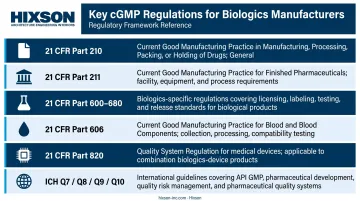
For biological product deviations, 21 CFR Part 600.14 sets a specific requirement: manufacturers must report a deviation to FDA no later than 45 calendar days after acquiring information suggesting a reportable event that may affect safety, purity, or potency of a distributed product. That 45-day clock has direct implications for how facilities design their deviation tracking and documentation workflows — which is where regulatory requirements begin shaping facility design decisions.
cGMP vs. GMP: International Considerations
Manufacturers targeting both U.S. and EU markets face a design challenge: FDA and EMA requirements are similar but not identical. FDA enforces cGMP through inspections — compliance is the manufacturer's responsibility, and no certificate is issued. EMA issues GMP certificates after inspection and maintains the EudraGMDP database.
FDA and EMA have Mutual Recognition Agreement (MRA) arrangements that allow reliance on each other's inspection findings for certain products. Facilities designed to satisfy both agencies should build dual-market documentation requirements into schematic design — not address them as a late-stage correction during construction documentation.
The Core Pillars of cGMP for Biologics Facilities
21 CFR Part 211 organizes cGMP requirements into distinct subparts — each one translates directly into facility design, staffing, and procedural obligations. These are the areas auditors evaluate.
Personnel and Organization (Subpart B)
Under Subpart B, manufacturers must:
- Designate a quality control unit with authority independent from production
- Employ personnel with appropriate education and training for their specific roles
- Document all training activities
For biologics, personnel competencies extend beyond standard pharmaceutical requirements. Aseptic technique, contamination control, and biosafety awareness are required for all personnel with access to classified spaces.
Buildings and Facilities (Subpart C)
Facilities must be designed, constructed, and maintained to allow orderly processing and prevent contamination and mix-ups. For biologics, this means:
- Defined clean and controlled areas with documented classification rationale
- Segregation of incompatible operations (for example, separating different organisms or product streams)
- Controlled environmental conditions with continuous monitoring
- Appropriate drainage and sanitation systems
Poor facility design decisions made early in a project become recurring compliance burdens. Retrofitting classified spaces or segregated process flows after construction is both costly and operationally disruptive.
Equipment (Subpart D)
Equipment must be appropriately sized, cleanable, and maintained per written schedules. For biologics, this extends to:
- Fermenters, bioreactors, and cell culture systems
- Chromatography and ultrafiltration/diafiltration equipment
- Fill-finish lines and lyophilizers
All equipment requires Installation Qualification, Operational Qualification, and Performance Qualification (IQ/OQ/PQ) before commercial use. Facility and utility design must be planned with validation protocols in mind from the start.
Production and Process Controls (Subpart F)
All production operations must follow written procedures. Required documentation includes yields, in-process sampling results, time limits on processing steps, and controls for microbiological contamination.
For biologics, process validation is critical. Living cell systems are process-dependent — the product quality attributes emerge from the process itself. This is why FDA's process validation guidance defines a three-stage lifecycle:
- Stage 1 – Process Design: Capture knowledge from development to define commercial manufacturing
- Stage 2 – Process Qualification: Confirm the process design can be reproduced at commercial scale
- Stage 3 – Continued Process Verification: Ongoing assurance that the process remains in a state of control
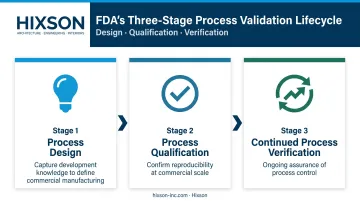
For biologics, this validation lifecycle extends across cell banking, fermentation, purification, and fill-finish — each requiring documented protocols and acceptance criteria before commercial distribution.
Laboratory Controls and Records (Subparts I and J)
Once product leaves the production floor, laboratory and records requirements take over. Subpart I addresses stability testing, reference standards, and out-of-specification (OOS) investigations. Subpart J governs the documentation trail: master batch records, equipment logs, distribution records, and complaint files.
Together, these subparts define the core of a facility's data integrity posture — and both are closely scrutinized during inspections.
Under 21 CFR Part 600, biologics manufacturers have additional obligations: biological product deviation reporting to FDA and retention of samples from each lot.
Facility Design and Engineering Requirements Under cGMP
The physical facility is the compliance foundation. Design decisions made during programming and schematic design ripple through construction, qualification, and every inspection thereafter.
Hixson's integrated A&E approach embeds cGMP requirements into facility systems from day one — with architecture, mechanical, electrical, plumbing, process engineering, and controls disciplines coordinated under one roof throughout design. That early alignment is what keeps compliance from becoming a retrofit problem during qualification.
Cleanroom Classification and Environmental Controls
Biologics manufacturing typically requires ISO-classified cleanrooms for aseptic processing and fill-finish. FDA's aseptic processing guidance designates the critical area as ISO 5 — the zone where sterile product, containers, and closures are exposed. Background areas are classified at ISO 7 or ISO 8 depending on activity.
EU GMP Annex 1 aligns these classifications to Grades A through D, with defined particle limits:
| Grade | ≥0.5 µm particles/m³ at rest | In operation |
|---|---|---|
| A (ISO 5) | 3,520 | 3,520 |
| B | 3,520 | 352,000 |
| C | 352,000 | 3,520,000 |
| D | 3,520,000 | Not predefined |
Classification must be validated and monitored continuously — not just confirmed at commissioning.
HVAC Design for Contamination Control
HVAC is one of the most inspection-scrutinized facility systems in biologics manufacturing. Key design elements include:
- HEPA filtration with unidirectional airflow in critical zones
- Pressure differentials between adjacent areas of different classification (FDA guidance references approximately 10–15 Pa between zones)
- Positive pressure to protect product in aseptic areas; negative pressure to contain potent compounds or live biological organisms
- Temperature and humidity control within validated ranges
- Continuous environmental monitoring infrastructure built into the design — not added later
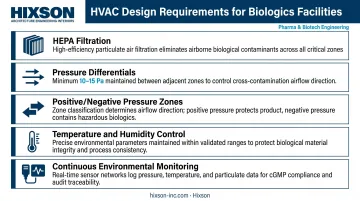
HVAC scope for biologics facilities must address both contamination control and biosafety containment — requirements that frequently conflict and require deliberate design coordination across mechanical, process, and architectural disciplines.
Water Systems: WFI, Purified Water, and Clean Steam
Three water grades are required in biologics facilities:
- Water for Injection (WFI): Direct product contact, formulation, and final rinses. USP WFI may be produced by distillation or reverse osmosis
- Purified Water (PW): Equipment cleaning and non-critical applications
- Clean Steam: Sterilization of equipment and systems that contact product
Loop design — including material selection, slope, drainage points, and dead-leg elimination — affects your ability to maintain microbial control and pass validation. Monitoring requirements for each water system need to be designed into the infrastructure from the start — sizing piping chases, locating sample ports, and specifying instrumentation during design rather than during construction or qualification.
Material and Personnel Flow
Unidirectional, logical flow for materials, personnel, and waste is a cGMP requirement that shows up in architectural layout decisions. The design must prevent cross-contamination between:
- Different product grades or organisms
- Processing stages (upstream vs. downstream)
- Clean and less-clean areas
The physical tools — airlocks, gowning rooms, pass-throughs, and segregated corridors — are architectural solutions to these regulatory requirements. When personnel or materials can inadvertently bypass gowning sequences or move against the contamination gradient, inspectors treat it as a design deficiency — one that procedural controls alone cannot resolve.
Quality Systems, Documentation, and FDA Inspections
Quality Management System Requirements
A robust QMS encompasses:
- SOPs covering all production, cleaning, and laboratory operations
- Change control for any modification to process, equipment, or facility
- Deviation management with root cause investigation
- CAPA (Corrective and Preventive Action) systems with verified effectiveness checks
- Supplier qualification for raw materials and critical components
- Biological product deviation reporting to FDA under 21 CFR Part 600.14
Automation is now central to biologics QMS. Manufacturing execution systems (MES), electronic batch records, and process control systems must comply with 21 CFR Part 11 — covering electronic records and signatures — to be audit-ready.
That means validated systems with secure audit trails, authority checks, and access controls. Hixson's Controls & Automation team builds Part 11 compliance into facility automation from the design phase, which reduces data integrity findings before inspections happen — not after.
FDA Inspection Types and Outcomes
Those documentation systems become the foundation inspectors examine. FDA conducts two primary inspection types for biologics manufacturers:
- Pre-Approval Inspections (PAI): Conducted before BLA approval to verify manufacturing readiness and cGMP compliance
- Surveillance Inspections: Periodic inspections using a risk-based site selection model to prioritize facilities by risk profile
Inspection outcomes are classified as:
- NAI (No Action Indicated): No objectionable conditions found
- VAI (Voluntary Action Indicated): Objectionable conditions found, but FDA is not prepared to recommend regulatory action
- OAI (Official Action Indicated): Regulatory or administrative actions are indicated
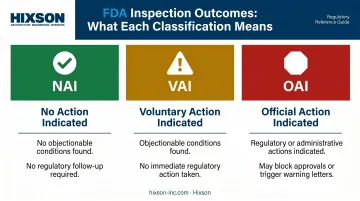
OAI findings carry serious commercial consequences — they can block product approvals, trigger import alerts, or result in warning letters. Manufacturers should conduct internal mock audits and gap analyses against current Form 483 observation trends before inspections, not after.
Establishment Registration and Reporting Obligations
All biologics manufacturing facilities must:
- Register electronically with FDA and list products annually
- Report permanent discontinuance or interruption in manufacturing under Section 506C of the FD&C Act (supporting drug shortage prevention)
- For blood and blood products specifically, comply with 21 CFR Part 607 registration requirements — including initial registration within 5 days of starting operations or BLA submission
Frequently Asked Questions
What are the current Good Manufacturing Practice (cGMP) requirements for biologics facilities?
cGMP requirements for biologics are governed by 21 CFR Parts 210, 211, and 600–680, covering facility design, personnel qualifications, equipment, production controls, laboratory controls, and records. FDA enforces compliance through pre-approval inspections before BLA approval and surveillance inspections thereafter.
What are the core pillars of Good Manufacturing Practices (GMP) for biologics facilities?
The core pillars are qualified personnel, appropriate facilities, validated equipment, controlled production operations, robust laboratory controls, and complete recordkeeping. Together, they safeguard product safety, identity, strength, quality, and purity — and a gap in any one pillar puts the others at risk.
What is the difference between cGMP and GMP in the context of biologics?
GMP refers to the international standard concept used by WHO, EMA, and other agencies. cGMP is FDA's U.S.-specific term, with "current" emphasizing that standards must reflect up-to-date science and technology. FDA's cGMP regulations are legally enforceable and compliance is verified through facility inspections; FDA issues no compliance certificate — only inspection outcomes.
Which CFR regulations apply specifically to biologics manufacturing?
Biologics must comply with 21 CFR Parts 210 and 211 (general and finished pharmaceutical cGMP) plus Parts 600–680 (biologics-specific requirements). Depending on product classification, Parts 606 or 820 may also apply — for blood components and combination products, respectively.
What facility design elements are most critical for cGMP compliance in biologics manufacturing?
The most consequential design elements are cleanroom classification and HVAC design, Water for Injection systems, unidirectional personnel and material flow, and validated equipment. Decisions made during facility planning are hard to reverse — and costly when they need to be.
How does FDA conduct inspections of biologics manufacturing facilities?
FDA conducts pre-approval inspections before BLA approval and routine surveillance inspections using a risk-based prioritization model. Inspectors evaluate cGMP compliance across all facility systems, with outcomes classified as NAI, VAI, or OAI. An OAI (Official Action Indicated) finding can trigger regulatory action and halt commercial manufacturing.