Introduction
Combustible dust kills people, and the incident record is unambiguous. According to the U.S. Chemical Safety and Hazard Investigation Board's 2006 multi-decade study, 281 combustible dust incidents killed 119 workers and injured 718 more across general industry between 1980 and 2005. A subsequent CSB update covering 2006–2017 added 105 more incidents, 59 fatalities, and 303 injuries — and the CSB acknowledges that count is incomplete.
Despite this record, many facilities across food and beverage, pharmaceuticals, wood processing, and metals manufacturing remain underprepared when OSHA arrives. That's a significant exposure given the National Emphasis Program (NEP) drives roughly 600 targeted inspections per year.
This guide covers:
- What combustible dust is and which materials qualify
- How OSHA's regulatory framework applies across industries
- What the 2023 NEP revision means for your facility
- What a Dust Hazard Analysis requires
- How to build a compliance program that holds up to scrutiny
Key Takeaways
- The CSB documented 400+ combustible dust incidents across two study periods — making it one of the most persistent hazards in industrial facilities
- OSHA enforces combustible dust compliance through a patchwork of 29 CFR 1910 standards plus the General Duty Clause, with no single unified standard covering all scenarios
- The 2023 NEP (CPL 03-00-008) added commercial bakeries, truss manufacturing, and other industries to OSHA's inspection targeting list
- A Dust Hazard Analysis is required under NFPA 660 and is one of the first things inspectors look for
- Engineering controls built into facility design are far cheaper than post-construction retrofits
What Is Combustible Dust and Why Is It So Dangerous?
The Definition and the Science
OSHA and NFPA align on the core definition: combustible dust is a finely divided combustible particulate solid that presents a flash-fire or explosion hazard when suspended in air. Particle size matters — OSHA's interpretation flags particles 420 microns or smaller as the historic threshold, while newer voluntary standards use 500 microns.
Material type alone doesn't determine risk. Aluminum, for example, is non-combustible in bulk form but explosible as fine dust.
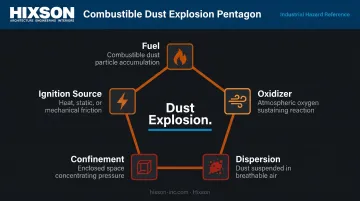
The hazard mechanism goes beyond ordinary fire. Where a standard fire requires three elements (fuel, oxygen, ignition), a dust explosion requires five simultaneous conditions — often called the Dust Explosion Pentagon:
- Fuel — the combustible dust itself
- Oxidizer — ambient air
- Dispersion — dust suspended in air at sufficient concentration
- Confinement — an enclosed space that allows pressure to build
- Ignition source — a spark, hot surface, or static discharge
Remove any one condition and the explosion cannot occur. In most active production facilities, all five conditions coexist routinely — which is why facility design and dust control are the first line of defense, not the last.
Why Secondary Explosions Are the Real Killer
The initial explosion is rarely the worst event. When a primary blast disperses accumulated settled dust from overhead surfaces, beams, and ledges, the resulting airborne cloud can ignite within seconds. CSB investigations consistently find that secondary explosions cause most of the casualties and structural damage — the 2008 Imperial Sugar refinery explosion, which killed 14 workers, followed exactly this pattern. Controlling settled dust accumulation isn't a housekeeping preference; it's a core compliance requirement under OSHA's combustible dust enforcement framework.
Common Combustible Materials by Industry
| Industry | Representative Combustible Dusts |
|---|---|
| Food & Beverage | Flour, sugar, starch, spices, dried dairy, dried blood |
| Pharmaceuticals | Active pharmaceutical ingredients, excipient powders |
| Metals | Aluminum, magnesium, titanium, zinc |
| Wood & Lumber | Wood flour, sawdust, sanding dust |
| Plastics & Rubber | Resin powders, rubber dust |
| Agriculture | Grain dust, feed ingredients |
OSHA's Regulatory Framework: Standards That Apply
The Patchwork Problem
OSHA has no single, standalone combustible dust standard. Compliance is built from multiple 29 CFR 1910 provisions, each addressing a specific dimension of the hazard:
- 1910.22 — General housekeeping and walking-working surfaces
- 1910.94 — Ventilation, including dust hazards in abrasive operations
- 1910.146 — Permit-required confined spaces (combustible dust at or above LFL is a recognized hazardous atmosphere)
- 1910.307 — Electrical equipment in hazardous classified locations
- 1910.1200 — Hazard communication and combustible dust classification
- 1910.272 — Grain handling facilities (specific standard)
- 1910.263 — Bakery equipment, including flour dust controls
- 1910.265 — Sawmills and wood dust collection
Facilities in states with their own OSHA-approved State Plans should verify whether additional or more stringent requirements apply.
The General Duty Clause as OSHA's Primary Tool
When no specific standard directly addresses a condition, OSHA cites Section 5(a)(1) of the OSH Act — the General Duty Clause — which requires employers to maintain a workplace "free from recognized hazards" likely to cause death or serious harm.
OSHA commonly applies the General Duty Clause to scenarios such as:
- Dust collectors located inside buildings without explosion protection
- Non-metallic or ungrounded ductwork
- Filtered exhaust air returned inside an occupied building without propagation protection
- Inadequate or absent deflagration venting
NFPA Standards and Their Enforcement Role
That General Duty Clause exposure is where NFPA standards become enforcement tools. OSHA increasingly cites them as evidence that a hazard is "recognized" — making NFPA compliance a practical necessity even though the standards carry no independent legal weight.
The key standard is NFPA 660, Standard for Combustible Dusts and Particulate Solids (2025 edition) — a consolidated document that replaced NFPA 61, 484, 652, 654, 655, and 664. If your facility was following NFPA 652 or 654, NFPA 660 is now the governing reference.
Two companion standards govern specific protection methods:
- NFPA 68 — Explosion protection by deflagration venting
- NFPA 69 — Explosion prevention systems
The Authority Having Jurisdiction (AHJ) — fire marshal, building official, or insurance carrier — enforces NFPA standards locally. AHJ interpretations determine how your facility is permitted and inspected. Confirm their position on key requirements before design decisions are finalized.
The OSHA National Emphasis Program (NEP) for Combustible Dust
What the NEP Is and How It Works
The Combustible Dust NEP (CPL 03-00-008), effective January 30, 2023, directs OSHA compliance officers to prioritize inspections at facilities with known or likely combustible dust hazards. OSHA has conducted approximately 600 inspections per year under this program since its inception in 2007. The 2023 directive replaced a version that had been in effect since 2008.
What Changed in the 2023 Revision
The 2023 update refined the industry targeting list based on violation data and incident patterns, including OSHA's finding that wood and food products were involved in an average 70% of combustible dust fires and explosions in 2018. Six industries were added while two were removed.
Industries added to the NEP targeting list:
- Commercial Bakeries (NAICS 311812)
- Printing Ink Manufacturing (325910)
- Cut Stock, Resawing Lumber, and Planing (321912)
- Leather and Hide Tanning and Finishing (316110)
- Truss Manufacturing (321214)
- Grain and Field Bean Merchant Wholesalers (424510)
Fossil Fuel Electric Power Generation and Cookie and Cracker Manufacturing were removed due to lower violation rates.
What Inspectors Look for During an NEP Inspection
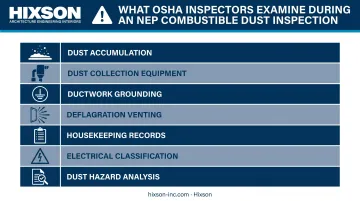
Understanding what triggers citations helps facilities prepare before an inspector arrives. During an NEP inspection, compliance officers typically examine:
- Dust accumulation on surfaces, overhead structures, and equipment
- Design, condition, and placement of dust collection equipment
- Ductwork material (metallic vs. non-metallic) and grounding continuity
- Adequacy of deflagration venting on collectors and connected equipment
- Housekeeping records and written cleaning procedures
- Electrical area classification documentation
- Whether a current, documented Dust Hazard Analysis exists
Findings can result in citations under specific standards, the General Duty Clause, or both.
Dust Hazard Analysis: The Foundation of Compliance
What a DHA Is and Why It's Required
A Dust Hazard Analysis is a systematic review identifying and evaluating potential fire, flash fire, and explosion hazards associated with combustible particulate solids throughout a facility's processes, equipment, and spaces. NFPA 660 requires a documented DHA for all facilities handling combustible dust — and an outdated or absent DHA is one of the most common gaps OSHA inspectors find.
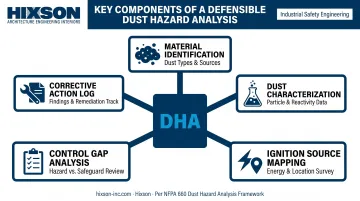
Key Components of a Defensible DHA
A defensible DHA addresses:
- Material identification — all combustible dust-generating processes and materials in the facility
- Dust characterization — particle size, deflagration index (Kst), maximum explosion pressure (Pmax), minimum explosive concentration (MEC), and minimum ignition energy (MIE)
- Ignition source mapping — locations throughout the facility where ignition could occur
- Control gap analysis — evaluation of existing safeguards against current standards
- Corrective action log — documented findings with assigned timelines for remediation
Laboratory testing often supports the DHA by establishing a material's actual explosive properties. An MIE of 30 millijoules or less indicates a dust sensitive enough to be ignited by human electrostatic discharge — a fact that directly determines grounding requirements and personal protective measures.
DHA Frequency and Common Gaps
NFPA 660 requires DHA review whenever processes, materials, or equipment change significantly. Industry guidance commonly references a five-year review cycle as a baseline. Facilities that have never conducted a DHA, or whose DHA predates significant process changes, face the highest citation risk.
Closing those gaps requires more than a checklist — it requires connecting hazard findings to engineering action. Hixson's process engineering team, led by Warren Green, P.E., Manager of Process Engineering, conducts safety and dust evaluations including DHA support, PSM/HAZOP analyses, and Layer of Protection Analysis (LOPA) for food and beverage, pharmaceutical, and cGMP facilities. This integrated approach allows DHA findings to drive engineering solutions rather than purely operational workarounds.
Engineering Controls and Prevention Strategies
Dust Collection System Design
A compliant dust collection system is more than a filter on a duct. Key design requirements include:
- Metallic ductwork with proper bonding and grounding to prevent static accumulation
- Transport velocity maintained throughout the system to prevent dust settling inside ducts
- Collector placement outside the building wherever feasible — OSHA requires this for metal dust collectors specifically; indoor non-metal collectors require recognized explosion protection such as venting to a safe outdoor location
- Explosion venting or suppression devices on all collectors
- No return of dust-laden air back into occupied spaces without adequate propagation protection
Spark detection and suppression systems, explosion isolation devices (rotary valves or chemical isolation systems), and anti-static grounding for conductive materials are additional controls that prevent flame propagation between connected equipment.
Hixson integrates dust collection design into the broader facility design process — coordinating ductwork layout, grounding specifications, collector placement, and explosion protection — for food and beverage, powder handling, spray drying, and pharmaceutical facilities.
Hazardous Area Electrical Classification
Under OSHA 1910.307 and NEC definitions, combustible dust environments require Class II electrical classification, not Class I (which applies to flammable gases and vapors):
- Class II, Division 1 — combustible dust is present in suspension under normal operating conditions in explosive or ignitable quantities
- Class II, Division 2 — dust is not normally suspended in ignitable quantities, but accumulations can interfere with heat dissipation or become suspended under abnormal conditions
This classification determines which electrical equipment — motors, lighting, control panels, wiring methods — is permitted in each zone. At Hixson, Kyle McAllister's Electrical Engineering team handles hazardous area classification as a defined discipline on combustible dust projects, covering equipment selection through wiring method specifications for each zone.
Housekeeping: The Control That Requires Ongoing Commitment
Engineering controls address design-phase risk — but housekeeping addresses the risk that accumulates every shift. OSHA's benchmark is direct: dust accumulation of 1/32 inch over at least 5% of a room's floor area is considered a hazardous condition that could fuel a catastrophic secondary explosion.
Effective housekeeping practices include:
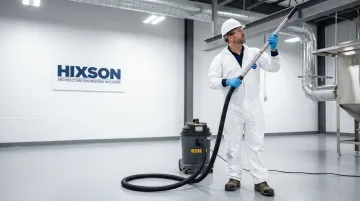
- Using vacuum systems rated for Class II locations — not compressed air, which disperses dust into suspension
- Establishing written cleaning frequency schedules for each zone
- Documenting all cleaning activities with dates and signatures
- Including overhead surfaces, beams, and ledge areas, not just floor-level accumulation
Building a Compliance Program That Holds Up to Inspection
Documentation OSHA Inspectors Request Immediately
When an OSHA compliance officer arrives, they typically request records within the first hour. Have these ready:
- Current DHA with corrective action log showing resolved and open items
- Written housekeeping procedures with cleaning frequency schedules
- Employee training records specific to combustible dust hazards
- Equipment inspection and maintenance logs for dust collection systems
- Emergency action plan per 29 CFR 1910.38
Responding to an OSHA Citation
If a citation is issued:
- Post it at or near the violation location for at least three working days, or until corrected — whichever is longer (29 CFR 1903.16)
- Develop an abatement plan with realistic, documented timelines
- Document every corrective action with photos, equipment records, and training logs
- Notify OSHA within the required timeframe
Demonstrating good-faith progress matters, even when full remediation takes months. Current OSHA penalties (effective January 15, 2025) reach $16,550 per serious violation and $165,514 for willful or repeated violations. Beyond fines, facilities face operational shutdowns, litigation exposure, and the human cost of a preventable incident.
Integrating Combustible Dust Controls from Day One
Designing compliance in from the start costs significantly less than retrofitting it later. Facilities that address combustible dust during the design or expansion phase avoid the expensive cycle of post-construction remediation — new ductwork routing, relocated collectors, electrical panel replacements, and added suppression systems.
Hixson's integrated team addresses combustible dust requirements across every relevant discipline during design: process engineering, electrical engineering (including hazardous area classification), and fire protection engineering covering deflagration venting and suppression systems.
Construction administrators then verify during site visits that dust collectors, ductwork grounding, and explosion protection devices are installed per specifications. This cross-discipline coordination — handled within a single firm — reduces both compliance risk and the likelihood of costly surprises during an NEP inspection.
Frequently Asked Questions
What is the new standard for combustible dust?
NFPA 660, Standard for Combustible Dusts and Particulate Solids (2025 edition), is the consolidated standard that replaced NFPA 61, 484, 652, 654, 655, and 664. While it's not federal law, OSHA references it when evaluating combustible dust hazards under the General Duty Clause.
What is the OSHA National Emphasis Program for combustible dust?
The NEP is a directive instructing OSHA compliance officers to prioritize inspections at facilities likely to have combustible dust hazards. The current version (CPL 03-00-008) took effect January 30, 2023, and targets specific industries with elevated explosion risk, including commercial bakeries, truss manufacturers, and grain wholesalers.
What is considered combustible dust?
Combustible dust is any finely divided combustible particulate solid that presents a flash-fire or explosion hazard when suspended in air. Common examples include wheat flour and dried milk in food facilities, aluminum or titanium dust in metals operations, and wood flour in sawmills.
Is combustible dust a Class I hazard?
No. Combustible dust is classified as Class II under the NEC and OSHA 1910.307. Class I applies to flammable gases and vapors. Class II, Division 1 covers locations where combustible dust is suspended in air in ignitable quantities under normal operating conditions.
What are the penalties for OSHA combustible dust violations?
As of January 15, 2025, serious violations carry a maximum penalty of $16,550; willful or repeated violations can reach $165,514. Facilities may also face shutdown orders and litigation costs on top of those fines.
How often is a Dust Hazard Analysis required?
NFPA 660 requires DHA review whenever processes, materials, or equipment change significantly. Most facilities use five years as a standard review cycle. Facilities that have never conducted a DHA must complete one — its absence is among the most common findings during NEP inspections.