Key Takeaways
- PSM in pharma covers facility-wide hazards: flammable solvents, energetic reactions, HPAPIs, and combustible dusts — not just PPE.
- OSHA 29 CFR 1910.119 applies at threshold quantities; most pharma solvents trigger coverage through the 10,000 lb flammable-liquid rule.
- Dual compliance is unavoidable — OSHA PSM and FDA GMP overlap directly in change control, equipment integrity, and operating procedures.
- Building PSM into facility design costs far less than retrofitting — area classification, HVAC, and explosion venting must reflect hazard findings before construction starts.
What Makes Pharmaceutical PSM Different
Pharmaceutical manufacturing doesn't fit neatly into the PSM frameworks written for petrochemical refineries or ammonia plants. The hazard profile is broader and more varied than most traditional PSM frameworks anticipate.
A single API synthesis route can involve flammable solvents, reactive intermediates, high-pressure reactors, and potent compounds — sometimes within the same unit operation. That combination puts pharma facilities in a different risk category than a single-commodity chemical plant, where the hazards are better defined and more uniform.
What further complicates pharmaceutical PSM is the dual regulatory environment. Facilities must satisfy OSHA PSM requirements (29 CFR 1910.119) while simultaneously meeting FDA cGMP standards — two frameworks with overlapping but not identical goals. OSHA focuses on catastrophic release prevention; FDA focuses on product quality and contamination control. Designing a facility that satisfies both without creating operational conflicts requires deliberate, coordinated engineering from the start.
Key hazard categories that distinguish pharma PSM from conventional chemical processing include:
- Flammable solvent inventories used in synthesis, extraction, and purification steps
- Reactive chemistry including exothermic reactions, peroxide-forming compounds, and unstable intermediates
- Highly potent active pharmaceutical ingredients (HPAPIs) requiring containment at the operator exposure level
- Cryogenic systems for low-temperature synthesis or storage
- Dust explosion risk from dry milling, granulation, and powder handling operations
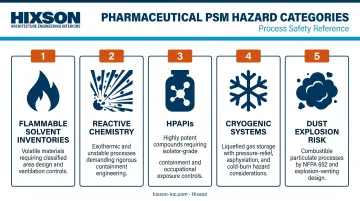
Each of these hazards demands a different engineering response — and many pharmaceutical facilities manage several of them simultaneously across a single production floor.