Introduction
Picture a food processing facility where every hazard — from a slippery floor to a high-pressure ammonia refrigeration system — receives the same level of documentation, review, and response. The safety team spends equal time on paperwork for a minor housekeeping issue and a potential ammonia release. Meanwhile, the genuinely catastrophic risks get the same thin layer of protection as the routine ones.
Risk-Based Process Safety Management (RBPS) exists precisely to address this gap. Not all hazards carry the same consequences, and treating them as if they do wastes resources while leaving the highest-risk processes dangerously under-protected.
Developed by the Center for Chemical Process Safety (CCPS), a technical entity of the American Institute of Chemical Engineers (AIChE), RBPS emerged after decades of OSHA PSM implementation revealed a persistent problem: regulations existed, but the systems applying them lacked both depth and prioritization.
This guide covers:
- What RBPS is and how it differs from traditional compliance-driven PSM
- How RBPS compares to OSHA's PSM standard
- The 4 pillars and 20 elements of the CCPS framework
- Practical implementation steps for existing facilities
- Specific considerations for food & beverage and pharmaceutical operations
Key Takeaways
- RBPS is a CCPS/AIChE framework that builds on OSHA's 14-element PSM standard with 20 elements organized under 4 pillars
- Core philosophy: allocate safety resources proportionally to the magnitude of each hazard — not uniformly
- The 4 pillars are: Commit to Process Safety, Understand Hazards and Risk, Manage Risk, and Learn from Experience
- Implementation is continuous, cycling through gap assessment, hazard analysis, controls, and management review
- RBPS applies beyond mandatory OSHA PSM thresholds, including food & beverage and pharma facilities handling significant process hazards
What Is Risk-Based Process Safety Management?
RBPS is a systematic management framework developed by CCPS/AIChE for identifying, evaluating, and controlling process safety risks — with resource allocation tied directly to risk magnitude. The term "risk-based" is the critical differentiator: controls and management effort scale with the actual severity and likelihood of each hazard, not with a one-size-fits-all standard.
Why RBPS Was Developed
OSHA's PSM standard (29 CFR 1910.119) took effect in May 1992. Despite widespread adoption, catastrophic incidents continued. The CSB's investigations documented cases that illustrated the gap between regulatory compliance and genuine safety performance:
- BP Texas City refinery (2005): 15 killed, 180 injured
- Imperial Sugar dust explosion (2008): 14 deaths, 38 injuries
- West Pharmaceutical dust explosion (2003): 6 deaths, dozens injured
CCPS responded with the Guidelines for Risk Based Process Safety, published in 2007 — a revised framework built on two decades of accumulated PSM lessons.
Who RBPS Applies To
OSHA PSM is mandatory for facilities handling specific highly hazardous chemicals above threshold quantities. RBPS is voluntary but applies to any organization managing hazardous processes — including those that fall below OSHA thresholds.
Industries with strong reasons to adopt RBPS include:
- Food & beverage plants — combustible dust, ammonia refrigeration, and CIP chemical hazards
- Pharmaceutical manufacturers — flammable solvents, reactive chemistries, and high-potency compounds
- Industrial manufacturers — pressurized systems, toxic releases, and thermal runaway risks
- Facilities below OSHA thresholds — where voluntary adoption closes the gap between compliance and actual risk control
RBPS vs. OSHA's PSM: Understanding the Difference
OSHA PSM (29 CFR 1910.119)
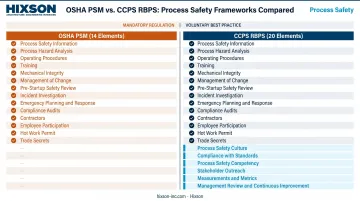
OSHA's standard applies to processes involving listed highly hazardous chemicals above specified threshold quantities — for example, anhydrous ammonia at or above 10,000 lb. It contains 14 interdependent elements:
| OSHA PSM Element | OSHA PSM Element |
|---|---|
| Employee Participation | Mechanical Integrity |
| Process Safety Information | Hot Work Permit |
| Process Hazard Analysis | Management of Change |
| Operating Procedures | Incident Investigation |
| Training | Emergency Planning & Response |
| Contractors | Compliance Audits |
| Pre-startup Safety Review | Trade Secrets |
Non-compliance carries significant consequences — OSHA's maximum penalties as of January 2025 reach $165,514 per willful or repeated violation.
How RBPS Expands on PSM
CCPS RBPS retains all 14 foundational PSM elements and adds six that OSHA's standard doesn't explicitly define:
- Process Safety Culture
- Compliance with Standards
- Process Safety Competency
- Stakeholder Outreach
- Measurements and Metrics
- Management Review and Continuous Improvement
All 20 elements are reorganized under 4 pillars, shifting the focus from minimum compliance to ongoing performance improvement.
The EPA's Role
Both OSHA PSM and EPA's Risk Management Program (40 CFR Part 68) apply above specific thresholds. But the EPA's General Duty Clause (Clean Air Act Section 112(r)(1)) applies — requiring all facilities handling hazardous substances to take reasonable steps to prevent accidental releases, regardless of whether they meet RMP threshold quantities. This makes a proactive, risk-based approach relevant even for organizations well below regulatory thresholds.
The 4 Pillars of RBPS and Their 20 Elements
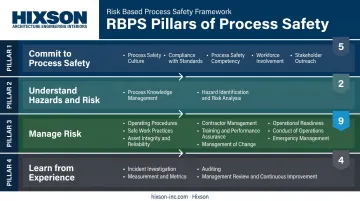
CCPS organizes the 20 RBPS elements into 4 pillars, each serving a distinct function. The pillars are interdependent: weakness in one undermines the others.
Pillar 1: Commit to Process Safety (5 Elements)
Elements: Process Safety Culture · Compliance with Standards · Process Safety Competency · Workforce Involvement · Stakeholder Outreach
This pillar is the foundation. Without genuine leadership commitment and a culture where safety is a core organizational value (not a compliance checkbox), the remaining pillars erode over time. This is a meaningful expansion from OSHA's original PSM, which did not explicitly define culture or competency requirements.
Pillar 2: Understand Hazards and Risk (2 Elements)
Elements: Process Knowledge Management · Hazard Identification and Risk Analysis (HIRA)
HIRA addresses three fundamental questions:
- What can go wrong?
- How bad could it be?
- How often might it happen?
This pillar is equivalent to OSHA's Process Safety Information and Process Hazard Analysis elements, but RBPS adds the requirement to assess risk tolerance and allocate resources accordingly — not just document hazards.
Pillar 3: Manage Risk (9 Elements)
Elements: Operating Procedures · Safe Work Practices · Asset Integrity and Reliability · Contractor Management · Training and Performance Assurance · Management of Change · Operational Readiness · Conduct of Operations · Emergency Management
This is the largest pillar, focused on sustaining incident-free operations. It covers how processes are run, maintained, changed, and prepared for. Management of Change is the most failure-prone element in this group: a disproportionate share of process incidents trace back to modifications that were never adequately reviewed.
Pillar 4: Learn from Experience (4 Elements)
Elements: Incident Investigation · Measurements and Metrics · Auditing · Management Review and Continuous Improvement
This pillar closes the loop. RBPS is not static, and Pillar 4 is what keeps it honest. It requires:
- Tracking near-misses before they become incidents
- Monitoring both leading and lagging performance indicators
- Conducting audits that measure actual system performance, not just documentation compliance
- Systematically implementing and verifying corrective actions
Organizations that treat this pillar as an administrative formality typically find their RBPS program drifting — on paper compliant, in practice hollow.
| Pillar | Elements | Primary Focus |
|---|---|---|
| 1. Commit to Process Safety | 5 | Culture, leadership, competency |
| 2. Understand Hazards and Risk | 2 | Process knowledge, HIRA |
| 3. Manage Risk | 9 | Operations, maintenance, change control |
| 4. Learn from Experience | 4 | Metrics, audits, continuous improvement |
How to Implement RBPS: A Practical Step-by-Step Guide
Step 1 — Conduct a Gap Assessment
Before implementation, evaluate your current program against all 20 RBPS elements to identify what's missing, underdeveloped, or partially in place. This gap analysis determines where to invest first, prioritized by risk magnitude — the core RBPS principle. Facilities already compliant with OSHA PSM have a head start; 14 of the 20 elements overlap.
Step 2 — Establish and Reinforce Process Safety Culture
Culture-building must precede or run parallel to technical implementation. Three non-negotiables:
- Leadership must visibly champion safety as a core organizational value
- Employees must feel safe reporting hazards without fear of retaliation
- Cross-functional safety committees should be established with real authority
Without this foundation, technical controls will degrade. An organization can have excellent written procedures and still experience incidents if culture is weak.
Step 3 — Perform Hazard Identification and Risk Analysis
RBPS recognizes multiple HIRA methodologies. Choose based on process complexity and lifecycle stage:
- HAZOP — systematic guide-word analysis for continuous or batch processes
- What-If / Checklist — efficient for simpler processes or preliminary design reviews
- FMEA — component-level failure analysis
- LOPA (Layer of Protection Analysis) — scenario-based analysis of independent protection layers
CCPS notes that HIRA conducted early in conceptual or preliminary design is more cost-effective than analysis performed after construction. Per OSHA 29 CFR 1910.119(e)(6), PHAs must be revalidated by a qualified team at least every five years.
Multi-disciplinary teams are required: operations, engineering, safety, and maintenance all need a seat at the table. This is where firms with dedicated process safety expertise add real value.
Hixson's process engineering team, led by Warren Green, P.E., conducts PSM and HAZOP studies across food & beverage and pharmaceutical sectors, integrating HAZOP, LOPA, PHA, and What-If/Checklist analyses directly with process design and P&ID development.
Step 4 — Implement Risk Controls and Operational Procedures
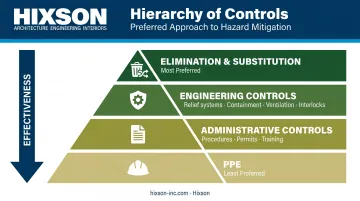
Once hazards are identified and analyzed, address them through the hierarchy of controls, applied in order of preference:
- Elimination/Substitution — remove the hazard or replace with a less hazardous alternative
- Engineering controls — relief systems, containment, ventilation, interlocks
- Administrative controls — procedures, permits, training
- PPE — last line of defense, not a substitute for engineering controls
Operating procedures must be written in plain language, cover normal operations, startup, shutdown, and emergency scenarios, and be updated whenever processes change. Any process change that isn't reflected in updated procedures is a management of change failure waiting to surface in an incident investigation.
Step 5 — Monitor, Measure, and Continuously Improve
Keeping RBPS effective requires four ongoing activities:
- Metrics tracking — establish both leading indicators (safety observations, near-miss rates) and lagging indicators (incident frequency, severity rates)
- Auditing — go beyond compliance checks to assess whether management systems actually perform as intended
- Incident investigation — investigate all incidents and near-misses within required timeframes using formal root cause analysis
- Management review — conduct formal periodic reviews to identify systemic improvements and close the loop through Pillar 4
Benefits and Challenges of Implementing RBPS
Benefits
The business case for RBPS rests on a straightforward premise: catastrophic incidents are far more expensive than prevention. According to CCPS, effective safety management can improve productivity by 5% to 15%. Beyond productivity, the primary benefits include:
- Incident prevention — protecting lives, assets, and operational continuity
- Smarter resource allocation — directing safety investment toward highest-risk activities
- Reduced regulatory exposure — structured risk data simplifies regulatory documentation and audits
- Distributed safety ownership — RBPS embeds safety responsibility across every employee, not just the safety department, which speeds near-miss identification and resolution
Challenges
RBPS implementation is demanding — organizations should anticipate several recurring obstacles:
- 20-element scope — each element requires multi-disciplinary expertise, cross-functional coordination, and sustained planning
- Change resistance — employees and middle management often push back on new systems, especially when the current system "seems to be working"
- Evolving processes — risk assessments must be updated as processes change; static documents erode quickly
- Resource constraints — smaller organizations may struggle to staff the multi-disciplinary teams HIRA requires
- Continuous management obligation — RBPS requires sustained leadership attention; it cannot be treated as a one-time project
RBPS in Food & Beverage and Pharma Facility Design
Food & beverage and pharmaceutical facilities face a specific set of process hazards that make RBPS highly relevant, even for facilities below OSHA PSM thresholds.
Key Process Hazards in These Sectors
- Combustible dust — flour, sugar, starch, spice, dried dairy, pharmaceutical APIs. The CSB identified 281 combustible dust incidents between 1980 and 2005, causing 119 fatalities and 718 injuries
- Ammonia refrigeration — OSHA PSM applies when systems contain 10,000 lb or more of anhydrous ammonia; many large cold storage and food processing facilities meet or approach this threshold
- Flammable solvents — common in pharmaceutical manufacturing and flavors & ingredients production
- CIP chemical systems — concentrated caustic and acid cleaning chemicals in food and dairy facilities
- High-pressure processing — HPP systems used in beverage and ready-to-eat food production

Why Facility Design Is the Right Starting Point
Engineering decisions made early in a project — process layout, equipment placement, ventilation design, electrical area classification, relief system sizing — either create inherent safety or require costly operational controls to compensate. Retrofitting safety after construction is expensive and often incomplete.
CCPS is explicit on this point: HIRA conducted during conceptual or preliminary design is more cost-effective for future safe operations than analysis performed later. That's why bringing the right engineering team in before construction begins — not after — is the decision that shapes safety outcomes.
Hixson's multidisciplinary model spans process engineering, mechanical, electrical, plumbing, fire protection, controls, and architecture under one roof, enabling safety-by-design from concept through commissioning. Specific capabilities include:
- Combustible dust hazard analysis aligned with NFPA 652, NFPA 61, and NFPA 654
- PSM-compliant ammonia refrigeration system documentation
- HAZOP and LOPA studies integrated with P&ID development
- OSHA 1910.119 PSM program support and EPA RMP assistance
Where to Start for F&B and Pharma Facilities
If you're unsure where to begin, these are the highest-priority actions:
- Conduct a Dust Hazard Analysis (DHA) if your facility handles any combustible powders — flour, sugar, spice, dried dairy, pharmaceutical powders, or similar materials
- Evaluate your ammonia refrigeration system against OSHA PSM thresholds (10,000 lb anhydrous ammonia)
- Engage a multidisciplinary engineering team early in any capital project to incorporate RBPS principles into design before construction
- Run HAZOP or What-If studies during process development — catching hazards at the design stage costs a fraction of addressing them operationally
Frequently Asked Questions
What is risk-based process safety?
Risk-based process safety (RBPS) is a CCPS/AIChE framework that identifies, evaluates, and manages process safety risks by allocating resources proportionally to each hazard's severity and likelihood — so the highest-risk activities receive the most rigorous controls.
What are the 4 pillars of risk-based process safety?
The four pillars are: (1) Commit to Process Safety, (2) Understand Hazards and Risk, (3) Manage Risk, and (4) Learn from Experience. These four pillars organize all 20 RBPS elements into a coherent management structure where each pillar reinforces the others.
What are the 5 steps of the risk management process?
Most risk management frameworks follow five steps: (1) identify hazards, (2) analyze risks, (3) evaluate and prioritize risks, (4) implement and monitor controls, and (5) communicate and document findings. RBPS embeds all five within its 4-pillar framework, ensuring continuous application rather than a one-time exercise.
How does RBPS differ from OSHA's Process Safety Management standard?
OSHA PSM is a mandatory regulatory standard with 14 elements for facilities above specific chemical threshold quantities. CCPS RBPS is a voluntary best-practice framework with 20 elements that builds on PSM by adding cultural, competency, and continuous improvement elements — and applies a risk-proportional resource allocation philosophy that OSHA PSM does not explicitly require.
Which industries are required to implement Process Safety Management?
OSHA's PSM standard applies to any facility — in any industry — that uses listed highly hazardous chemicals above threshold quantities. This includes chemical manufacturing, petroleum refining, food processing, pharmaceuticals, and utilities. All industries handling significant process hazards are encouraged to adopt RBPS principles voluntarily, regardless of threshold applicability.
What is a Process Hazard Analysis (PHA) and why is it important in RBPS?
A PHA is a systematic, team-based evaluation of process hazards using methods such as HAZOP, What-If, or FMEA. In RBPS, it anchors Pillar 2 — required at process initiation, revalidated every five years, and the foundation for all subsequent risk control decisions.