: Complete Guide](https://file-host.link/website/hixson-inc-efh0x3/assets/blog-images/a8a56c52-ad13-412a-bc27-55355251cee8/1777998386151367_a4aecd20d024458497ffb62cd381c1e0/360.webp)
Unlike operational decisions that can be adjusted quarterly, plant location is essentially permanent. Manufacturing construction spending in the U.S. reached a record $225 billion in January 2024, with facilities that will shape regional labor markets, supply chains, and operating costs for decades. Yet most companies tackle this decision only once or twice in a generation.
This guide covers what plant location and site selection is, how the process works, the critical factors you must evaluate, and why engaging an experienced architecture and engineering firm from the earliest stages can reduce risk and accelerate timelines.
Summary
- Plant location and site selection is the process of identifying the best geographic site for a new or expanded manufacturing facility
- Poor location choices inflate labor costs, logistics expenses, and regulatory burden that compound over the facility's entire life
- The process follows four stages: define requirements, screen regions, analyze candidate sites, then negotiate incentives and complete due diligence
- Critical factors include labor availability, transportation access, utilities, raw material proximity, regulatory environment, and site characteristics
- Bringing in architecture and engineering (A&E) early turns site constraints into buildable designs — before capital is committed
What is Plant Location and Site Selection?
Plant location is the strategic decision of choosing the geographic region, community, and specific parcel of land where a manufacturing facility will be built. Site selection is the formal evaluation process used to reach that decision — a progressive, data-driven elimination of candidate sites against operational, financial, and regulatory criteria.
While the terms are often used interchangeably, plant location refers to the outcome (where the facility is) while site selection refers to the process (how you get there). Both require deliberate analysis before design or construction begins.
Consider the scale: Lucid Motors evaluated more than 60 sites across 13 states before selecting a 500-acre property in Casa Grande, Arizona, for its purpose-built EV factory. That level of rigor is now standard for major manufacturing investments.
Plant Location vs. Site Selection: Is There a Difference?
Yes — the distinction matters operationally.
Each stage answers a different question:
- Plant location (macro): Which region, state, or metro area offers the right labor pool, tax climate, and market access?
- Site selection (micro): Does this specific parcel have adequate power infrastructure, soil load-bearing capacity, zoning clearance, and buildable acreage?
A region can check every macro box and still contain no viable parcels. A site with poor utility infrastructure or restrictive zoning can derail a project long after the regional decision is made — which is why both levels of analysis must be completed before capital is committed.
The Site Selection Process: Step by Step
An effective site selection process is fundamentally a site elimination process. You begin with a broad universe of potential regions and progressively narrow to a finalist list, then a single preferred site.
Most site selection projects remain on a 6-to-18-month timeline, though fast-tracked projects are becoming more common.
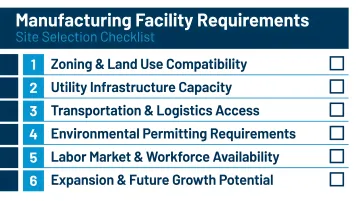
Step 1: Define Operational Requirements
Before evaluating any location, inventory your facility requirements:
- Square footage and building configuration
- Utility demand (power, water, gas)
- Labor headcount and skill profile
- Inbound/outbound shipment volumes and modes
- Environmental discharge characteristics
- Target project timeline
Skipping this step leads to paralysis by analysis or choosing a site that meets some needs while creating unforeseen operational constraints.
Step 2: Regional Screening
High-level screening filters candidate regions at the state or multi-state level using macro factors:
- Labor market size and cost
- Proximity to key markets or raw material sources
- Tax and regulatory climate
- Transportation network quality
The goal is to eliminate regions that cannot meet minimum requirements, typically narrowing to 3–5 viable regions for deeper analysis.
Step 3: Community and Site-Level Analysis
Evaluation shifts from regional to local:
- Utility availability: Capacity commitments from providers, not just theoretical access
- Zoning and permitting: Timeline estimates and variance requirements
- Site configuration: Buildable acreage, expansion room, topography
- Access infrastructure: Road quality, distance to highways and rail
- Local labor depth: Available workforce within commuting distance
Step 4: Due Diligence and Incentives Negotiation
Once 2–3 finalist sites are identified, technical due diligence begins:
- Phase 1 Environmental Studies (and Phase 2 if contamination is flagged)
- Geotechnical analysis (soil load-bearing capacity, depth to bedrock)
- Hydrologic analysis (drainage, flood plain status)
- Infrastructure capacity confirmation (written utility commitments)
This is the stage to engage an engineering firm for independent site review. Maintaining two finalist locations in different states until the final decision also maximizes negotiating leverage for government incentive packages — tax credits, grants, infrastructure improvements, and utility rate discounts.
Step 5: Acquisition and Design Kickoff
After the final selection, property acquisition and facility design move forward together — not in sequence. Site constraints surfaced during due diligence should be actively shaping preliminary design parameters before the ink dries on the purchase agreement.
Key Factors in Plant Location and Site Selection
Six categories of factors consistently drive industrial site selection decisions. The weighting varies by industry, product type, and operational model, but these factors appear across nearly every manufacturing project.
Labor Availability and Cost
Labor is consistently ranked as the top or second most important factor in manufacturing site decisions. Availability of skilled labor is rated "very important" or "important" by nearly all consultants responding to industry surveys.
What matters:
- Availability of both skilled and unskilled workers
- Local wage rates
- Unionization levels
- Pipeline of future workforce (local colleges, technical schools)
Regional wage variation is significant. According to 2025 BLS benchmark data, average hourly earnings for manufacturing production employees range from $23.28 in Mississippi to $35.34 in Washington — a 50% difference.
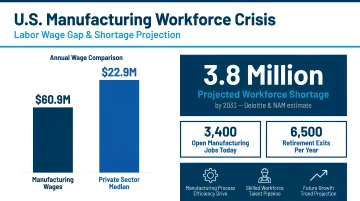
The net need for new manufacturing employees could be approximately 3.8 million between 2024 and 2033, with around 1.9 million of those positions potentially going unfilled. That makes labor availability more critical than ever.
Transportation and Logistics Infrastructure
Proximity to multiple modes of transportation — highway, rail, port, and in some cases air freight — is essential. Over-reliance on a single transportation mode creates supply chain fragility.
Transportation infrastructure ranks #4 among the most important location criteria in industry surveys of site selectors, behind workforce skills, incentives, and tax structure.
Manufacturers need reliable inbound supply chains for raw materials and efficient outbound distribution to customers. Surface freight from inland China/Asia to the U.S. Midwest takes approximately 6 weeks, and 43% of OEMs are willing to pay a 10–20% price premium for components arriving 5 weeks earlier.
Raw Material and Supply Chain Proximity
For high-volume, low-margin industries (food and beverage, bulk chemicals, building materials), locating closer to raw material sources reduces transportation cost as a share of total production cost.
For low-volume, high-value products (pharmaceuticals, specialty ingredients), proximity to markets matters more than proximity to inputs.
Supply chain resilience is now a board-level priority, not just an operational concern. 65% of U.S. manufacturing companies want to increase reshoring due to continued supply chain disruptions, with 67% of reshoring cases (where country is known) coming from China.
Utilities: Power, Water, and Natural Gas
Utility availability, capacity, and cost are non-negotiable for most manufacturing operations. Large facilities require:
- Confirmed power demand capacity from local utilities
- Adequate water supply and wastewater treatment capacity
- Natural gas line sizing and pressure confirmation
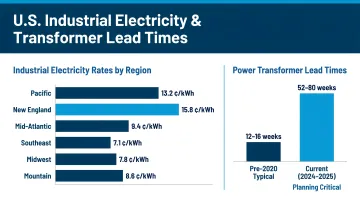
Secure utility commitments during due diligence — don't assume capacity is available. Industrial electricity rates vary dramatically by region: the U.S. average is 8.13 cents/kWh, but rates range from 5.43 cents in New Mexico to 34.13 cents in Hawaii — a 6x difference.
Water-intensive industries (food and beverage, pharmaceuticals, biotech) have particularly stringent requirements. U.S. industrial water use exceeds 18.2 billion gallons per day, and securing adequate supply is non-negotiable.
Power grid capacity constraints are real. Large power transformer lead times now range from 80 to 210 weeks, up from approximately 50 weeks in 2021, and transformer prices are 80% higher since COVID-19. This means securing power commitments early is critical.
Regulatory Environment, Zoning, and Government Incentives
Zoning classification, permitting timelines, environmental discharge regulations, and air quality standards all vary by jurisdiction. Some sites may require variances or environmental impact statements before construction can begin.
America's permitting system costs manufacturers $7.9 billion to $8 billion per year, and the U.S. takes up to 80% longer to move projects forward compared to peer nations.
Government incentives should be negotiated as a tiebreaker between qualified finalist sites — not as the primary location driver. Recent major incentive deals include:
- TSMC (Arizona): $6.6 billion in federal CHIPS Act funding
- Hyundai (Georgia): $2.1 billion in state and local incentives for 8,500+ jobs
- Micron (NY, ID, VA): $6.4 billion in federal funding for 90,000 jobs
Model incentive packages over a 10-year operating horizon to assess real financial impact.
Site Characteristics, Land Cost, and Community Fit
Regulatory approvals clear the path to build — but physical site attributes determine what you can build and at what cost:
- Parcel size and expansion acreage
- Topography and grading requirements
- Soil load-bearing capacity
- Flood plain status
- Environmental remediation needs
A site that appears inexpensive may carry significant hidden development costs if grading, piling, or environmental remediation is required.
Community fit matters for long-term operations: quality of local schools, housing availability, healthcare access, and community receptiveness to industrial development all affect your ability to recruit and retain employees.
Greenfield vs. Brownfield: Choosing Your Starting Point
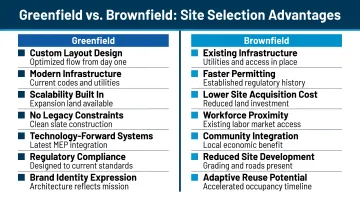
Greenfield sites are undeveloped land where a facility is built from scratch. They offer full design flexibility but require all utilities, roads, and infrastructure to be extended to the site.
Brownfield sites are previously developed or industrial parcels where an existing structure may be adapted or demolished. They offer existing infrastructure connections but potentially carry environmental remediation requirements.
Both site types have a legitimate place in facility planning — the right choice depends on your timeline, budget, and operational requirements.
Decision Tradeoffs
Greenfield advantages:
- Maximum design optimization for your specific operation
- Room for future expansion
- No contamination risk
Brownfield advantages:
- Lower purchase price
- Proximity to urban labor and infrastructure
- Faster market entry (if retrofit is viable)
- 20-40% lower costs and 6-12 month faster timelines compared to greenfield
Costs to reconfigure an existing facility for modern production, food safety, or laboratory requirements can easily exceed the cost of a purpose-built greenfield facility — a tradeoff many teams don't model until late in the decision process.
Median urban brownfield cleanup cost is $158,000, more than 10x the rural median of $14,000. Commission Phase 1 and Phase 2 Environmental Studies before committing to any brownfield site — remediation exposure needs to be priced into the deal, not discovered after closing.
How Hixson Can Help
Hixson is a full-service architecture and engineering firm with 75+ years of experience delivering complex manufacturing facilities for Food & Beverage, Science & Technology, and Workplace clients throughout North America. Major clients include Maple Leaf Foods, Milo's Tea Company, Samuel Adams, Abbott Nutrition, and Nestlé.
Hixson's value in the site selection phase comes from its integrated, 20-discipline in-house team. When architects, civil engineers, mechanical and electrical engineers, and process engineers are involved from day one, site constraints identified during due diligence are immediately translated into design parameters. This eliminates the costly rework that happens when companies finalize a site before bringing in their A&E firm.
Key disciplines Hixson brings to the site evaluation process include:
- Architecture and civil engineering for site feasibility and code review
- Mechanical, electrical, and plumbing engineering for utility assessment
- Process engineering for production flow and equipment layout analysis
- Controls and automation for infrastructure readiness evaluation
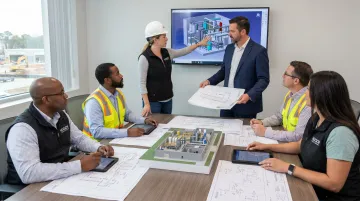
Hixson's Project Management team, led by Chris Jarc, guides clients through the full project lifecycle — from initial business opportunity through capital approval, design, construction, and startup. The team embeds directly into client workflows at each stage, not just during design.
Bringing A&E expertise into site selection early — before commitments are made — consistently produces better outcomes on cost, schedule, and facility performance. To discuss how Hixson can support your next project, contact the team at info@hixson-inc.com or call +1 513-241-1230.
Frequently Asked Questions
What is plant location and site selection?
Plant location is the decision of where to situate a manufacturing facility. Site selection is the structured evaluation process used to reach that decision, covering regional screening, site-level analysis, due diligence, and incentives negotiation before any design or construction begins.
What is the procedure for selecting a plant site?
The process follows five steps: (1) define operational requirements, (2) regional screening, (3) community and site-level analysis, (4) due diligence and incentives negotiation, and (5) acquisition and facility design. Phases often overlap, particularly steps 3 and 4.
What factors should be considered when selecting a plant location?
The six primary categories are labor availability and cost, transportation and logistics infrastructure, raw material and supply chain proximity, utility capacity and cost, regulatory environment and government incentives, and physical site characteristics and community fit.
Where are manufacturing plants typically located?
Manufacturing plants are typically located near major transportation corridors (interstate highways, rail lines, ports), within proximity to primary raw material sources or end markets, and in regions offering competitive labor pools, favorable utility costs, and supportive regulatory environments. The South captured 60% of all reshoring + FDI job announcements in 2024, with Texas, Kentucky, North Carolina, Tennessee, and Ohio leading in new manufacturing jobs.
What is the difference between a greenfield and brownfield manufacturing site?
A greenfield site is undeveloped land offering full design flexibility but requiring new infrastructure. A brownfield site is a previously developed parcel with existing infrastructure but potential environmental liabilities. The right choice depends on timeline, budget, design requirements, and environmental due diligence findings.
How does site selection affect facility construction and operating costs?
Site characteristics — soil conditions, topography, utility availability, and zoning — directly determine construction costs. Regional factors such as labor rates, utility pricing, and tax climate shape long-term operating costs. Engaging architecture and engineering expertise early ensures total cost of ownership is accurately modeled across all candidate sites before committing to a location.