Introduction
Investor timelines don't wait for permit boards. Supply chain disruptions don't pause while you evaluate labor markets. And market demand rarely aligns with the 18-24 months a complex facility actually takes to build.
Fast-growing companies in food & beverage, pharma, biotech, and science & technology face a real tension: move fast enough to capture opportunity, but not so fast that you skip the due diligence that keeps projects on track.
A site chosen without proper evaluation of utilities, zoning, or workforce depth doesn't accelerate your timeline. It creates budget overruns, regulatory delays, and operational problems that compound for years.
This guide covers what every site evaluation must address before you commit:
- The seven factors that separate viable sites from costly mistakes
- Greenfield, brownfield, and adaptive reuse tradeoffs
- How regulatory timelines can quietly destroy your schedule
- Why involving your engineering team before signing is one of the most schedule-protective decisions you can make
Key Takeaways
- Reactive site decisions cause more delays post-commitment than thorough upfront evaluation
- Every site requires evaluation across seven factors: workforce, utilities, zoning, cost, supply chain, scalability, and community reception
- Regulatory permitting is the most underestimated schedule risk — build scenario buffers in from day one
- Incentive negotiations must happen before site commitment — not after — to maximize leverage
- Engaging an A&E firm during shortlisting (not after signing) prevents costly technical surprises
Why Fast-Growing Companies Face Unique Site Selection Challenges
The Forces Driving Expansion Pressure
Several converging forces are pushing companies to expand faster than their due diligence processes were built to handle.
Across multiple sectors, the pressure points are stacking up simultaneously:
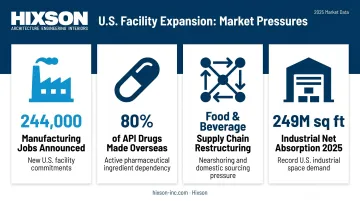
- The Reshoring Initiative reported 244,000 U.S. manufacturing jobs announced in 2024 — a record level of reshoring and foreign direct investment activity
- 80% of active pharmaceutical ingredients used in U.S. generic drugs are currently made outside the country, pushing pharma manufacturers to reshore API sourcing
- Food & beverage companies are restructuring supply chains following pandemic-era disruptions
- Industrial net absorption is projected at 249 million square feet for full-year 2025, according to NAIOP, reflecting intense national competition for developable space
These pressures aren't isolated to one sector. They're converging across industries, in the same regional labor markets, competing for the same limited inventory of developable land.
The Shovel-Ready Supply Problem
Demand for truly shovel-ready sites — where zoning, utilities, and permitting are already resolved so construction can begin promptly after purchase — far exceeds supply. Area Development has reported that many available sites have disqualifying issues: insufficient usable acreage, inadequate power, or water systems that can't support the intended use.
The difference between a genuinely ready site and one that merely appears ready:
- Actually shovel-ready: Zoning approved, utilities stubbed to the fence line with documented capacity, environmental clearance in hand, permitting process begun or complete
- Appears ready but isn't: Utilities available "in the area" but not at capacity for your load, zoning conditional on approvals that haven't happened, environmental assessment not yet conducted
That distinction matters enormously when your build schedule is already compressed.
The Compounding Risk of a Hot Market
When multiple companies target the same high-demand regions at the same time, construction labor costs escalate, subcontractor availability shrinks, and utility interconnection queues lengthen. A disciplined evaluation process matters here for two reasons: it protects you from committing to a site with hidden disqualifiers, and it compresses your decision timeline so you can act before a competing buyer does.
The 7 Key Factors to Evaluate When Selecting a Site Under Pressure
Skipping or shortcutting any of these factors is where companies lose months and millions after commitment.
1. Workforce Availability and Labor Market Depth
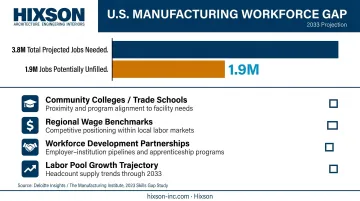
Current unemployment rates tell you very little. What matters is labor pool trajectory, wage benchmarks relative to competing employers in the region, and whether local educational infrastructure can supply a sustained pipeline. Specifically, look for:
- Community colleges and trade schools with programs tied to your industry
- Regional wage benchmarks versus competing employers
- Active workforce development partnerships between state agencies and industry
- Labor pool growth trajectory, not just current availability
Deloitte and the Manufacturing Institute project that U.S. manufacturing could need 3.8 million net new workers by 2033, with 1.9 million jobs potentially going unfilled. That gap isn't evenly distributed. States like Georgia, Virginia, and South Carolina have built customized training models integrated with technical colleges that substantially outperform generic workforce development programs for advanced manufacturing and life sciences hiring.
2. Infrastructure and Utility Capacity
For food processing plants, pharmaceutical manufacturing facilities, and biotech labs, utility capacity is critical — and what's available "on paper" frequently doesn't reflect actual capacity at the site level.
The grid situation is tightening. Grid Strategies reported the U.S. five-year load-growth forecast increased nearly 5x over two years, with manufacturing alone potentially adding up to 20 GW of new demand. A competitive site doesn't need every utility at the fence line, but it does need a credible, funded utility delivery plan aligned with your project timeline. Engage local utility providers early — not after site commitment.
3. Zoning and Regulatory Environment
Zoning approvals, land use entitlements, and environmental reviews vary dramatically by jurisdiction. A site with excellent labor and utility characteristics can still add 12-18 months to your timeline if local zoning requires extended approval cycles.
Some Southeastern states have invested in streamlined permitting frameworks specifically to attract capital investment. Researching a region's typical approval timeline should be part of your initial site screening — before you're deep enough into a deal to absorb a surprise.
4. Cost and Financial Feasibility
The lowest land cost is rarely the lowest total cost. Model all cost categories over a 10-year horizon:
- Land acquisition and site preparation
- Construction costs (up 4.69% year over year as of Q4 2024, per RLB)
- Operating expenses: utilities, taxes, insurance
- Logistics and supply chain costs
- Regulatory compliance and incentive clawback risk
Life sciences projects deserve particular attention — CBRE reported that life sciences project costs are 20-25% above pre-pandemic levels, with specialty equipment costs 30-50% higher.
5. Supply Chain Access and Logistics
U.S. business logistics costs totaled $2.3 trillion in 2024 — 8.7% of GDP — according to CSCMP. Proximity to suppliers, ports, rail, and major highway corridors affects total landed cost in ways that don't show up in real estate pricing but show up every day in operations. Supply chain alignment must match the facility's actual production or distribution model, not just a general preference for accessibility.
6. Scalability and Room for Expansion
Fast-growing companies consistently outgrow facilities faster than projected. A site that lacks adequate acreage or structural capacity for a phase-two expansion forces an eventual relocation — one of the most expensive outcomes in facility planning. Treat expansion potential as a filter criterion from the start, not a secondary consideration once you're already evaluating finalists.
7. Community Reception and Quality of Life
Community and regional quality-of-life factors — housing affordability, schools, healthcare, cultural amenities — affect your ability to attract relocated talent. More immediately, community opposition to large industrial or manufacturing projects can trigger additional review cycles, public hearings, or legal challenges.
Early engagement with economic development agencies and community stakeholders, framed around job creation and infrastructure investment, is a strategic priority. Companies that treat it as a process step to check off typically encounter the friction they were hoping to avoid.
Greenfield, Brownfield, or Adaptive Reuse: Choosing the Fastest Path Forward
Each development path has a different risk-and-timeline profile. The right choice depends on your technical requirements, not just your preferred schedule.
| Path | Timeline | Key Advantage | Key Risk |
|---|---|---|---|
| Greenfield | Longest | Maximum customization | Time to break ground |
| Brownfield | Moderate | Faster permitting in some jurisdictions | Hidden remediation costs |
| Adaptive Reuse | Potentially fastest | Existing structure | Structural or MEP incompatibility |
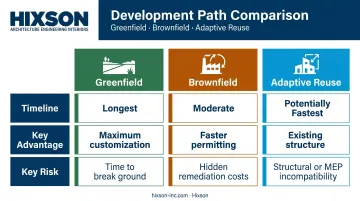
How each path maps to your sector:
- Food & beverage companies with custom process layouts, drainage slopes, and hygienic construction requirements often favor greenfield — retrofitting typically costs more than building new
- Pharmaceutical companies needing a fast lab or fill-finish suite often target existing building stock, provided the structure can support cleanroom loads and clean utility infrastructure
- Science & technology companies establishing R&D campuses may find adaptive reuse of former industrial space attractive when floor plates and utility entry points align
The critical warning on brownfield and adaptive reuse: discovering hidden remediation liabilities or structural incompatibilities after signing a lease or purchase agreement can delay occupancy far longer than a planned greenfield build would have. An engineering feasibility review of the existing structure and utilities must happen before commitment, not after.
The EPA awarded $233 million in FY2024 Brownfields grants, so federal remediation support exists. However, grant timelines are measured in months to years, not weeks, making them a poor fit for companies under schedule pressure.
Regulatory Timelines and Permitting: The Schedule Risk Most Companies Underestimate
NAM estimates permitting delays cost U.S. manufacturers $7.9 billion annually — and 50.8% of manufacturers say permitting concerns actively discourage investment in new or expanded capacity.
What Drives the Timeline
Permitting complexity isn't just about getting a building permit. Large industrial facilities often require:
- Zoning variances or land use entitlements
- Environmental impact reviews
- Air quality permits (which can take 8+ months in favorable jurisdictions and 18+ months or more where regulatory complexity or late engagement is involved)
- Community board reviews — in some jurisdictions, getting on a planning board agenda alone requires 60-90 days' advance notice
Getting ahead of each of these processes independently requires coordinated project management from the start.
Where You Build Determines How Long It Takes
Some Southeastern states have built certified industrial site programs specifically to reduce pre-construction timeline risk — Georgia, for example, maintains more than 60 certified industrial sites designed for accelerated development. Other markets layer review requirements that extend pre-construction timelines by 12 months or more. Researching a region's permitting track record is part of site screening, not a separate exercise. That track record should directly inform how you model schedule risk before committing to a location.
Build Regulatory Buffer Explicitly Into Your Plan
Companies that treat permitting as a parallel-path activity — assuming it proceeds independently while design moves forward — consistently face surprises. Model three regulatory scenarios:
- Fast-track: Certified site in a business-friendly jurisdiction
- Moderate: Standard municipal review with no community opposition
- Contested: Community review triggered, additional public hearings required
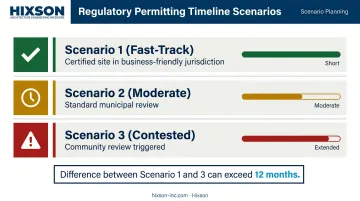
The difference between scenarios one and three can exceed 12 months. Teams with in-house civil engineering and architecture can engage regulatory bodies concurrently with early design — compressing the gap between site selection and groundbreaking rather than waiting for permits to clear before design advances.
How to Secure State and Local Incentives Without Losing Momentum
Incentives can represent a meaningful percentage of total project cost — and they require negotiation before site commitment, not after.
Major Incentive Categories
- Job creation tax credits and payroll rebates — often the most lucrative, especially in Southeastern states
- Capital investment tax credits and property tax abatements
- Utility infrastructure grants and rate reductions
- Custom negotiated packages for large-scale projects
- Georgia's agreement with Hyundai Motor Group: minimum $5.545 billion investment, 8,100 full-time jobs
- New Jersey's Next NJ Manufacturing Program: $500 million tax-credit program
The Timing Trap
Many fast-moving companies sign letters of intent before engaging economic development agencies, leaving money on the table. Running a short list of two or three competing sites simultaneously strengthens negotiating leverage; states move faster and offer more when they know they're not the only option.
Don't Overlook Clawback Obligations
Most incentive awards include clawback provisions requiring companies to meet job creation, investment, or payroll thresholds over 5–10 years. Build a compliance tracking strategy at the outset. Without documented compliance records, you could be required to repay awards that have already been spent on equipment, build-out, or staffing.
Involve Your Engineering and Design Team Before You Sign
Site selection for specialized facilities — food processing plants, pharmaceutical manufacturing facilities, biotech labs — is an engineering decision as much as a real estate one.
A site can pass a real estate feasibility screening and still be fundamentally incompatible with the facility's technical requirements:
- Electrical service capacity too low for process loads
- Soil conditions requiring expensive foundation systems
- Water supply insufficient for process needs
- Stormwater drainage limitations that constrain site layout options
Construction Industry Institute data shows that deviations resulting in rework — including redesign, repair, or replacement — average 12.4% of total installed project cost. Discovering site incompatibilities after signing costs far more than discovering them during due diligence.
What Early A&E Engagement Looks Like
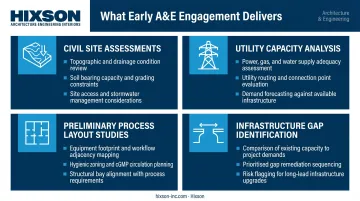
When engaged during the shortlisting phase, a firm like Hixson — with 20 integrated in-house technical disciplines spanning civil, mechanical, electrical, plumbing, process engineering, and architecture — can provide:
- Civil site assessments: Terrain, stormwater drainage, site utilities, road access, expansion acreage
- Utility capacity analysis: Electrical service sizing, water and wastewater capacity relative to process loads, gas availability
- Preliminary process layout studies: Whether the candidate site's physical footprint and structural grid can accommodate the intended equipment configuration
- Infrastructure gap identification: What capital investment would be required before construction can begin
For Milo's Tea Company, Hixson's scope included master planning, site selection, process and packaging engineering, building and utilities design, and automation. That integrated pre-commitment engagement supported a greenfield facility designed to accommodate up to 12 additional production lines.
The ROI Case
The cost of a preliminary engineering site assessment is a fraction of the cost of redesigning a facility mid-construction or — in the worst case — walking away from a committed site. For fast-growing companies, early A&E engagement both reduces risk and compresses the timeline from site selection to groundbreaking: design and engineering work begins in parallel with final site negotiations rather than sequentially after them.
Frequently Asked Questions
What are the 7 factors to be considered in selecting an ideal site?
The seven key factors are:
- Workforce availability and labor market depth
- Infrastructure and utility capacity
- Zoning and regulatory environment
- Cost and financial feasibility
- Supply chain access and logistics
- Scalability and room for expansion
- Community reception and quality of life
Evaluate all seven before any site commitment — not after.
How long does site selection typically take for a new manufacturing or processing facility?
Timelines range from a few months for straightforward cases to 12-24 months for complex facilities requiring specialized utilities or extensive permitting. Regulatory permitting and utility infrastructure gaps are the primary drivers of extended timelines.
What is a shovel-ready site and why does it matter for fast-growing companies?
A shovel-ready site has zoning, utilities, and permitting already resolved so construction can begin shortly after purchase. These sites are scarce and often priced at a premium — but when timeline is the priority, the speed and reduced permitting risk frequently justify the cost.
How do state and local incentives affect the site selection process?
Incentives — including job creation credits, capital investment abatements, and utility grants — can offset a meaningful share of total project cost. Negotiate them before site commitment, not after. Engaging economic development agencies early and running competing sites in parallel gives you the most leverage.
What is the most common mistake fast-growing companies make during site selection?
Prioritizing speed over due diligence on regulatory timelines, utility capacity, or workforce depth. This consistently creates longer delays after commitment than a thorough upfront evaluation would have.
When should an architecture and engineering firm get involved in site selection?
A&E involvement should begin during the site shortlisting phase — before any commitment is made. Technical feasibility issues related to utilities, civil constraints, and process layout compatibility should inform the final site decision, not surface as costly surprises after signing.