Dairy processing is meaningfully different from general food plant design. Raw milk receiving, pasteurization, CIP sanitation, multi-temperature refrigeration, and pathogen control create requirements that can't be retrofitted into a generic food building. Whether you're designing a fluid milk plant, a cheese facility, a yogurt line, or a spray drying operation, the planning must be purpose-built from the first phase.
This guide covers the key planning areas for a new or expanded dairy processing facility: site selection and master planning, process flow-driven layout, food-safety architecture, utility systems, controls and automation, and scalability.
Key Takeaways
- Start cross-disciplinary coordination — architecture, process, mechanical, electrical, plumbing, and controls — simultaneously at kickoff, not in sequence
- Process flow drives layout (raw receiving → processing → packaging → cold storage), with strict separation between raw and finished product zones
- Hygienic zoning must be embedded in the building structure, not managed by procedure alone
- Size utility systems for peak simultaneous demand and build in capacity buffer for future growth
- Build expansion zones into the master plan from day one; retrofitting them later costs significantly more
Site Selection and Facility Master Planning
Why Site Decisions Have Long-Term Consequences
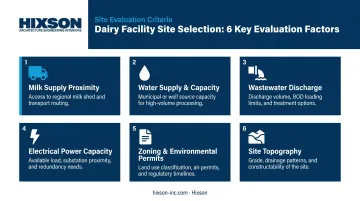
Site selection isn't a preliminary formality : it sets constraints that will affect facility cost, permitting timelines, logistics efficiency, and operational capacity for the life of the building. Key factors to evaluate before committing to a site:
- Proximity to milk supply and distribution routes — raw milk is time- and temperature-sensitive; transportation distance matters
- Water supply and wastewater capacity — dairy plants can use more than 4 gallons of water per gallon of milk processed, and a typical facility may consume more than 50 million gallons annually; municipal water and sewer capacity must be verified early
- Wastewater discharge — dairy wastewater is high-strength; raw effluent BOD₅ concentrations of 1,000–4,000 mg/L are typical, which often requires pretreatment before discharge
- Available electrical power capacity — refrigeration and processing loads are significant
- Zoning and environmental permits — EPA stormwater permits are required for construction disturbing one acre or more; state dairy regulatory approvals add another layer
- Site topography — slope, drainage patterns, and flood risk directly affect drainage design and stormwater management costs
The Master Planning Phase
A facility master plan establishes the overall site layout — building footprint, truck docks, utility infrastructure, expansion zones, parking, and waste handling — before detailed design begins. The decisions made here — or skipped — shape every phase that follows.
Hixson's master planning process for food and beverage manufacturers covers utility infrastructure scale-up (refrigeration, steam, compressed air, wastewater), site capacity expansion, raw material logistics, and phased capital deployment. Getting civil and process engineers working from the same plan at this stage — rather than sequentially — avoids costly conflicts between utilities or site conditions and production requirements.
State regulatory requirements vary, and missing them mid-project is expensive. A few examples:
- Michigan requires plan review with the inspector before a Grade "A" dairy plant license is issued
- Pennsylvania reviews new dairy plant construction prior to approval
- Maryland prohibits constructing or extensively altering a dairy plant without prior plan approval
Identifying these requirements at the master planning phase — not during construction documents — keeps the project schedule intact.
Designing Around Process Flow
Let the Process Drive the Layout
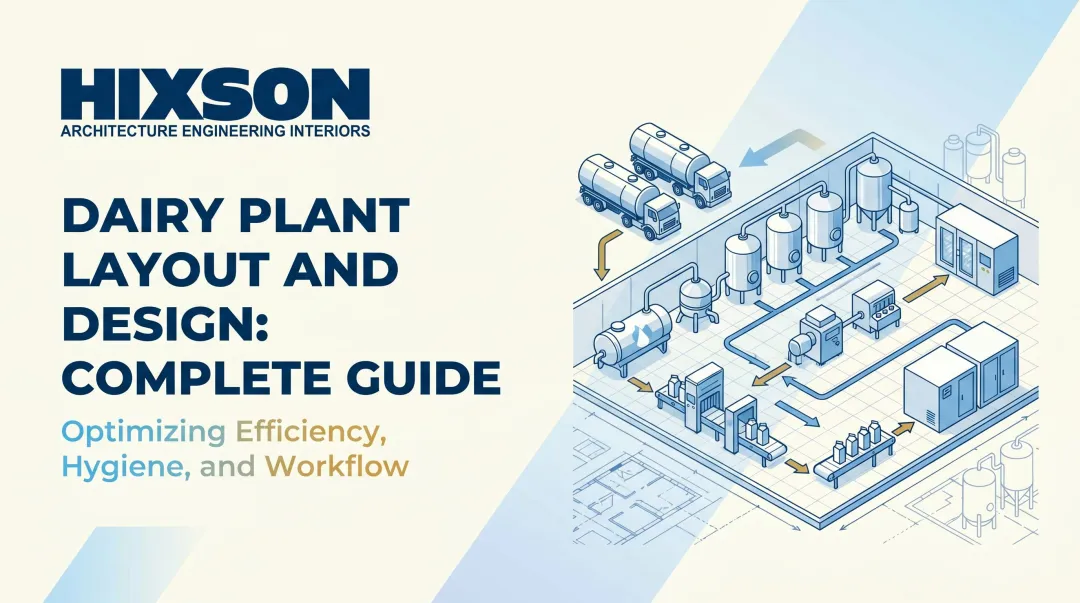
The core principle of dairy facility layout is straightforward: the building should follow the process, not the other way around. The standard processing sequence — raw milk receiving and storage, separation and standardization, heat treatment, further processing (culturing, drying, cheese-making), packaging, finished goods cold storage — should move in a logical direction that eliminates backtracking and cross-traffic.
The Pasteurized Milk Ordinance (PMO) makes this a regulatory requirement, not just an efficiency preference: rooms for pasteurizing, processing, cooling, reconstitution, condensing, drying, and packaging must be separated, and raw and pasteurized milk areas must be physically divided.
Process Flow Diagrams Before Floor Plans
Process flow diagrams (PFDs) and preliminary equipment lists should be complete (or at least well-developed) before architectural floor plans are finalized. When the building gets designed first and equipment gets fitted in afterward, problems are predictable: insufficient ceiling heights, undersized column bays, floors that can't handle equipment loads, and aisle widths that don't allow maintenance access.
Hixson's Manufacturing Engineering team develops mass and energy balances, block flow and process flow diagrams, equipment layouts, and utility requirements as early-phase deliverables. These feed directly into architectural and structural decisions, rather than competing with them after the fact.
Adjacency Planning
Not every area can be adjacent — but some must be:
- Raw milk receiving dock should sit adjacent to raw milk silos
- CIP rooms should be positioned to minimize return line lengths to the processing areas they serve
- Quality lab should be close to production for real-time sampling and testing
- Raw and pasteurized product zones must be separated by physical barriers
Aisle widths, ceiling heights, floor load capacities, and column spacing should be determined by equipment dimensions and maintenance access requirements. FDA 21 CFR 117.20 requires adequate space for equipment placement and aisles that permit duties to be performed without contamination risk — but the regulatory language is performance-based, meaning the equipment drives the number, not a standard default.
Hixson's integrated approach, with process engineers, manufacturing engineers, and architects working from a shared 3D model, identifies layout conflicts before construction documents are issued. A ceiling height conflict caught in the model is a minor coordination effort. The same problem discovered during construction becomes a change order.
Building Food Safety Into the Facility Architecture
Hygienic Zoning
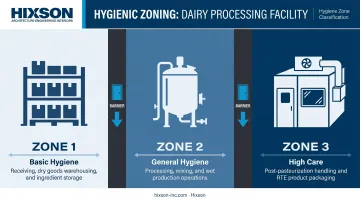
Hygienic zoning is the physical separation of areas handling raw or incoming product from areas handling pasteurized or finished product. Zones typically progress from basic hygiene (receiving, warehousing) through hygiene (general processing) to high hygiene or high care (post-pasteurization, ready-to-eat packaging).
The separation is enforced through building design — not just operating procedures. This means:
- Physical walls and doors between zones (not just painted lines or signage)
- Dedicated personnel entry points and gowning areas at zone transitions
- Air pressure differentials that prevent migration of contaminated air into higher-care areas
- Controlled traffic flow patterns for people, equipment, and materials
Hixson designs to recognized hygienic design standards including 3-A Sanitary Standards, EHEDG guidelines, and FDA/USDA requirements, with hygienic zoning integrated into architectural decisions from the schematic design phase.
Materials and Finishes
The PMO specifies that floors in milk handling and processing rooms must be concrete or equally impervious material — smooth, properly sloped, provided with trapped drains, and easily cleanable. Walls and ceilings must have smooth, washable, light-colored surfaces.
These requirements rule out many standard commercial construction approaches and must be specified explicitly.
Key material selection criteria for dairy processing spaces:
- Floor surfaces must withstand thermal cycling from hot CIP water, provide slip resistance when wet, and use joint designs that don't trap bacteria
- Wall materials must be non-porous and chemical-resistant to caustic cleaners and acid rinses, with no exposed fasteners or ledges
- Ceilings require smooth, sealed surfaces resistant to condensation and moisture infiltration
Drainage Design
Floor drainage is a food safety issue, not just a plumbing detail. Drains must be correctly sized and positioned to prevent pooling.
Drainage systems must not create cross-contamination pathways between zones. Shared drain channels between raw and pasteurized areas represent a direct food safety risk that building design — not operational controls — must prevent.
HVAC and Building Pressurization
High-care areas should operate under positive air pressure relative to adjacent lower-hygiene zones, preventing ingress of contaminated air. EHEDG Doc. 47 covers air handling system design for food plants, and Campden BRI guidelines address filter selection and environmental air quality for high-care and high-risk areas.
Key HVAC and pressurization requirements for dairy processing facilities include:
- Positive pressure in high-care zones relative to all adjacent lower-hygiene areas
- Filtered air intake on all pressurized ventilation systems
- 20 foot-candles (220 lux) minimum illumination in working areas, per PMO
- Ventilation designed to minimize dust, odors, and excessive condensation
- Cold surface condensation designed out at the building level — moisture in processing zones creates direct pathogen risk
Engineering Utility Systems for Dairy Processing
Sizing for Peak Demand
Dairy processing is among the most utility-intensive categories in food manufacturing. A single facility may require:
- High-volume potable and process water (4+ gallons per gallon of milk processed)
- Process steam and hot water for pasteurization and CIP
- Refrigeration at multiple temperature levels
- Food-grade compressed air
- Significant electrical power for motors, controls, and refrigeration
The critical sizing principle: design for peak simultaneous demand, not average load. Refrigeration alone can account for 25–30% of total plant electricity consumption. Undersizing any utility system at design creates operational constraints that are expensive and disruptive to correct after construction.
CIP System Design
Clean-in-place systems are a utility-side requirement unique to dairy. The PMO defines CIP as removing soil from product-contact surfaces in process position by circulating, spraying, or flowing chemical solutions and water rinses. The PMO also requires a return-solution temperature-recording device and cleaning records retained for at least two years.
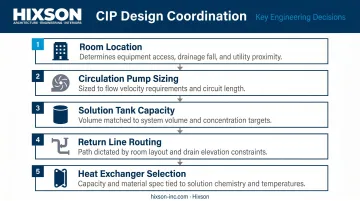
CIP design decisions that must be made early and coordinated across disciplines:
- Room location — minimize return line distances to processing areas served
- Circulation pump sizing — matched to the longest and most flow-resistant circuit
- Solution tank capacity — sized for the largest single cleaning circuit
- Return line routing — must be integrated with architectural and structural plans
- Heat exchanger selection — coordinated with steam supply and hot water systems
Poorly designed CIP systems are a leading cause of microbiological failures in dairy plants. CIP design must be developed alongside process piping layout, not treated as a late-phase detail.
Refrigeration System Design
Dairy plants require refrigeration at multiple temperature levels simultaneously:
- Raw milk receiving and storage (typically 34–38°F)
- Pasteurized product cooling
- Packaging cold rooms
- Finished goods cold storage and freezer warehousing
For large dairy facilities, centralized ammonia (R-717) refrigeration systems are common — they offer lower operating costs and high efficiency at scale. Ammonia system design must comply with ANSI/IIAR 2 for safe design and ANSI/IIAR 6 for inspection and maintenance. Machine room design, ventilation, and emergency shutdown controls are specific IIAR/ASHRAE requirements that must be incorporated from the start.
Distributed systems (CO₂ or HFC-based) may be appropriate for smaller facilities or when ammonia poses siting or permitting challenges.
The Coordination Challenge
Utility systems in a dairy facility are deeply interdependent. Process water supply affects CIP design. Refrigeration load affects HVAC sizing. Steam demand affects boiler and utility room sizing. CIP hot water requirements interact with both steam and plumbing systems.
When these systems are designed in isolation — separate mechanical, plumbing, and process engineers working from different models — conflicts surface in the field, where they cost far more to resolve. Hixson's 20 integrated in-house disciplines, including mechanical, plumbing, process, and controls engineering, work from a shared design model. Coordination issues get resolved during design, not during construction.

Integrating Controls, Automation, and Expansion Planning
Automation and Controls Design
Modern dairy facility controls extend well beyond basic PLC equipment control. SCADA systems, process historians, automated CIP sequencing, and OEE (overall equipment effectiveness) monitoring are baseline expectations in new facility design. As the IDFA's 2025 State of AI report notes, many dairy businesses still rely on outdated software and manual data collection — which means new facility design is an opportunity to close that gap from day one.
Controls and automation design must begin during the process design phase, not after equipment selection. Why this timing matters:
- Instrument locations must be built into process piping layouts
- Control panel locations affect electrical room sizing and conduit routing
- Data network infrastructure (cable trays, conduit, fiber) must be designed into the building
- HMI access points need to be positioned for operator use, not wherever space remains
Cybersecurity is a design consideration, not an afterthought. NIST SP 800-82 Rev. 3 provides guidance for securing operational technology systems while maintaining performance and safety requirements. Process networks should be segmented from business IT networks, and remote vendor access requires secure, defined protocols established during controls design.
The same principle that drives early controls integration applies directly to physical growth: decisions made during design cost a fraction of what they cost to retrofit later.
Planning for Scalability
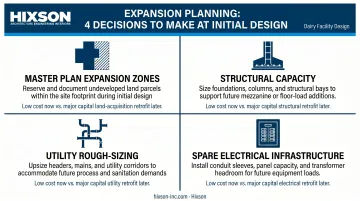
The most cost-effective time to plan for expansion is during initial facility design. Decisions that cost little during construction become major capital projects if deferred:
- Master plan expansion zones — commit future building footprints to site plans before grading begins, while repositioning is still inexpensive
- Structural capacity — size foundations and structural systems now to carry future floor loads without costly reinforcement later
- Utility rough-sizing — switchgear, boiler capacity, refrigeration headers, and water systems should be sized for future phases, not just Day 1 throughput
- Spare capacity in electrical infrastructure — switchgear and distribution panels with spare breaker positions cost little to add during construction and a great deal to modify later
Dairy Foods' 2021 Plant of the Year coverage of MWC's 400,000 sq ft cheese and whey processing facility highlighted future expansion as a design priority from the start. That approach — embedding growth capacity before the first pour of concrete — is what separates facilities that scale smoothly from those that require disruptive, costly retrofits mid-operation.
Hixson's master planning work for food and beverage manufacturers includes utility infrastructure scale-up planning and phased capital deployment — embedding expansion capacity into the initial design before operational pressure forces the issue.
The T. Marzetti Company dairy facility expansion in Columbus, Ohio illustrates what that looks like in practice: a $22.8 million brownfield project that added 17,000 sq ft and three new packaging lines without disrupting existing production, because the original facility had been designed with that growth in mind.
Frequently Asked Questions
What regulatory standards govern dairy processing facility design in the United States?
Four frameworks govern most U.S. dairy facility projects:
- 2023 Revision Grade "A" Pasteurized Milk Ordinance (PMO), enforced by state dairy regulatory authorities
- FDA 21 CFR Part 117 (FSMA cGMPs)
- 3-A Sanitary Standards for equipment and facility design
- USDA requirements for federally graded products
Regulatory drawing review is standard in the industry. Design firms with dairy experience can anticipate reviewer requirements and reduce approval cycle time.
What is hygienic zoning and how does it affect dairy facility design?
Hygienic zoning physically separates raw or incoming product areas from pasteurized or finished product areas. Enforcement comes through building design — walls, dedicated entry points, air pressure differentials, and controlled traffic flow — not operating procedures alone. This separation must be embedded in the architectural design from the earliest project phases.
How are CIP systems incorporated into dairy facility design?
CIP systems deliver timed sequences of hot water, caustic, and acid solutions through processing lines without disassembly. Effective design requires early coordination of room placement, pump sizing, tank capacity, return line routing, and heat exchanger selection — all planned alongside process piping layout, not added after the fact.
Should automation and controls design begin before or after equipment selection?
Controls design should begin during the process design phase. Instrument locations, control panel placement, electrical conduit routing, and network infrastructure must be integrated into the building design. Retrofitting these elements after construction typically results in compromised functionality and added cost.
What is the difference between a greenfield and brownfield dairy processing facility project?
A greenfield project is built on an undeveloped site, offering maximum design flexibility but requiring full site infrastructure development. A brownfield project renovates or expands an existing facility, offering reduced site costs but requiring careful coordination around existing operations, structural constraints, and regulatory compliance across the combined old and new areas.
How should utility systems be sized for a new dairy processing facility?
Process water, steam, compressed air, refrigeration, and electrical systems should all be sized for peak simultaneous demand plus a buffer for future growth. Sizing to average load instead is one of the most common design errors in new dairy facilities — and one of the most expensive to fix once construction is complete.