Introduction
Where you build your facility determines your costs, your workforce, your supply chain, and your competitive position for decades to come. Nonresidential real property has a 39-year depreciation period under IRS guidelines, meaning a poor site choice isn't a short-term inconvenience. It's a multi-decade financial commitment you can't easily reverse once construction begins.
[U.S. business logistics costs have reached $2.3 trillion — roughly 8.7% of GDP — and the network decisions that determine how far goods travel, and from where, carry real financial weight.
Get the location wrong, and you're looking at higher transportation costs, strained workforce pipelines, utility gaps, and regulatory friction — structural problems that compound every year you operate.
This guide walks through what facility location analysis is, why it matters, the five key factors to evaluate, the step-by-step process, and the quantitative methods that bring rigor to the decision.
TL;DR: Key Takeaways
- Facility location analysis is the systematic process of identifying the optimal site based on strategic, operational, and financial criteria
- A poor location decision permanently raises costs, limits workforce access, and constrains future growth
- Key factors: market proximity, labor availability, land and construction costs, infrastructure readiness, and regulatory environment
- The decision process moves from objective-setting through site visits, financial modeling, and risk assessment
- Weighted Scoring, Center of Gravity, and Break-Even Analysis are the three primary quantitative methods, used together rather than in isolation
What Is Facility Location Analysis?
Facility location analysis — sometimes called location-allocation analysis — is the systematic process of identifying the optimal site for a facility from a defined set of candidate locations. It applies to manufacturing plants, distribution centers, food and beverage production facilities, pharmaceutical and biotech sites, laboratories, and corporate offices.
The core objective is balancing three competing goals:
- Service level — can the facility serve customers or internal operations within required lead times?
- Cost minimization — do transportation, labor, utility, and construction costs support the business model?
- Strategic fit — does the location support the organization's growth plans over a 10–20 year horizon?
Greenfield vs. Brownfield Analysis
Two distinct approaches shape how location analysis is conducted:
Greenfield analysis evaluates entirely new sites with no existing infrastructure. It offers maximum design flexibility but requires full utility connections, site preparation, and often longer permitting timelines.
Brownfield analysis evaluates previously developed or existing sites. These may offer existing building shells, utility connections, and established zoning — but often require environmental remediation, renovation, or code-compliance upgrades that affect true cost.
Site type selection depends on operational and regulatory requirements, not just cost. When Hixson designed the $772 million Maple Leaf Foods poultry facility in London, Ontario, the greenfield approach was chosen to accommodate a 640,000 SF footprint with environmental controls — including 150-foot air stacks for odor control and wetlands protection — that no available brownfield site could support.
When Organizations Conduct Location Analysis
Organizations revisit location analysis across the facility lifecycle — typically when:
- Expanding capacity to serve new volume
- Entering new geographic markets
- Consolidating or restructuring supply chain networks
- Responding to supply chain disruptions or regulatory changes
Why Getting Facility Location Right Matters
Once a site is selected and construction begins, the decision is essentially permanent. Relocating an operating facility means disrupting production, absorbing stranded capital costs, and rebuilding supplier and workforce relationships from scratch.
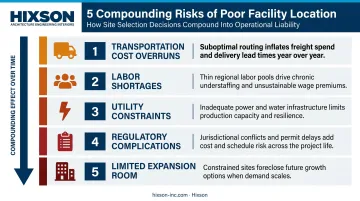
A poor location choice creates compounding operational problems:
- Transportation cost overruns — at an average trucking operating cost of $2.27 per mile, extra miles between your facility and suppliers or customers add up fast across thousands of annual shipments
- Labor shortages — a site chosen without analyzing long-term workforce demographics may face chronic hiring gaps within five years
- Utility constraints — inadequate electrical capacity or water treatment access can cap production throughput, regardless of equipment investment
- Regulatory complications — food and pharma facilities carry FDA siting requirements that, if ignored early, force expensive retrofits or prevent full regulatory approval
- Limited expansion room — sites without adequate acreage or infrastructure headroom force premature relocation when growth demands it
The Regulatory Dimension Is Non-Negotiable
For food, beverage, and pharmaceutical facilities, regulatory compliance is a siting constraint, not a design afterthought. Under 21 CFR Part 211, drug manufacturing buildings must be of suitable size, construction, and location to support GMP operations and contamination control. Similarly, food facilities must be sited and designed to prevent contamination under 21 CFR Part 117.
A low-cost site that fails these requirements will cost far more in retrofits, delays, or lost approvals than any upfront savings.
Key Factors to Consider in Facility Location Analysis
Factors vary by facility type and industry, but most analyses evaluate five core categories.
Market and Supply Chain Proximity
Proximity to customers, raw material suppliers, and distribution networks directly affects transportation costs and lead times. For food and beverage producers, this is especially critical: USDA research confirms that quality loss in perishable food transport is a cumulative function of time and temperature exposure across loading, transit, and unloading stages. Locating a dairy or beverage facility close to ingredient suppliers and regional distribution points isn't a preference. It's a quality and compliance requirement.
For pharmaceutical and biotech facilities, the same logic applies. Cold-chain infrastructure failures don't just delay shipments — they can compromise product integrity and trigger regulatory action. Proximity to qualified carriers and temperature-controlled logistics hubs is a site selection constraint, not a preference.
Labor and Workforce Availability
Labor analysis goes beyond current headcount. A rigorous workforce assessment covers:
- Skill availability (skilled trades, food science technicians, laboratory professionals, automation specialists)
- Wage rates by metro area and occupation
- Local workforce development programs and technical colleges
- Population trends that indicate whether a location can sustain hiring over a 10–20 year period
BLS projects agricultural and food science technicians to grow 5% from 2024 to 2034, with roughly 6,100 openings per year nationally — but that supply is not evenly distributed. Sites in areas with strong agricultural colleges or food manufacturing clusters will have meaningfully different labor dynamics than rural greenfield locations.
Land, Construction, and Operating Costs
The full cost picture includes both one-time and ongoing expenses:
| Cost Category | Components |
|---|---|
| One-time capital | Land acquisition, site preparation, construction, utility connections, permitting |
| Ongoing operating | Labor, utilities, local/state taxes, transportation, maintenance |
| Incentives/offsets | Tax abatements, state grants, workforce training programs |
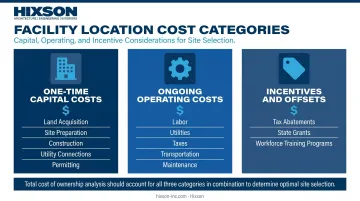
Regional construction costs vary significantly and are subject to ongoing volatility — Gordian's Q2 2025 Construction Cost Insights Report flags potential cost volatility, supply-chain adjustments, and regional price disparities driven by tariff impacts on materials like steel and copper. A single national construction cost estimate applied across candidate regions will produce unreliable comparisons.
On incentives: business incentives average over 30% of state and local business taxes, and subsidy packages of $100 million or more exist for large facilities. These are significant, but they should appear as one line in total cost of ownership modeling, not as the primary decision driver.
Infrastructure and site readiness determine whether a cost-competitive location can actually support your facility — which is where the next layer of evaluation begins.
Infrastructure and Site Readiness
Road access is the starting point, not the full picture. A thorough site readiness evaluation covers:
- Utilities capacity: electrical load capacity, natural gas availability, water supply and pressure, wastewater treatment capacity
- Transportation networks: highway access, rail service, port proximity
- Zoning and land use: current zoning designation, variance requirements, neighborhood compatibility
- Site characteristics: terrain, acreage, expandability, soil conditions, stormwater management
- Telecom and data: fiber availability, redundancy for operations and controls
Hixson evaluates all of these dimensions through an integrated team spanning Civil, Mechanical, Electrical, Plumbing, Structural, and Process Engineering disciplines.
On the Milo's Tea Company greenfield facility in Moore, South Carolina, that integrated approach included master planning that built in capacity for up to 12 additional production lines in future phases. Infrastructure evaluation at the site selection stage shapes long-term capacity decisions, not just initial construction.
Regulatory, Environmental, and Risk Factors
This category functions as a feasibility screen rather than a scoring input. Sites that fail regulatory or risk thresholds should be eliminated before financial modeling begins:
- Natural hazard exposure: FEMA's National Risk Index provides county-level data across 18 natural hazards, including flood, seismic, hurricane, and wildfire risk
- Food and pharma compliance: sites must support FDA and USDA requirements for sanitary layout, utilities, drainage, access, and hygienic zoning
- Environmental permitting: air emissions, stormwater, wastewater discharge, and hazardous materials requirements vary by state and county
- Sustainability: access to renewable energy, grid carbon intensity, and water stewardship obligations are increasingly relevant to corporate sustainability commitments
The Facility Location Analysis Process: Step by Step
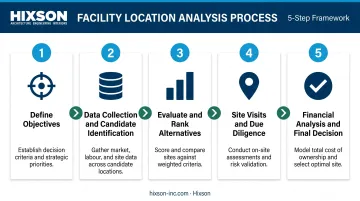
Step 1 — Define Objectives and Evaluation Criteria
The process starts by establishing what the facility must accomplish: capacity targets, service level requirements, cost thresholds, and regulatory mandates. These become weighted evaluation criteria that guide every subsequent step. Without this foundation, site comparisons become subjective.
Step 2 — Data Collection and Candidate Identification
For each candidate location, gather data across six categories:
- Demographic and labor market conditions
- Infrastructure capacity (utilities, roads, rail, port access)
- Transportation networks and freight economics
- Regulatory environment and permitting requirements
- Real estate availability and cost
- Environmental constraints and site history
This phase should consider both greenfield and brownfield options and may incorporate supply chain network modeling to identify geographic zones that optimize freight economics before specific sites are evaluated.
Hixson's process engineering and manufacturing engineering teams contribute here by developing preliminary utility requirements and process flow data. Those inputs make subsequent infrastructure screening far more specific than generic capacity checks.
Step 3 — Evaluate and Rank Alternatives
Apply quantitative methods (detailed in the next section) to score each candidate against weighted criteria. This step requires cross-functional input from operations, finance, legal, and engineering, not just real estate or executive preference.
Organizational familiarity bias — where teams favor sites near existing facilities or headquarters — is one of the most common sources of suboptimal location decisions.
Step 4 — Site Visits and Due Diligence
On-site visits verify data assumptions, assess infrastructure conditions firsthand, and surface red flags that don't appear in secondary data. For technical facilities — food plants, pharma manufacturing, laboratories — this phase typically includes:
- Preliminary utility capacity studies
- Zoning consultations with local planning authorities
- Meetings with economic development offices
- Evaluation of site access, drainage, and expansion potential
Partnering with an architecture and engineering firm at this stage grounds site selection in actual buildability. Hixson's integrated team — covering architecture, civil, MEP, process engineering, and environmental health and safety — evaluates whether a site can physically support the facility program before capital is committed.
Step 5 — Financial Analysis, Risk Assessment, and Final Decision
The final step involves:
- Total cost of ownership modeling: capital investment, 10–20 year operating costs, incentives and abatements, net present value comparison across finalist sites
- Risk assessment: supply chain disruption scenarios, regulatory change exposure, labor market shifts, natural hazard probability
- Governance and documentation: formal stakeholder alignment, decision documentation, and communication to internal and external parties
A well-documented decision withstands scrutiny from lenders, regulators, and board members who will evaluate the capital commitment for years to come.
Quantitative Methods for Facility Location Analysis
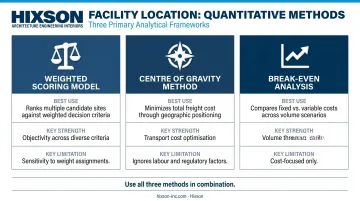
Three methods provide the analytical backbone of most facility location analyses. They work best in combination.
Weighted Scoring Model (Location Factor Rating)
This method assigns numerical weights to each evaluation factor, reflecting its relative importance to the organization's objectives. Each candidate site is then scored against each factor on a 0–100 scale. The site with the highest total weighted score is the preferred location.
The value is objectivity: it forces explicit, documented trade-offs between factors and reduces the influence of organizational politics or executive intuition.
For example, a food manufacturer might weight labor availability at 0.30 and transportation access at 0.25, while a corporate office might weight the reverse.
Key limitation: results are sensitive to weight assignments and qualitative scoring judgments. Sensitivity testing — varying weights and re-running scores — is essential before treating results as definitive.
Centre of Gravity Method
This method uses geographic coordinates and demand or shipment volumes at served locations to calculate the mathematically optimal facility placement point that minimizes total transportation distance and cost.
Best suited for: distribution centers, warehouses, and facilities serving geographically dispersed customers where freight cost is the dominant siting variable.
That said, the model is blind to labor availability, utility capacity, zoning, GMP constraints, and regulatory feasibility — it optimizes for distance and cost only. Use it to identify a candidate geographic zone, then apply weighted scoring and due diligence within that zone.
Break-Even Analysis
This method compares total costs — fixed plus variable — across candidate locations at various output volumes. It identifies which site becomes cost-advantageous at different production or throughput levels.
Most useful when:
- Candidate sites have very different fixed cost structures (e.g., one site requires major utility upgrades, another is shovel-ready)
- The organization faces genuine uncertainty about future demand volume
- Financial leadership wants to understand the volume threshold at which a higher-capital site pays off
Frequently Asked Questions
What is facility location analysis?
Facility location analysis is the systematic process of identifying the optimal site for a facility — manufacturing, distribution, laboratory, or office — from a set of candidates. It uses defined criteria to balance cost, service levels, labor, infrastructure, and strategic objectives simultaneously.
What factors should be considered in facility location analysis?
The primary categories are: proximity to markets and suppliers, labor availability and cost, land and construction costs, infrastructure and utilities readiness, regulatory environment, and natural hazard or environmental risk exposure.
What common facility-related costs should be included in location analysis?
A valid total cost of ownership comparison requires modeling both cost categories across all candidate sites:
- One-time costs: land acquisition, construction, permitting, utility connections, site preparation
- Ongoing operating costs: labor, utilities, transportation, property taxes, maintenance
What quantitative methods are used for facility location analysis?
The three primary methods are Weighted Scoring (Location Factor Rating), Center of Gravity, and Break-Even Analysis. In practice, these methods work best in combination, since each surfaces trade-offs the others cannot measure on their own.
What are the dominant facility location factors for service organizations?
Service organizations — hospitals, labs, banks, corporate offices — prioritize customer proximity, transportation accessibility, workforce quality, and market demographics. Unlike manufacturing, raw material logistics and freight costs are minor considerations in service facility siting.