Introduction
Water is simultaneously an ingredient, a processing aid, and the backbone of every cleaning and sanitation program in a food plant. That triple role makes it unlike any other utility — and it makes overconsumption unusually expensive.
The pressure to cut consumption is coming from multiple directions. Municipal water and sewer bills across 50 U.S. cities rose 24.2% cumulatively over five years, with wastewater charges climbing an additional 4.4% in 2025 alone.
Regional water restrictions are tightening in drought-affected areas across North America. ESG disclosure requirements and retailer sustainability programs now demand measurable reductions in water intensity — with audit trails to back them up.
Food safety doesn't bend to cost pressures. Sanitation standards require significant water use, and that isn't changing. The goal is precision: use what's required, recover what's safe to reuse, and eliminate waste that serves no hygienic purpose.
This article walks through a practical, engineering-grounded framework: water auditing, process and equipment improvements, facility design decisions, and the organizational practices that sustain efficiency gains long-term.
Key Takeaways
- Start with a water audit — you can't manage what you haven't measured
- CIP system optimization and production scheduling are the highest-impact process-level changes
- Flow control hardware and submetering deliver fast, measurable ROI
- Facility design decisions made early determine water efficiency for the life of the building
- Technology only works when your team understands and supports the goals
Why Water Conservation Is a Business Imperative in Food Processing
The Scale of the Problem
The U.S. food processing and packaging sector withdrew 582 billion gallons of freshwater in 2012, according to USDA Economic Research Service data. That figure represents only the processing and packaging stage of the domestic food supply chain — upstream agriculture and downstream distribution are separate. For individual facilities, water intensity varies widely by product category, but virtually every food plant has significant reduction opportunities.
The Compounding Cost Problem
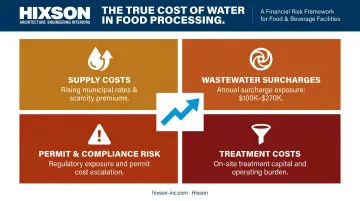
Water costs in food processing aren't just the metered supply rate. They compound:
- Supply costs rising year over year as municipal utilities face infrastructure investment pressures
- Wastewater surcharges tied to BOD and TSS load — a single mid-size dairy or prepared foods facility can face surcharges exceeding $100,000–$270,000 annually based on real municipal rate structures
- Permit and compliance risk as water-stressed regions tighten industrial withdrawal permits or impose seasonal restrictions
- Treatment costs when facilities operate their own pretreatment systems — higher input volumes mean higher operating costs
Most processors overlook a direct consequence: reducing input water volume also cuts wastewater treatment fees, so savings compound on both sides of the meter.
The Regulatory and Stakeholder Dimension
Water conservation has moved from operational efficiency into ESG territory. Three disclosure frameworks now put facility-level water data under direct scrutiny:
- GRI 303 requires disclosures on water withdrawal, discharge, and consumption in water-stressed areas
- CDP Water Security demands facility-level data with year-over-year tracking
- Retailer supplier programs are increasingly embedding water management expectations into procurement requirements
For food processors, water intensity is now a metric that procurement teams, investors, and brand owners actively track. Facilities without a credible reduction program carry both financial exposure and supply chain risk.
Conducting a Water Audit: The Essential First Step
No conservation program should start with equipment purchases or process changes. It should start with a water balance.
What a Water Audit Actually Is
A water audit — sometimes called a water balance — is a systematic map of every point where water enters, is used, and exits a facility. That includes:
- Process operations (washing, blanching, cooling, conveying)
- CIP systems (wash, rinse, and sanitize cycles)
- Utilities (steam generation, condensate losses, cooling towers)
- Sanitary uses (hand-washing stations, hose stations, floor cleanup)
- Leaks and uncontrolled discharges
- Wastewater streams
The Oklahoma State University Extension's food plant water conservation framework describes this as tracking water inputs and outputs across all process operations and utility systems. Without this baseline, any conservation investment is a guess.
Practical Steps for Conducting a Plant Survey
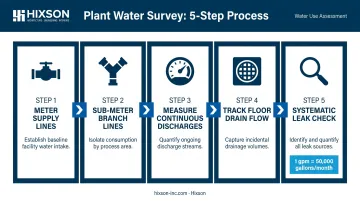
A thorough plant water survey involves:
- Identify and meter all major water supply lines — document quality, quantity, and temperature at each entry point
- Sub-meter branch lines and hose connections, including infrequently used hose bibs
- Measure continuous discharges that are not being captured or reused
- Track flow in floor gutters — high floor-drain flow often signals solids management problems driving unnecessary water use
- Check for leaks systematically — a 1 gpm leak loses approximately 50,000 gallons per month
What the Audit Tells You
The output is a ranked list of water-consuming operations by volume. That ranking immediately separates quick wins — leaks, over-pressurized lines, hoses left running — from longer-term engineering projects. Most facilities find that two or three operations account for the majority of water use, which focuses the investment case sharply.
Hixson's Process Engineering team provides water balance auditing as part of its Water Reuse & Conservation Engineering services — giving processors the engineering baseline needed to build a prioritized, phased reduction plan.
Process-Level Best Practices for Reducing Water Use
Shift from Manual to Automated Cleaning
Cleaning and sanitation consistently represent one of the largest water use categories in food plants. The contrast between manual hosing and automated Clean-In-Place (CIP) systems is stark:
| Approach | Water Control | Repeatability | Volume |
|---|---|---|---|
| Manual hosing | Operator-dependent | Inconsistent | High, unregulated |
| CIP (single-use) | Automated, controlled | Consistent | Lower |
| CIP (recirculating) | Automated + recirculated | Consistent | Significantly lower |
Recirculating CIP systems store and reuse rinse water across sequential cleaning cycles, or cascade rinsewater into subsequent pre-rinse steps. The results can be substantial: Schreiber Foods' California facility reduced total water use by 28%, saving 25,000 gallons per day, while increasing production, after evaluating CIP circuits and RO opportunities.
CIP hardware design matters too. Alfa Laval's testing showed that optimizing valve-seat CIP processes — using pressurized supply and short seat lifts — reduced water per lift from 12.96 L to 3.67 L, a 72% reduction. For a facility with 30 valves, that single change saved nearly 1,000 m³/year.
Optimize Production Scheduling and Changeovers
Production scheduling directly affects how often full cleaning cycles run. Sequencing similar products back-to-back — chocolate pudding before vanilla rather than after — can eliminate cleans between runs entirely. That's a direct reduction in water use without any capital investment.
Additional low-tech, high-impact practices:
- Remove solids dry first — sweeping, shoveling, or using vacuum equipment before hosing dramatically reduces water volume needed for final cleanup
- Use dry ice cleaning for equipment where appropriate — eliminates water entirely for those applications
- Stagger breaks and minimize stop/start cycles to reduce the frequency of full equipment washes
Recover Utility Water
Beyond the process floor, utility systems offer significant recovery opportunities that are often overlooked until it's too late to address them cost-effectively. Steam condensate should be recovered and returned to the boiler — both for energy efficiency and to reduce makeup water demand. Cooling water should cycle through cooling towers rather than running to drain.
These recirculation loops are far easier to incorporate during initial facility design than to retrofit later. Process engineering decisions at the drawing board stage determine whether the pipe runs, storage capacity, and heat exchanger configurations needed for recovery are even feasible.
Equipment Upgrades and Monitoring Systems
Precision Flow Control Equipment
Uncontrolled flow is one of the most common sources of water waste in food plants, and it's largely solved by hardware:
- Pressure regulators stabilize supply-side variation that causes over-delivery at use points
- Self-closing hose nozzles limiting flow to 5 gpm (as recommended by OSU Extension) replace unregulated open hoses
- Automatic shutoff valves tied to motor controls or solenoids stop water flow the moment production pauses or a line shuts down
- Low-flow, high-efficiency spray nozzles for washdown and product cooling achieve equivalent results with less water
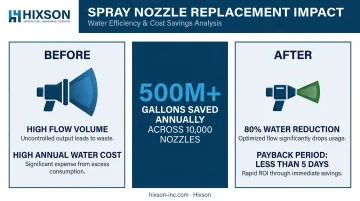
The nozzle replacement opportunity is frequently underestimated. One leading snack food producer found oversized nozzles on corn chip cleaning lines; replacing them cut water use by 80% in that operation. Across North American plants, replacing 10,000 nozzles saved more than 500 million gallons per year and over $3 million annually in water and wastewater costs — with a payback period of less than 5 days.
In-line strainers upstream of nozzles prevent clogging that causes uncontrolled flow and forces operators to work around malfunctioning equipment with open hoses.
Smart Monitoring and Submetering
You can't control what you can't see. Submetering at the department or process-line level gives operations teams the visibility to act:
- Flowmeters on major branch lines establish consumption by area
- Pressure and conductivity sensors in CIP systems flag cycles running outside specification
- Real-time dashboards let operators spot anomalies before they become significant waste events
- Automated reporting creates the data trail needed for ESG and sustainability disclosures
Modern wireless submetering systems can auto-generate usage reports, reducing manual data-collection overhead.
The deeper value comes from tying monitoring data into a facility's broader automation and control infrastructure. Hixson's Controls & Automation team designs control systems with experience spanning CIP systems, utility infrastructure, and PLC/HMI integration across food and beverage sectors. These systems trigger automated responses when water flow exceeds set parameters and track gradual performance degradation in CIP cycles or heat exchangers before it becomes uncontrolled waste.
That monitoring capability connects directly to maintenance. Leaking hose nozzles, fouled spray headers, worn gaskets, and failing heat exchangers are common sources of untracked water loss — and the hardest to catch without scheduled inspections. A targeted inspection program for water-using equipment is low-cost and consistently delivers high returns.
Facility Design and Infrastructure for Water Efficiency
Plumbing System Design
Water efficiency in a food plant is locked in at the design stage. Decisions made on the drawings determine water waste for the life of the building:
- Pipe run lengths affect how long it takes for hot water to reach a use point — longer runs mean more water wasted waiting for temperature to stabilize
- System pressure settings calibrated to actual demand prevent over-delivery at every use point
- Insulation on hot and chilled water lines reduces thermal drift and the purging volume needed to get water to temperature
- Recirculation lines on long hot water runs eliminate the need to run water to drain waiting for temperature
Drainage design is equally important. Proper slope of drainage piping enables self-draining, reduces standing water, and decreases the cleaning requirements during sanitation. Strategic placement of floor drains, curbs, and floor slopes reduces the washdown area and volume during each sanitation event.
These plumbing and drainage decisions work together — and both demand attention from the start of a project. Hixson's Plumbing Systems Engineering team, led by John Brockmeier, P.E., designs domestic water, process water, hot water production, high-pressure and rinse water, and sanitary drainage systems for food processing facilities, with water efficiency considered from project inception rather than addressed as an afterthought.
Facility Layout and Water Conservation
Where equipment is placed affects how much water is needed to clean it. Key layout decisions include:
- Locating CIP skids and reuse tanks close to the equipment they serve — reducing pressure losses and pipe-run volume
- Positioning wash stations at logical points in the production flow to minimize travel distance and idle water use
- Designing maintenance corridors and utility spaces to remain dry by default, reducing the area requiring water-based cleanup
Water Reuse and Advanced Treatment
Water reuse options span a wide range, and the appropriate solution depends on the intended application, regulatory requirements, and food safety considerations:
Non-potable reuse — lower complexity, lower regulatory burden:
- Reclaimed cooling tower blowdown for equipment exterior washing
- Floor drain water after treatment for irrigation
Advanced potable reuse — higher complexity, with significantly greater savings potential:
- Ultrafiltration (UF) removes suspended solids and biological material
- Reverse osmosis (RO) removes dissolved contaminants and can produce water meeting potable standards
- Closed-circuit RO (CCRO) can push recovery rates to 95–98% according to manufacturer data, compared to conventional multistage RO
The regulatory path matters. Under 21 CFR 117.80, water used for washing, rinsing, or conveying food must be safe and of adequate sanitary quality; reused water must not cause allergen cross-contact or increase contamination risk. HACCP plans and applicable state regulations govern what recovered water can contact product or product-contact surfaces.
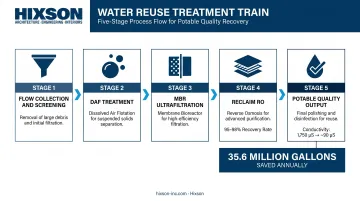
A Midwest ready-to-drink beverage facility using flow collection, screening, DAF, MBR ultrafiltration, and reclaim RO achieved annual water savings of 35.6 million gallons. RO permeate conductivity dropped from 1,750 µS to approximately 90 µS — well within potable quality ranges.
Hixson's water reuse engineering work spans condensate recovery and CIP water reuse at the simpler end, through RO and closed-loop integration with wastewater treatment systems at the more complex end.
Building a Plant-Wide Water Conservation Culture
Infrastructure and equipment are necessary but not sufficient. Plants that sustain water efficiency gains over time treat conservation as an organizational practice, not a one-time project.
The structural requirements:
- Designate a water conservation coordinator with clear accountability and authority
- Establish visible, shared performance metrics — water use per unit of production, by department
- Tie conservation goals to routine operational reviews, not just annual sustainability reports
- Train all personnel on standard operating procedures: turning off hoses when not in use, reporting leaks immediately, using equipment correctly
Employee Engagement as a Force Multiplier
Workers closest to the equipment identify waste first. A hose left running, a spray nozzle dripping, a CIP cycle that seems longer than usual — operators notice these things before instrumentation does.
Structured suggestion programs, water-use dashboards visible on the plant floor, and giving production teams ownership of their area's consumption data build the habits that sustain efficiency. When people see the numbers tied to their work, behavior follows.
Hixson has observed that clients who combine engineering improvements with clear operational accountability achieve more durable results. The facility design creates the conditions; the culture sustains them.
Frequently Asked Questions
How to save water in the food industry?
Start with a water audit to identify where consumption is highest and where waste is occurring. Then prioritize: automated CIP systems, flow control hardware, submetering for real-time visibility, process water reuse where food safety permits, and consistent staff training on water-conscious procedures.
What are 5 methods of water conservation in food processing?
Five proven methods:
- Conduct a water balance audit to establish baselines and identify waste
- Implement or optimize CIP systems with fluid recirculation to cut cleaning water volume
- Install precision flow controls and automatic shutoff valves at every use point
- Redesign production schedules to sequence similar products and reduce full cleaning cycles
- Deploy water submetering for real-time consumption visibility and anomaly detection
What is a water audit in food processing and why is it important?
A water audit maps all inputs, uses, and outputs across a facility — process operations, utilities, sanitation, and waste streams — to establish a consumption baseline. It identifies waste hotspots like leaks, over-pressurized lines, and unnecessary draining, and ranks them by volume to prioritize investment. Without this baseline, conservation programs are guesswork.
What is Clean-In-Place (CIP) and how does it reduce water use?
CIP is an automated system that cleans and sanitizes food-processing equipment in place without disassembly, using precisely controlled water volumes and chemical concentrations. Recirculating CIP designs store and reuse rinse water across sequential cleaning steps, dramatically reducing total water demand compared to manual hosing or disassembly-and-wash methods — while also improving cleaning consistency.
How can water be safely reused in a food processing facility without compromising food safety?
Safe reuse depends on the intended application: non-potable reclaimed water suits non-product-contact uses such as exterior equipment washing, while ultrafiltration and reverse osmosis treatment can produce water meeting potable standards for production use. Any reuse system must be validated against 21 CFR 117.80 and applicable HACCP plans before contacting product or product-contact surfaces.