Introduction
Food and beverage plants, pharmaceutical manufacturers, and industrial facilities move enormous volumes of water through process lines, cooling towers, CIP circuits, and boiler systems every day. Yet most operate without a clear picture of where that water actually goes — or how much is quietly lost.
That blind spot is expensive. According to the EPA's Lean & Water Toolkit, cooling operations alone account for over 50% of combined industrial and commercial water demand, and cleaning equipment in food processing and pharmaceutical facilities can consume 50% to 70% of total water use. When that water isn't tracked, losses accumulate undetected.
An industrial water audit maps every water-using system from supply to discharge, quantifies consumption and losses, and identifies where money is leaving through the drain.
This guide covers what an industrial water audit entails, why it matters, the complete checklist of systems to evaluate, and how to conduct one step by step.
Key Takeaways
- Industrial water audits track water from point of entry through every use — process, cooling, sanitation, utilities — to discharge or reuse
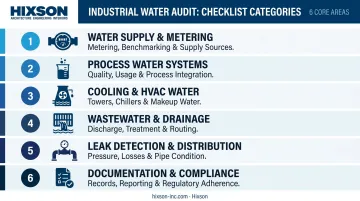
- A complete checklist covers six areas: metering, process water, cooling systems, wastewater and drainage, leak detection, and documentation
- Industrial audits carry far greater scope, regulatory complexity, and water quality requirements than commercial building audits
- Acting on findings reduces utility costs, prevents compliance violations, extends equipment life, and supports ESG goals
What Is an Industrial Water System Audit?
An industrial water system audit is a structured, facility-wide review that traces water from the point of entry through every use — process, cooling, sanitation, utilities — to discharge or reuse. The purpose is to quantify consumption, surface losses, and confirm that operations satisfy regulatory requirements.
That scope sets industrial audits apart from the commercial variety in meaningful ways.
How Industrial Audits Differ from Commercial Audits
A commercial building audit covers fixtures, irrigation, and HVAC. Industrial facilities involve systems and regulatory obligations that commercial audits don't account for:
- Process water quality requirements — direct-contact water in food or pharma settings must meet FDA, USDA, or cGMP standards
- Regulatory discharge obligations — NPDES permits, categorical pretreatment standards, and local sewer agreements impose limits on what a facility can discharge and in what quantities
- Multi-system water flows — cooling circuits, CIP systems, boiler makeup, high-pressure rinse water, and RO/DI systems all interact, making a simple fixture count useless
Self-Audits vs. Professional Audits
Most facilities use one of two approaches:
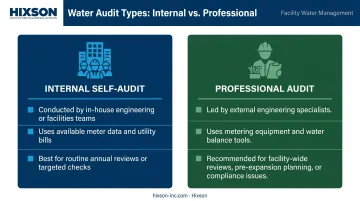
- Internal self-audit — conducted by in-house engineering or facilities teams using available meter data and utility bills; appropriate for routine annual reviews or targeted system checks
- Professional audit — led by external engineering specialists with metering equipment, water balance tools, and regulatory expertise; recommended for comprehensive facility-wide reviews, pre-expansion planning, or when compliance is at issue
Why Industrial Facilities Need a Water Audit
Financial Impact
Water isn't just a utility line item. The EPA notes that the full cost of industrial water includes energy for heating and pumping, chemicals for pretreatment, wastewater treatment fees, and regulatory compliance costs for NPDES permits. Facilities that don't track water by system have no way to know which processes are driving those costs or where efficiency gains are available.
Undetected leaks, aging distribution infrastructure, and inefficient cooling tower operation steadily inflate those totals year after year.
Regulatory Risk
Industrial facilities discharging process wastewater face legal obligations under the Clean Water Act and Safe Drinking Water Act. NPDES permits establish specific effluent limits — BOD, TSS, pH, temperature — and violations carry real consequences.
Recent EPA enforcement actions show what's at stake:
- Hanover Foods agreed to a $1.15 million penalty for Clean Water Act violations at a wastewater treatment facility
- Austin Powder Company paid a $2.3 million civil penalty for wastewater treatment failures
Both cases involved conditions that a structured audit would have flagged well before regulators did.
Operational and Sustainability Risk
Facilities without a clear water map routinely miss early warning signs: slow leaks that become pipe failures, cooling tower chemistry drift, cross-contamination risks from degraded distribution systems. WRI's Aqueduct analysis projects that by 2050, 31% of global GDP will be exposed to high water stress.
That pressure is already showing up in practice — through tighter permit conditions, customer supply chain audits, and ESG disclosure requirements that expect documented water use data from industrial suppliers.
The Industrial Water Audit Checklist: Key Areas to Cover
Every industrial water audit should address six core system categories. Here's what to inspect in each.
1. Water Supply and Metering
The audit starts at the meter — and works inward.
- Verify the main water meter exists, is calibrated, and is functioning accurately
- Identify all submeters tied to individual production lines, processes, or zones — and flag any major water-using systems that lack dedicated metering
- Pull 12–24 months of utility bills to establish seasonal consumption baselines
- Review for unexplained consumption spikes, which typically indicate leaks, metering errors, or process changes that weren't captured in documentation
If submetering is absent across large portions of the facility, that gap alone is an audit finding. Without consumption data at the system level, identifying waste or isolating the source of overages becomes guesswork.
2. Process Water Systems
In food and beverage, pharmaceutical, and manufacturing facilities, this is the most technically demanding section of the audit.
- Document all points where water contacts product or process: direct contact water, rinse water, CIP circuits, hot water systems, high-pressure rinse lines
- Verify that water quality specifications match what's required by regulation — under FDA 21 CFR 117.37 for food facilities, USDA 9 CFR 416.2 for meat and poultry, and 21 CFR 211.48 for pharmaceutical manufacturing
- Confirm that filtered, treated, RO, DI, or potable-grade water is specified and delivered where required — verify actual installed conditions, not just original design documents
- Check that water heating equipment (direct contact heaters, hot water generators) is operating within design parameters and producing water at specified temperature and pressure
3. Cooling and HVAC Water Systems
Cooling towers are one of the largest water consumers in industrial facilities and one of the most commonly overlooked in audits.
Key inspection points:
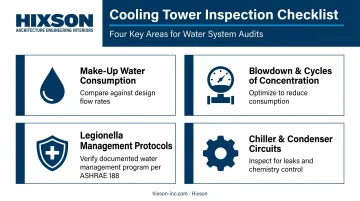
- Make-up water consumption — compare against design flow rates and identify excessive use
- Blowdown frequency and cycles of concentration — optimizing cycles is one of the most direct ways to reduce tower water consumption; the EPA identifies this as a primary efficiency lever for cooling tower operation
- Legionella management protocols — CDC guidance and ASHRAE Standard 188 both require documented water management programs for cooling towers; verify that a current program exists and is being followed
- Chiller and condenser water circuits — inspect for leaks, verify chemistry control logs, and check whether recirculation or water reuse strategies are in place
4. Wastewater and Drainage Systems
This section is where regulatory exposure is highest.
- Map all process drainage and sanitary drainage pathways — confirm they're separated where required and routed to the correct discharge point
- Verify that discharge volumes and quality parameters (BOD, TSS, pH, temperature) comply with the facility's NPDES permit or local pretreatment agreement
- Inspect floor drains, trench drains, and interceptors for function and condition — blocked or degraded drains create both compliance and sanitation risks
- Review discharge monitoring reports (DMRs) and any records of past violations or corrective actions
Facilities discharging to municipal systems must also verify compliance with categorical pretreatment standards under the National Pretreatment Program. That program governs industrial users discharging to publicly owned treatment works and carries its own reporting and sampling requirements.
5. Leak Detection and Distribution Integrity
Leaks in industrial distribution systems are easy to overlook and costly to ignore. The EPA's Lean & Water Toolkit identifies undetected distribution losses as a consistent source of preventable water waste across manufacturing facilities.
- Perform a pressure test or flow-balance check to identify distribution losses not visible during normal operations
- Walk exposed piping, joints, valves, and fittings for signs of corrosion, mineral buildup, or active leaks
- Review maintenance logs for recurring leak repairs — repeated fixes at the same location signal systemic pipe degradation, not isolated events
- Flag any dead-leg sections or low-use lines that create water quality risks (stagnant water) and wasteful consumption
6. Documentation, Records, and Compliance Readiness
The final checklist category is often the one that gets facilities in trouble during inspections.
- Verify water quality test records (chemical and microbiological) are current, complete, and accessible
- Confirm that system schematics, P&IDs, and utility drawings reflect actual installed conditions — not the original design that was modified three times since construction
- Check that sampling procedures specify location, frequency, and acceptance criteria
- Ensure permits, inspection reports, and corrective action records are organized and ready for review
Documentation gaps are especially common in facilities that have undergone expansions or equipment additions — systems get installed, but the records that should follow them never do. That's the kind of finding that turns a routine audit into a corrective action plan.
How to Conduct an Industrial Water Audit Step by Step
Step 1 – Define Scope and Establish Baselines
Set geographic and system boundaries first: which buildings, production lines, and utility systems are in scope. Pull 12–24 months of utility bills to establish consumption baselines by season — this is what you'll compare measured findings against.
Gather all existing system documentation before fieldwork begins:
- P&IDs and process flow diagrams
- Utility drawings and as-built plumbing plans
- Permit records, discharge authorizations, and prior audit reports
Facilities with engineering-quality as-built documentation — including those developed through a Hixson design engagement — reduce field verification time significantly, since teams can confirm conditions rather than map them from scratch.
Step 2 – Map Water Flows Across the Facility
Walk the facility and physically trace water from the main supply through all use points to drainage or discharge. Document each use point by system type and note whether submeters are present. Every gap in metering or documentation is a location where water consumption is unknown — and therefore unmanaged.
Step 3 – Collect Data and Measure Consumption
Install or read submeters at key locations identified during the mapping stage. Record flow rates, temperatures, pressures, and quality parameters at each critical point.
Then build the water balance: compare total input volume to the sum of all metered uses plus documented losses. The gap is non-revenue water — consumption that's occurring but isn't attributed to any specific system.
Step 4 – Analyze Findings and Identify Inefficiencies
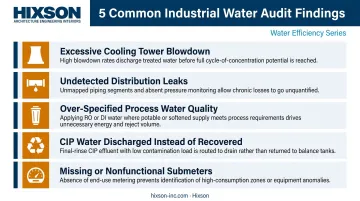
With the water balance in hand, compare measured consumption against benchmarks for your facility type. Common findings include:
- Excessive cooling tower blowdown relative to cycles of concentration
- Undetected distribution leaks inflating overall consumption
- Process water specified at higher quality than the application requires
- CIP water discharged rather than recovered and reused
- Missing or nonfunctional submeters creating blind spots
Flag any compliance gaps separately — discharge quality exceedances, incomplete sampling records, or permits that haven't been updated after process changes.
Step 5 – Prioritize Recommendations and Build an Action Plan
Rank findings by impact and implementation difficulty:
- Quick wins: Fix identified leaks, adjust cooling tower blowdown frequency, update sampling logs
- Near-term improvements: Add submetering to unmonitored systems, upgrade treatment equipment
- Capital projects: Redesign process water circuits, add water reuse or recovery infrastructure, upgrade wastewater pretreatment
Assign ownership for each action item, establish a timeline, and set measurable reduction targets. Without named owners and deadlines, findings stall — the action plan is what converts audit data into actual water savings.
How Hixson Can Help
Hixson is a full-service architecture and engineering firm with 75+ years of experience designing industrial facilities — particularly in food and beverage, pharma and biotech, and manufacturing sectors where water system complexity is high and the consequences of compliance failures are significant.
Hixson's Plumbing Systems & Fire Protection Engineering team, led by John Brockmeier P.E., covers the full range of industrial water systems, including:
- Domestic and process water distribution
- Hot water production and direct contact water heaters
- High-pressure rinse water systems
- Sanitary and process drainage
- Central sanitation systems
That breadth means Hixson can both conduct the water assessment and design the improvements it uncovers.
What sets Hixson apart from a standalone audit firm is what happens after the findings. When water system findings need to translate into action — whether that means redesigning a process water circuit, adding submetering, or upgrading wastewater pretreatment — Hixson's Process Engineering, Mechanical, Civil, and Controls & Automation teams are already part of the engagement. Findings move directly into design without a handoff delay.
That model has delivered results for clients like Abbott Nutrition, where Hixson's engineering work on a $400 million facility expansion included enhanced wastewater pretreatment systems, and Nestlé's Modesto dairy facility, where Hixson's work supported the facility becoming the first dairy plant in the U.S. to earn Alliance for Water Stewardship (AWS) certification.
Frequently Asked Questions
What should an industrial water audit checklist include?
A complete checklist covers six core areas: water supply and metering, process water systems, cooling and HVAC water, wastewater and drainage, leak detection and distribution integrity, and documentation and compliance records. Inspection items within each category should be tailored to the facility type and applicable regulatory requirements.
What is an industrial water system audit?
An industrial water system audit is a facility-wide evaluation that tracks water from point of entry through all process uses to discharge or reuse. It quantifies consumption, identifies losses and inefficiencies, and verifies that water use and discharge meet applicable regulatory requirements.
How often should an industrial facility conduct a water audit?
Full audits every two to three years are a sound baseline, with additional audits triggered by significant operational changes — new production lines, facility expansions, or major equipment upgrades. Annual meter reviews and targeted spot checks help catch issues between full audits.
What is the difference between a water audit and a water assessment?
The terms are often used interchangeably, but a water audit typically involves a rigorous, data-driven water balance — comparing total input to metered uses and quantified losses. A water assessment may be a broader, less quantitative review of water use patterns and conservation opportunities, without the same level of measurement discipline.
Can an industrial water audit help with regulatory compliance?
Yes. Audits directly support compliance by identifying discharge quality gaps, verifying permit adherence, and confirming that water quality records — sampling logs, test results, corrective action documentation — are complete and current before an EPA or state inspection.