Many manufacturers make this worse by treating site selection as a logistics question and moving straight to facility design. Food manufacturing carries site-specific requirements that most industrial categories don't: high-volume process water, high-strength wastewater, cold chain sensitivity, and FDA/USDA regulatory alignment that varies meaningfully by geography. None of those are solvable through good design if the site itself can't support them.
This article covers the six factors that should drive every food manufacturing site evaluation — and why compressing or skipping any of them tends to surface as expensive problems later.
Key Takeaways
- Site selection for food manufacturing goes far beyond cost per square foot — utilities, logistics, workforce, and food-specific regulations all shape long-term viability.
- Water availability and wastewater capacity are the most underestimated factors; confirm both before advancing any site.
- Raw material proximity shapes ingredient quality, cold chain complexity, and input costs — evaluate all three together, not separately.
- Build expansion into the decision from day one: acreage, zoning flexibility, and utility scalability all need to pencil out before you commit.
- Incentives should confirm a decision, not drive one.
Why Site Selection Is Uniquely Critical for Food Manufacturing
Food manufacturing is among the most infrastructure-dependent categories in industrial real estate. According to the U.S. Department of Energy, food and beverage manufacturing accounts for 6% of total U.S. industrial energy use across more than 30,000 facilities nationwide. The EPA reports that cleaning process equipment alone can represent 50% to 70% of total water use at food, beverage, and pharmaceutical facilities — and that's before accounting for product formulation water.
Unlike general manufacturing, food plants generate high-strength wastewater with elevated BOD, COD, and FOG levels that can trigger municipal surcharges or outright rejection from local treatment systems. Getting a letter of intent from the utility is a starting point; confirming actual capacity for peak loads and pretreatment expectations is what protects the project.
There's also a community dimension most manufacturers underestimate. Food facilities generate impacts that attract regulatory and neighborhood scrutiny in ways a warehouse or light-industrial tenant simply doesn't:
- Odor from production and waste handling, particularly in protein and dairy operations
- Heavy truck traffic for raw material delivery and finished goods distribution
- High-strength effluent that strains local treatment infrastructure and draws permit conditions
Local zoning culture, neighboring uses, and community relations aren't soft factors. They directly affect permitting timelines and the operational limits placed on your facility.
The investment stakes reflect all of this. Food Engineering's Plant Construction Survey tracks hundreds of food and beverage plant projects of $1 million or more each year. Recent examples include Chobani's $1.2 billion New York dairy facility and a 525,000-square-foot Westrock Coffee manufacturing site in Arkansas. At that scale, a site that fails to clear utility, regulatory, or labor screens late in the process creates cost exposure that no incentive package can recover.
Key Factors to Consider When Choosing a Site
The right site balances food-specific operational requirements with broader business factors. These six areas form the foundation of a rigorous evaluation — and skipping or underweighting any of them during early screening tends to become visible during design, permitting, or early operations.
Proximity to Raw Materials and Distribution Networks
For perishable inputs — fresh produce, dairy, meat — transport distance isn't just a cost variable, it's a product quality variable. Every mile and every hour between the farm or processing source and your facility narrows the freshness window and adds complexity to cold chain management. The compounding effect is real: more refrigerated transport, tighter scheduling requirements, higher spoilage risk.
Outbound distribution matters equally. A site's highway access, rail connectivity, and proximity to distribution centers governs how efficiently finished goods reach customers. A mismatch (where raw material sources pull the site one direction and major markets pull it another) erodes margin on both ends of the supply chain simultaneously.
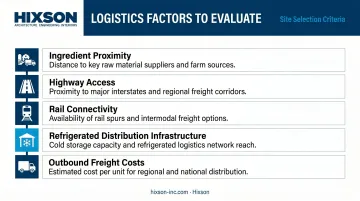
Key logistics factors to evaluate:
- Proximity to primary ingredient sources by product category (dairy, grain, produce, protein)
- Highway access and proximity to interstate networks
- Rail spur availability or access to Class I rail
- Distance to refrigerated warehouse and distribution infrastructure
- Outbound freight costs to top customer markets
Labor Market Availability and Workforce Skills
Food manufacturing requires both general production labor and workers with specific competencies: food safety protocols, sanitation practices, HACCP awareness, and equipment operation. Those skills aren't universal across industrial labor pools.
BLS QCEW data show that food manufacturing employment is deepest in California (167,813 workers), Texas (111,854), and Illinois (99,522). But workforce depth and wage pressure don't move in lockstep — Illinois's average annual food manufacturing pay of $74,712 compares to $57,506 in Texas, which matters significantly in long-term operating cost modeling.
Metrics worth evaluating during labor screening:
| Factor | What to Assess |
|---|---|
| Labor pool depth | Food manufacturing employment within commutable distance |
| Wage structure | Average pay by skill tier and shift type |
| Training infrastructure | Community colleges with PCQI, SQF, or HACCP programs |
| Industry concentration | Existing food and beverage employers in the region |
Regions with an existing food and beverage manufacturing base tend to have workforces that are faster to train and better acclimated to the operational culture: sanitation disciplines, temperature-controlled environments, and food safety documentation requirements.
Utility Infrastructure: Water, Wastewater, and Energy
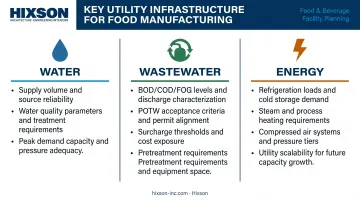
Water is the utility that most often kills a food manufacturing site late in the evaluation process, after significant time and money have been spent. Confirming adequate municipal supply is necessary but not sufficient.
The real questions are diagnostic: Can the local system handle your peak demand? What is the water quality, and does it require pretreatment before it touches your process? Will the POTW (publicly owned treatment works) accept your wastewater, at what strength, and at what surcharge?
Food and beverage wastewater is typically high in organic strength (elevated BOD, COD, and TSS) and often contains FOG that can create compliance problems downstream. Some municipalities won't accept food processing effluent above certain strength thresholds without on-site pretreatment. Discovering that requirement after site commitment changes the capital budget materially.
Beyond water, food facilities carry significant energy loads:
- Refrigeration for cold storage and process temperature control
- Steam and process heating for cooking, pasteurization, and CIP
- Compressed air for packaging and automation systems
Evaluate electric rate structures, natural gas availability, service redundancy, and whether the utility can scale as production capacity grows. For large facilities, energy cost per unit of production is a meaningful operating variable, not just a background expense.
Regulatory Environment and Zoning Compliance
The FDA's FSMA Preventive Controls for Human Food rule requires covered food facilities to have a documented food safety plan with hazard analysis and risk-based preventive controls. That's a design and operations requirement with direct site implications. The facility's layout must support hygienic zoning, sanitation traffic flows, allergen segregation, and waste handling. A site whose configuration can't accommodate those spatial requirements creates FSMA compliance risk before production begins.
USDA oversight applies depending on product category, adding another regulatory layer for meat, poultry, and egg products. Both agencies' regulatory culture varies by district and region. Pre-application meetings with regional FDA district offices during site evaluation can surface enforcement posture before you're committed to a location.
Local factors carry equal weight:
- Zoning classification determines permitted noise, odor, and effluent levels
- Industrial zones vary; not all industrial zoning accommodates food-grade processing
- Neighboring uses matter: a residential boundary adjacent to a rendering or fermentation operation creates permitting and community risk
- Jurisdictions with streamlined permitting processes can compress project timelines by weeks or months
Site Size, Configuration, and Expansion Potential
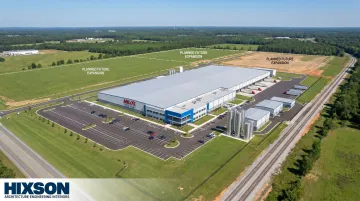
A food manufacturing facility's physical footprint includes more than the processing building. Truck staging, ingredient storage, employee parking, and potentially on-site wastewater pretreatment all require acreage — and undersized sites create either operational bottlenecks or a ceiling on future capacity.
The Milo's Tea Company facility that Hixson designed and engineered in Moore, South Carolina illustrates how expansion planning belongs in site selection, not a later phase. The initial 180,000-square-foot facility was designed for four filling and packaging lines — but the site was master planned from the start to accommodate up to 12 additional lines in the future. Forward-looking site configuration requires an integrated team assessing process layout, utilities, and civil site conditions simultaneously — from day one.
Footprint components to account for in early site screening:
- Processing and packaging building (including future phases)
- Receiving docks and truck staging/queuing area
- Dry and refrigerated ingredient storage
- Finished goods staging and shipping
- On-site wastewater pretreatment (if required)
- Employee parking and welfare facilities
- Utility infrastructure setbacks and easements
Incentives, Tax Climate, and Economic Development Programs
State and local incentives — property tax abatements, job creation credits, utility rate reductions, training grants — can improve project economics. Texas, Virginia, Oklahoma, and West Virginia each maintain competitive programs oriented toward manufacturing capital investment and job creation. But incentives should function as a tiebreaker between comparably viable sites, not as a primary driver.
The reason is structural. Incentives tied to job creation or capital investment thresholds create ongoing obligations. If the site underperforms operationally — because water capacity was overestimated or the labor market didn't deliver — the incentive structure doesn't compensate for that. A site must demonstrate operational and financial sustainability on its own terms before the incentive package factors into the decision.
How Hixson Can Help
Hixson is a full-service architecture and engineering firm with 75+ years of experience in food and beverage facility projects — from greenfield facilities like the Milo's Tea Company plant in South Carolina to large-scale, complex builds like the Maple Leaf Foods poultry processing facility in London, Ontario.
What makes Hixson's approach to site selection different is the depth of technical evaluation that happens simultaneously. With 20 integrated in-house disciplines — civil engineering, process engineering, mechanical and electrical engineering, industrial wastewater, refrigeration, architecture, and manufacturing engineering — Hixson can assess a site's feasibility across every critical dimension at once rather than sequentially.
Utility capacity, process layout viability, civil site constraints, environmental requirements, and zoning compatibility all get evaluated in parallel. That compressed timeline reduces the risk of a late-stage discovery derailing the project's direction.
Hixson's site selection services include:
- Site criteria development (acreage, utilities, layout, neighborhood compatibility)
- Site suitability evaluation (terrain, road and rail access, expandability)
- Environmental assessments (Phase 1 and Phase 2)
- Utility infrastructure assessment (water, wastewater, natural gas, electric)
- Permit requirements investigation and building code analysis

That depth of service reflects equally deep sector knowledge. Hixson's food and beverage experience covers dairy, meat, beverage, and prepared foods — sectors with meaningfully different utility, process, and regulatory requirements.
With an average associate tenure of more than 10 years, the engineers reviewing a dairy site's wastewater capacity or a meat plant's utility load have worked through those same assessments across dozens of real projects — and know where the surprises tend to hide.
Conclusion
The best food manufacturing site isn't the cheapest or the most incentive-rich. It's the one that aligns with the facility's long-term operational requirements across logistics, utilities, workforce, regulation, and expansion capacity. Those factors compound: a site that clears every screen except wastewater capacity will still stop a project in its tracks six months into design.
Site selection is the foundation on which every subsequent design, permitting, and construction decision gets built. A poor choice creates constraints that no amount of engineering skill can fully resolve — some sites simply cannot support the operation, whether due to physical limitations or regulatory barriers. Getting that call right early is far less costly than correcting it mid-design. That's why site evaluation deserves the same rigor as any phase of the facility project itself.
Frequently Asked Questions
What factors should be considered when selecting a site for a new food manufacturing facility?
The primary categories are proximity to raw materials, labor availability, utility infrastructure (especially water and wastewater), regulatory and zoning environment, site size and configuration, and economic incentives. Food-specific factors — water quality, FSMA/USDA regulatory alignment, and wastewater treatment capacity — deserve particular attention and should be screened early before other factors are weighed.
What are the best states for food manufacturing facility site selection?
It depends on your product category and supply chain. California, Texas, and Illinois offer the deepest food manufacturing labor pools; Midwestern states tend to have strong supplier ecosystems, while Southern states like Texas and Tennessee are often competitive on logistics and operating costs. The 2025 Global Location Strategies report flagged the East North Central region for broad-based food manufacturing investment strength.
Should I choose a greenfield or brownfield site for my food manufacturing facility?
Greenfield sites offer full design flexibility but require building all infrastructure from scratch. Brownfield sites can mean faster occupancy and existing utilities, though environmental liabilities or layout constraints may complicate food-grade operations. The right choice depends on your timeline, capital budget, and whether existing infrastructure genuinely supports food manufacturing requirements.
How important is water and wastewater infrastructure for food manufacturing site selection?
Water is typically the most critical utility for food manufacturing. High process water volumes, CIP cycles, and high-strength wastewater with elevated BOD and FOG exceed what many municipal systems can handle without pretreatment. Confirming POTW acceptance, effluent limits, and available capacity early in site evaluation is essential — problems discovered after site commitment are far more costly to fix.
How long does the site selection process typically take for a food manufacturing facility?
A thorough process — covering requirements definition, due diligence, utility confirmation, and incentives negotiation — typically spans several months before construction begins. Compressing this phase is a common mistake; problems that surface during design or permitting cost significantly more to resolve than taking the time to screen sites properly upfront.
How do zoning and permitting requirements affect food manufacturing site selection?
Food manufacturing facilities must satisfy both land use zoning requirements and industry-specific regulations under FDA and potentially USDA oversight. Sites in jurisdictions with clear industrial zoning and streamlined permitting processes consistently reach construction faster and with fewer cost surprises. Neighboring land uses and local community relations are also part of this equation — food facilities that generate odor, noise, or heavy truck traffic face more scrutiny in mixed or sensitive zones.