The design fundamentals aren't secret. What makes industrial HVAC genuinely difficult is the layer of complexity that residential and commercial systems never face: fluctuating process loads, hazardous environments, strict regulatory frameworks, and the operational cost of getting it wrong.
This guide walks through the full industrial HVAC design process — from pre-design inputs through BAS integration — and identifies the variables and mistakes that most often drive costly failures.
Key Takeaways
- Industrial load calculations must account for process heat separately from envelope and occupancy loads — software modeling is required
- System type (air-based, hydronic, DX, or hybrid) should match the facility's contamination risk, process profile, and maintenance needs
- Airflow, ventilation, and humidity control require zone-specific design logic, not generalized ACH or RH targets
- BAS integration must be planned from schematic design — not retrofitted after construction
- ASHRAE 62.1, 90.1, and 15, plus OSHA and GMP/FDA/USDA requirements, must be addressed from day one
How to Design an Industrial HVAC System: A Step-by-Step Process
Step 1: Perform Detailed Heating and Cooling Load Calculations
Industrial load calculations differ from commercial ones in a fundamental way: process loads. A food plant's ovens, washdown stations, or fermentation tanks can dwarf the combined heat contribution of lighting, occupancy, and building envelope — and none of that shows up in a square-footage estimate.
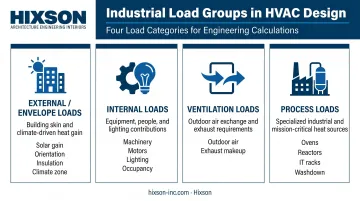
Per ASHRAE Standard 183-2024 and the Load Calculation Applications Manual, industrial load calculations should separate four distinct load groups:
- External/envelope loads — solar gain, building orientation, insulation values, climate zone data
- Internal loads — machinery, motors, lighting, and occupancy heat gain
- Ventilation loads — outdoor air quantities, exhaust makeup requirements
- Process loads — ovens, reactors, clean steam, fermentation, washdown, IT racks, or any heat-releasing manufacturing equipment specific to the operation
Manual rule-of-thumb estimates are insufficient for any of this. Undersized systems cause process failures and worker safety risks. Oversized systems waste capital — and create their own problems.
DOE/NREL research found that nearly 60% of fan systems are oversized by at least 10%. A 5% fan-speed reduction cuts power by roughly 15%. That's the real cost of starting with bad load numbers.
Hixson's mechanical engineering team develops mass and energy balances and process flow diagrams as part of the pre-design phase — treating process-related data as a fundamental load calculation input, not an afterthought.
Step 2: Select the Appropriate System Type and Equipment
System selection isn't primarily about efficiency ratings. It's a risk trade-off among contamination control, process compatibility, refrigerant safety, corrosion exposure, and maintainability.
| System Type | Best-Fit Industrial Application |
|---|---|
| Air-based AHUs/RTUs | High outdoor air requirements, filtration, exhaust, and pressurization control |
| Hydronic (chilled/hot water) | Large central plants, multi-zone cooling, process-adjacent heat recovery |
| DX/unitary | Packaged or localized loads with factory-rated vapor-compression equipment |
| VRF/VRV | Flexible zoning where refrigerant charge limits and service access are acceptable |
| DOAS + terminal units | Separating outdoor-air/dehumidification load from sensible zone cooling |
Equipment selection criteria to address:
- Capacity matched to calculated loads (not estimated loads)
- Efficiency specified via ASHRAE 90.1-2025 and AHRI 340/360 — not generic SEER ratings, which don't apply to most industrial equipment
- Corrosion-resistant coatings and NEMA enclosure types for harsh or chemically aggressive environments
- Redundancy configurations for pharmaceutical cleanrooms, data center support, and similarly sensitive spaces
- Refrigerant selection evaluated against EPA Section 608 requirements and the AIM Act's 85% HFC phasedown by 2036
Step 3: Design Ductwork, Airflow Layout, and Distribution
A compressed flexible duct section in an industrial facility can produce pressure drops 2 to 10 times higher than sheet metal — and those losses compound across the entire system.
SMACNA's HVAC Duct Construction Standards (4th edition) governs pressure class, leakage class, sealing, and testing requirements. In industrial environments, duct material selection must also account for:
- Chemical vapor exposure (acidic or caustic atmospheres degrade standard galvanized steel)
- High-temperature zones near process equipment
- Particulate-laden air streams that accelerate wear
- Hygiene requirements in food and pharmaceutical spaces
OSHA 29 CFR 1910.94 sets velocity requirements for specific process exhaust applications — for example, 4,500 fpm in branch ducts serving grinding and buffing operations. Facilities that fall short face OSHA citations and potential shutdown of the affected process.
Cleanroom airflow requires ISO 14644-1:2015 classification logic. USP <797> specifies ISO Class 7 cleanroom suites at 30 total HEPA-filtered air changes per hour and ISO Class 8 at 20 ACPH, with 0.02 inches of water column positive pressure between classified areas — generic commercial ACH tables don't apply.
Spatial coordination is equally critical. Routing ductwork around large process equipment requires active collaboration between mechanical and process engineering teams, not sequential handoffs.
Step 4: Plan the Ventilation Strategy and Indoor Air Quality Controls
ASHRAE 62.1-2025 sets the IAQ baseline for occupant ventilation. In industrial facilities, that baseline is the minimum — OSHA, FDA, USDA FSIS, and GMP requirements routinely demand more. OSHA, FDA, USDA FSIS, and GMP requirements routinely demand more — in some cases, significantly more.
Ventilation strategy selection by zone:
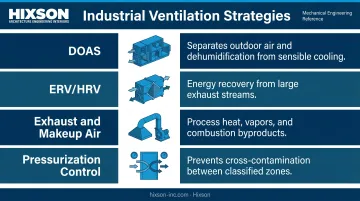
- DOAS (Dedicated Outdoor Air Systems) — separate outdoor air and dehumidification from sensible zone cooling; reduces latent load on terminal equipment
- ERV/HRV — recover energy from exhaust streams; appropriate where large outdoor air quantities create significant conditioning costs
- Exhaust and makeup air systems — required wherever process operations generate heat, moisture, chemical vapors, or combustion byproducts
- Pressurization control — prevents cross-contamination between zones with different cleanliness classifications
EU GMP Annex 1 requires a minimum 10 Pa pressure differential between adjacent rooms of different grades in sterile manufacturing environments, with Grade A unidirectional airflow verified at 0.36 to 0.54 m/s. In food processing facilities, USDA FSIS sanitation guidance requires ventilation adequate to control odors, vapors, and condensation.
Filtration levels must be specified by zone — from standard MERV ratings for general industrial spaces through HEPA for sterile pharmaceutical environments. There is no universal specification.
Step 5: Integrate Building Automation Systems and Ensure Code Compliance
A BAS provides centralized control, real-time diagnostics, predictive maintenance alerts, and integration with fire suppression, security, and process control systems. It's also how the system actually performs to design intent after construction — not just on paper.
DOE data shows high-performance controls reduce HVAC energy use by up to 30% in commercial buildings. In industrial settings, the consequences of underperforming controls go further: HVAC failure can halt production, trigger regulatory non-compliance, or create life-safety incidents.
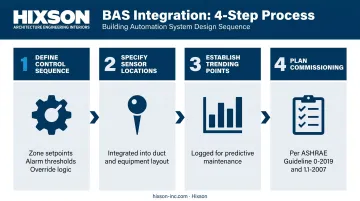
BAS design must begin at schematic design, not during construction administration. That means:
- Define the control sequence — zone setpoints, alarm thresholds, and override logic
- Specify sensor locations — not as a controls afterthought but as part of the duct and equipment layout
- Establish trending points — what data will be logged for predictive maintenance
- Plan commissioning per ASHRAE Guideline 0-2019 and Guideline 1.1-2007
Hixson's Controls & Automation team integrates BAS design alongside HVAC engineering from the start of each project — not as a downstream add-on. Their work spans Rockwell Automation platforms, AVEVA Wonderware/ArchestrA systems, and Inductive Automation Ignition 8.1, configured to each facility's specific process and environmental monitoring requirements.
Applicable compliance standards:
| Standard | Scope |
|---|---|
| ASHRAE 62.1-2025 | Ventilation and indoor air quality |
| ASHRAE 90.1-2025 | Building energy efficiency |
| ASHRAE 15-2024 | Refrigerant system safety |
| OSHA 29 CFR 1910.94 | Process exhaust and worker exposure |
| EPA Section 608 / AIM Act | Refrigerant handling and HFC phasedown |
| NFPA 70 / NEC Chapter 5 | Electrical equipment in hazardous locations |
| GMP / FDA / USDA FSIS | Industry-specific regulatory requirements |
What to Define Before Industrial HVAC Design Begins
The quality of an industrial HVAC design is only as good as its inputs. Starting without fully defined facility parameters guarantees costly revisions down the line.
Equipment and Facility Baseline Requirements
Before design begins, the following must be in hand:
- Confirmed building dimensions and envelope specifications
- Complete equipment list with heat dissipation values for all process and utility equipment
- Occupancy schedules and shift patterns
- Process flow diagrams identifying where thermal or ventilation demands originate
- Utility capacity constraints — electrical supply, water availability, gas service
Hixson's process engineering teams develop these process flow diagrams and equipment lists as part of pre-design work, so mechanical engineers have a confirmed load basis before system sizing begins.
Regulatory, Environmental, and Site Conditions
These external inputs shape system design from day one — and are harder to retrofit than any equipment choice:
- Local climate data — ASHRAE design temperatures for the project's climate zone
- Prevailing codes — jurisdiction-specific amendments to model codes
- Site constraints — rooftop structural load limits, proximity to contamination sources, prevailing wind direction relative to exhaust discharge
- Industry-specific compliance frameworks — GMP classification for pharmaceutical facilities, HACCP requirements for food processing, NEC hazardous area classification for combustible dust or flammable vapor environments
Hixson's EH&S Compliance & Permitting services are brought in during design, not after. Regulatory requirements get resolved as design decisions are made, not as expensive corrections once construction documents are issued.
Key Parameters That Determine Industrial HVAC System Performance
Thermal Load Variability
Industrial processes rarely produce constant heat loads. Batch processing cycles, equipment startup sequences, and seasonal variation all create load swings that a static design cannot handle.
Oversizing to peak loads without variable-capacity controls leads to short cycling and humidity control failure. Undersizing causes overheating of critical equipment and product quality failures.
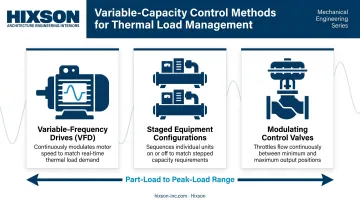
The system must be sized and controlled for both peak and part-load conditions using:
- Variable-frequency drives
- Staged equipment configurations
- Modulating control valves
Airflow Rate and Air Change Requirements
Air change requirements in industrial spaces are dictated by heat load density, contaminant generation rates, and regulatory requirements — not square footage. Food processing areas, chemical rooms, and cleanrooms each carry distinct ACH requirements from their governing standards.
Getting ACH wrong in either direction creates problems:
- Too low: heat buildup, poor IAQ, and regulatory non-compliance
- Too high: excess energy consumption and unsafe pressure differentials between adjacent zones
Humidity Control Tolerance
Humidity control in industrial settings is process-critical. USP <797> requires sterile compounding cleanroom suites to be maintained at 20°C or cooler and below 60% RH. In electronics manufacturing, insufficient humidity creates static discharge hazards. In food facilities, excess humidity produces condensation that enables pathogen growth.
Humidity control requires coordinated design of cooling coils, dehumidification capacity, humidifiers where needed, and envelope vapor barriers.
Failing to account for latent heat loads — particularly in humid climates or moisture-heavy processes like cooking, washing, or fermentation — produces systems that hold temperature setpoints while failing on humidity. That failure mode is common and expensive.
Equipment Environment and Material Compatibility
Industrial HVAC equipment is often installed in environments that degrade standard commercial-grade components faster than anyone anticipates. That degradation starts at specification, not maintenance.
Key material compatibility risks:
- Coil corrosion in food plants using caustic CIP cleaning chemicals
- Duct deterioration in environments with acidic vapors
- Motor and controls failure in electrically classified areas where NEC/ATEX explosion-proof ratings were required but not specified
Each of these risks requires deliberate specification choices — material selections, equipment ratings, and hazard analyses that get resolved at the design stage, not after installation. Hixson's mechanical engineering teams address these issues across food, pharmaceutical, and chemical processing facilities, including coordination of combustible dust hazard analyses per NFPA 652, 61, 654, and 484.
Common Mistakes Engineers Make in Industrial HVAC Design
Four mistakes account for the majority of industrial HVAC failures — and all four are avoidable with the right design approach.
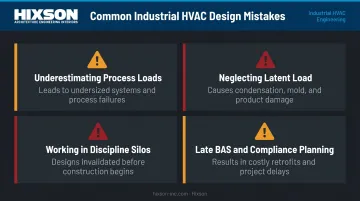
Underestimating process loads. Rules of thumb and area-based estimates consistently produce undersized systems in food, beverage, and pharma facilities, where process equipment heat loads often dwarf occupancy and lighting loads combined. Equipment-by-equipment load calculations are the only reliable method.
Neglecting latent load. Many failures trace back to designing for sensible (temperature) loads while underestimating latent load. Systems that hold temperature setpoints while failing on humidity cause condensation, mold, and product or equipment damage — particularly in humid climates and moisture-heavy operations.
Working in discipline silos. HVAC design cannot happen in isolation from process engineering. Changes to equipment layouts, production line configurations, or utility connections directly affect HVAC loads and airflow paths. When mechanical and process teams work sequentially rather than concurrently, designs are often invalidated before construction begins.
Treating BAS integration and compliance as late-stage tasks. Retrofitting sensor locations, control sequences, or compliance documentation into a finished design costs more and delivers less than embedding these requirements from schematic design. In regulated industries, compliance gaps discovered during jurisdictional review can delay a project by months.
Integrated design teams — where mechanical, process, and controls engineers work concurrently from day one — are the most reliable structural fix for the silo problem. Hixson's 20 in-house disciplines are organized specifically around this concurrent model.
Frequently Asked Questions
How is industrial HVAC design different from commercial or residential HVAC design?
Industrial HVAC must handle large-scale process loads, hazardous environments, variable production schedules, and mission-critical uptime — demands that go well beyond occupant comfort. That scope shifts every downstream decision: load calculations, equipment selection, ventilation strategy, and compliance obligations all differ substantially from commercial or residential work.
How do you calculate the cooling load for an industrial facility?
Industrial load calculations must account for internal loads (machinery, lighting, occupancy), external loads (building envelope, solar gain, climate data), and process-specific loads (heat from manufacturing equipment, chemical processes, or steam systems). Energy modeling software — rather than simplified rule-of-thumb estimates — is necessary to capture all load groups accurately before system sizing begins.
What ASHRAE standards apply to industrial HVAC system design?
The primary standards are ASHRAE 62.1-2025 (ventilation and IAQ), ASHRAE 90.1-2025 (energy efficiency), and ASHRAE 15-2024 (refrigerant system safety). Industry-specific requirements — GMP for pharmaceutical facilities, USDA/FDA for food processing — layer additional obligations on top of these baseline standards.
What role does a building automation system (BAS) play in industrial HVAC design?
A BAS provides centralized monitoring and control across all HVAC zones, supports real-time diagnostics and predictive maintenance, and integrates with fire suppression and process controls. It must be designed in from schematic design — retrofitting a BAS after construction is far more costly and rarely achieves the same level of integration.
What are the recommissioning intervals for industrial HVAC systems?
Stable facilities should plan for formal recommissioning every 5 to 7 years, or sooner after significant changes to process equipment, occupancy, or production schedules. Regulated industries follow tighter cycles: EU GMP Annex 1 requires requalification at 6-month intervals for Grade A/B cleanrooms and 12-month intervals for Grade C/D spaces.
Are there reliable rules of thumb for early-stage industrial HVAC scoping?
Early-stage heuristics can help frame the problem, but no authoritative source — ASHRAE, DOE, OSHA, or FDA — validates universal BTU/sq ft thresholds or energy savings benchmarks as reliable industrial sizing tools. Process-specific load profiles vary too widely. Any preliminary estimate must be validated with full load calculations before system sizing decisions are finalized.