Introduction
Specifying the wrong industrial mixer doesn't announce itself immediately. It shows up three months later as excessive vibration, inconsistent product quality, or a failed seal that shouldn't have needed replacement for years. For engineers and plant managers, a single poor specification decision — say, an undersized shaft or the wrong agitator geometry — compounds quickly into unplanned downtime and product rework.
This guide addresses industrial mixer design as a complete engineering discipline, not a catalog selection exercise. It covers:
- The four core mechanical subsystems every mixer shares
- How material properties dictate equipment choices
- Utility coordination, structural loading, and controls integration
- Regulatory compliance requirements by industry sector
Whether you're specifying mixing equipment for a food production line, a pharmaceutical suite, or a chemical process, the decisions documented here affect both operational reliability and long-term facility costs.
Key Takeaways
- Mixer design is built on four subsystems (drive, mounting, shaft, and impeller), each requiring application-specific engineering rather than off-the-shelf selection.
- Shear category — low, high, or high-viscosity — is the first selection decision; choosing wrong degrades or ruins product quality.
- Abrasive, corrosive, or reactive materials require deliberate design modifications beyond any standard configuration.
- Batch vs. continuous is a facility-level decision that shapes traceability, compliance, and how automation gets integrated.
- Mixer design must be coordinated across process, mechanical, electrical, and controls disciplines from the start.
What Is Industrial Mixer Design?
Industrial mixer design is the engineering discipline of configuring mixing equipment — every mechanical, electrical, and materials decision — to achieve a precise, repeatable process outcome at production scale. It's fundamentally different from purchasing a mixer off the shelf.
The distinction matters. An off-the-shelf mixer is sized for a typical application. An engineered mixer design accounts for your specific material properties, production volumes, regulatory requirements, and facility constraints — then specifies every component accordingly.
The industries that depend on engineered mixer design include:
- Food and beverage — ingredient fragility, sanitation requirements, and 3-A standards govern every wetted surface
- Pharmaceutical and biotech — shear sensitivity, GMP compliance, and batch traceability are non-negotiable
- Chemicals — corrosive or reactive feedstocks demand careful alloy selection and defined safety margins
- Minerals and mining — abrasive slurries rapidly destroy standard equipment without purpose-built design
- Nutraceuticals and biomass — variable feedstock properties require design flexibility baked in from the start
Each sector brings its own regulatory framework and performance requirements. Those requirements must be resolved at the design stage — not retrofitted through equipment modifications after installation costs have already been incurred.
Types of Industrial Mixers: Matching Equipment to Your Process
Shear Category: The First Selection Decision
Mixer selection starts with shear intensity — and selecting the wrong category is one of the most consistently costly mistakes in mixer specification.
ROSS's viscosity and application guide defines three primary categories:
- Low-shear mixers — designed for gentle blending of delicate materials. Appropriate for friable particles, whole fruits, fragile food ingredients where structural integrity must be preserved.
- High-shear mixers — operate in the 1 to 20,000 cP range. Used for emulsification, homogenization, and particle breakdown in pharmaceuticals, cosmetics, and food. Silverson notes that conventional agitators can leave pharmaceutical powders agglomerated or poorly dispersed in creams and ointments — a direct product quality failure.
- High-viscosity mixers — cover materials from 10,000 cP to over 8,000,000 cP, including battery pastes, silicones, rubber adhesives, meat-alternative doughs, and filled polymers.
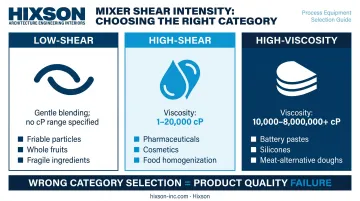
Shear category boundaries aren't arbitrary. In pharmaceutical applications, peer-reviewed research identifies shear stress as a driver of protein-therapeutic degradation — meaning excess shear in a biologics mixing application doesn't just reduce efficiency, it destroys the product.
Horizontal Mixers
Horizontal mixers are the workhorse configuration for bulk solids blending. The key variants and their mixing actions:
| Type | Mixing Action | Best Applications |
|---|---|---|
| Double ribbon | Inner and outer helical ribbons create opposing radial/axial movement at ~300 fpm | Seasonings, beverage mixes, pharma powders, plastic granules |
| Paddle | Lifts, folds, and tumbles material through a fluidized zone | Fragile particles, specialty blends, liquid addition |
| Hybrid (paddle + ribbon) | Counter-rotating agitators increase energy transfer, reduce center buildup | Twin-shaft applications; mix times as low as 30 seconds |
| Fluidizing paddle | Dual-directional action from paddles rather than ribbon conveyance | Bakery blends, nutraceuticals |
Uniformity benchmarks matter here. K-State's mixer testing methodology rates coefficient of variation (CV) below 10% as excellent for solids blending. Scott Equipment's twin-shaft horizontal batch mixer is documented at 3–6% CV with mix times as short as 30 seconds to 3 minutes, and capable of operating down to 10% of rated capacity.
Vertical and Tank-Mounted Mixers
Vertical agitators serve tank mixing applications across liquids, slurries, and suspensions. Impeller selection is driven by flow pattern requirements:
- Marine propeller / hydrofoil: cost-effective for lower-viscosity liquids at smaller scales; produces axial flow
- Pitched-blade turbine (45°): generates mixed axial/radial flow with high pumping rates — well-suited to mining slurries and food processing
- Radial/flat-blade turbine: discharges radially toward the vessel wall; the preferred choice for gas dispersion and high-shear applications
- HE-3 / airfoil hydrofoil: high-efficiency axial flow design (power number ~0.27) that maximizes pumping efficiency in turbulent flow regimes
Tank geometry heavily influences impeller selection. Most applications use an impeller-to-tank diameter ratio (D/T) of 0.25 to 0.40, with 0.33 common. Four baffles placed at 90° intervals, each approximately 1/12 of tank diameter, prevent vortexing and eliminate stagnant zones.
Batch vs. Continuous Mixer Types
This classification cuts across all mixer types and carries significant production-level implications:
Batch mode completes one full mix cycle before the next begins. It offers precise quality traceability by lot, fast formula changeovers, and tight control over mixing time and ingredient ratios — which is why it remains the dominant mode in pharmaceutical manufacturing.
Continuous mode feeds ingredients without interruption, reducing labor through automation and supporting high-volume, single-formula production. The FDA finalized ICH Q13 guidance for continuous pharmaceutical manufacturing in March 2023, and as of May 2026, 17 pharmaceuticals have received approval using continuous manufacturing.
Choosing between the two requires evaluating several process factors:
- Production volume and number of active SKUs
- Changeover downtime tolerance
- CIP/COP cleaning requirements
- Upstream and downstream equipment constraints
- Regulatory traceability obligations
Formal process flow analysis is the most reliable way to work through these trade-offs before committing to a mixer configuration.
The Four Core Components of Industrial Mixer Design
Every industrial mixer, regardless of type, shares four primary design subsystems. Each must be engineered to the specific application.
Drive System: Motor and Gearbox
The drive system must be sized for more than nameplate horsepower. Continuous mixing operation introduces combined radial (overhung) and thrust loads that standard industrial gearboxes aren't designed to handle reliably over time.
Agitator-specific gearboxes use heavy-duty low-speed shaft bearings engineered for these combined loads. SEW's agitator drive specifications confirm that permitted overhung load depends on service factor, required bearing service life, force direction, output speed, and torque — not just power rating.
Variable frequency drives (VFDs) are an increasingly standard addition. They allow operators to respond in real time to changes in feedstock viscosity or batch composition, avoiding the torque spikes that occur when mixing conditions shift.
Mounting Configuration
Mount selection is dictated by tank size and type, available headspace, desired flow pattern, and operating environment. The primary options:
- Bridge mount — spans the tank opening; common for open tanks
- Clamp or plate mount — attaches to tank rim or nozzle; portable or semi-permanent
- Flange mount — bolted to tank wall or top; used for closed, pressurized, or sanitary tanks
- Pedestal mount — floor-supported; for large high-torque applications
- Side-entry mount — enters through the tank wall at an angle; used in large storage or process tanks
Three to four baffles at approximately 1/12 of tank diameter (with a small wall gap) work alongside the mount to control vortexing, prevent air entrainment, and eliminate stagnant zones.
Shaft Design
Compromise any one shaft design factor and the others degrade with it:
- Shaft diameter — smaller diameters increase fatigue stress under cyclic mixing loads
- Static deflection — excessive deflection accelerates seal wear and misaligns bearings
- Dynamic deflection — affects agitator-to-trough clearance and mixing uniformity
- Stress risers — keyways, threads, and sharp transitions concentrate stress and initiate fatigue cracks
- Construction — solid one-piece shafts deflect less than hollow or coupled alternatives
- Straightness after welding — warped shafts accelerate both bearing and seal wear
- Agitator-to-trough clearance — large gaps increase coefficient of variation (a measure of mixing uniformity) and mix times
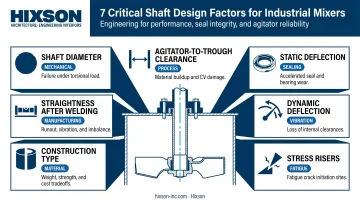
Critical speed — the natural harmonic frequency of the shaft/impeller system — must be calculated and factored into operating speed selection. ProQuip documents mixer examples operating at approximately 50% of first critical speed to avoid resonance-driven vibration failures.
Impeller and Agitator Selection
Impeller geometry determines flow pattern. Axial-flow impellers (hydrofoils, marine propellers, pitched-blade turbines at low angles) are suited to bulk mixing and solids suspension. Radial-flow impellers (flat-blade turbines, Rushton-style) are used where gas dispersion or high local shear is required.
Impeller positioning on the shaft — number of impellers and their spacing — directly controls mixing effectiveness, particularly in tall tanks or with stratified materials.
Material selection for wetted impeller components follows a straightforward hierarchy:
- Stainless steel (304/316) — standard for food and pharmaceutical applications
- Specialty alloys — for corrosive process streams
- Abrasion-resistant coatings — for high-wear or abrasive environments
Sealing Technologies
The wrong seal for the application shows up as contamination events, chronic leakage, or maintenance calls that shouldn't be happening. Three primary categories:
- Braided rope packing — economical, requires periodic adjustment and replacement, acceptable leakage tolerance required
- Composite lip seals — non-porous, shaft-friendly, FDA-compliant, 3-A certifiable; easier to maintain than mechanical seals for most food and pharma applications
- Mechanical seals — highest performance for demanding pressure, vacuum, or contamination-sensitive applications; higher initial cost
Mismatched seal selection is one of the more predictable sources of unplanned downtime in mixing operations — and it's avoidable at the design stage.
In food and pharmaceutical environments, 3-A Sanitary Standard 73-01 (Shear Mixers, Mixers, and Agitators) and 21 CFR 117.40 set the baseline for seal materials and cleanability. Those requirements need to be designed in from the start, not addressed after installation.
Material Selection and Designing for Harsh Environments
Harsh mixing applications fall into four categories, each requiring deliberate design responses:
- Abrasive materials (silica, limestone, mineral ores) — cause excessive wear on paddles, shafts, and seals
- Corrosive materials (pH extremes, high chloride content) — attack all wetted surfaces; the single most problematic material property in bulk processing
- Sticky or inconsistent feedstocks — variable moisture content creates metering challenges and material buildup
- Reactive materials — exothermic reactions, fugitive gases, or phase changes during mixing alter material properties and corrosiveness throughout the mixer
Engineers must design for worst-case scenarios — including unreacted free acid concentrations, peak temperature excursions, and maximum moisture content — not average operating conditions.
Abrasion-Resistant Design
Key design strategies for abrasive applications:
- Abrasion-resistant linings on paddle faces and backing plates
- Allowing natural material buildup on trough walls (as in pugmill designs) to serve as a sacrificial protective layer
- Oversizing shaft diameter and drive components to compensate for increased wear loads over time
- Trough material selection (carbon steel vs. stainless) affects both cleanout frequency and material adhesion
Corrosion-Resistant Material Selection
The decision hierarchy for corrosion resistance follows the actual corrosion mechanism — pH-driven, chloride-driven, temperature-accelerated, or moisture-range-specific:
| Material | Appropriate Service |
|---|---|
| Carbon steel | General industrial, non-corrosive, coated applications |
| 304/304L stainless | Mild corrosion resistance, standard food and beverage |
| 316/316L stainless | Improved corrosion resistance; better chloride resistance than 304 |
| Duplex stainless | Exceptional strength and stress corrosion cracking resistance; higher erosion resistance in slurry applications |
| Hastelloy / nickel alloys | High chloride, high-temperature, or aggressive chemical environments |
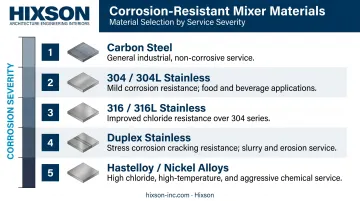
The decision often balances corrosion resistance against unit cost. In some cases, adjusting feedstock chemistry (moisture content or pH) can address corrosion risk without requiring a more expensive alloy upgrade.
Power Requirements and Safety Margins
Sticky, sludge-like, or reactive materials require significant horsepower and torque margins above the theoretical minimum. Drive sizing must account for worst-case material consistency, not design-point values.
Electronic shock relays and over-torque protection are critical for safeguarding drive components during unexpected process upsets or tramp material ingestion. U.S. Tsubaki's shock relays, for example, operate across motor current ranges of 0.25 to 16 amps with load-current detection from 30–130%, making them a practical specification choice for mixer overload protection.
Integrating Mixer Design Into Your Facility
Mixer selection doesn't happen in isolation. The equipment must be engineered within the context of the overall production facility, which means coordinating across multiple disciplines from the start.
Facility-Level Coordination Requirements
Utility connections that must be planned at the facility design stage:
- Compressed air, process water, steam supply and return
- CIP supply and return lines, including valve and drain locations
- Electrical load planning — VFDs, motor starters, power distribution
- Ventilation and dust/vapor management for dusty or reactive feedstocks
- Structural floor loading for large horizontal or high-torque vertical mixers
- Maintenance access clearances — shaft removal, drop-bottom door operation, seal replacement
Hixson's Process & Manufacturing Engineering teams develop equipment lists, utility requirements, and P&IDs that map these connections across the full production sequence. Their structural engineering capabilities cover equipment foundation design and support platforms, ensuring floor loading is addressed in the design documents rather than discovered during equipment installation.
Controls and Automation Integration
Controls design elevates mixer performance from basic operation to intelligent process control. Key integration elements:
- PLC-based sequence control for batch recipes
- VFD integration for dynamic speed adjustment based on feedstock conditions
- In-line viscosity or density feedback loops
- Automated CIP sequencing tied to production schedules
- SCADA/MES connectivity for production data and reporting
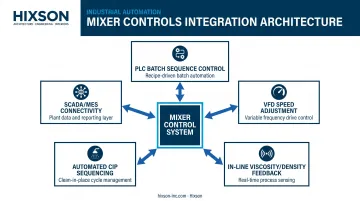
Hixson's Controls & Automation team — experienced in Rockwell Automation, AVEVA Wonderware, and Inductive Automation Ignition platforms — builds these automation strategies into the facility design from day one.
For food and pharmaceutical facilities, controls design must also address 21 CFR Part 11 compliance, audit trails, and recipe management. Hixson supports the full project lifecycle from User Requirements Specifications (URS) through Factory Acceptance Tests (FAT) and Site Acceptance Tests (SAT).
Regulatory and Sanitation Design
Those same compliance requirements extend beyond controls logic into the physical design of every mixer component. Regulatory standards must be factored into the specification from the start — not retrofitted after equipment selection. Critical considerations include:
- 3-A Sanitary Standard 73-01 for shear mixers, mixers, and agitators used in food processing
- 21 CFR 117.40 requiring cleanable, corrosion-resistant, nontoxic food-contact surfaces with smooth seams
- FSMA compliance governing equipment design and sanitation procedures
- USDA/FDA equipment acceptance for applicable facility types
For pharmaceutical and biotech facilities, GAMP 5 and GMP validation requirements (IQ/OQ/PQ under EMA Annex 15) require additional design documentation and commissioning rigor. Hixson has designed cGMP spaces for 75+ years, with multi-disciplinary teams covering documentation from URS development through IQ/OQ/PQ execution.
When utility routing, structural support, controls logic, and sanitation requirements are designed by the same team, compliance gaps get caught in documents — not during commissioning.
Frequently Asked Questions
What is an industrial mixer?
An industrial mixer is process equipment designed to combine, blend, or homogenize materials — liquids, solids, or gases — at production scale. They differ from commercial or consumer equipment in engineering complexity, capacity, material durability, and control system integration.
How much does an industrial mixer cost?
Costs range from a few thousand dollars for small portable mixers to hundreds of thousands for large custom-engineered systems with specialized alloys, explosion-proof drives, and automation. Total cost of ownership — factoring in energy, maintenance, and downtime risk — matters more than purchase price alone.
What is a mixer in construction?
In construction, a "mixer" typically refers to concrete or mortar mixing equipment that combines aggregate, cement, and water on job sites. This is distinct from industrial process mixers used in food, pharmaceutical, chemical, and similar production environments, which is what this guide covers.
What are the main types of industrial mixers?
Primary classifications are by shear intensity (low-shear, high-shear, high-viscosity), orientation (horizontal vs. vertical/tank-mounted), and operating mode (batch vs. continuous). Agitator type — paddle, ribbon, propeller, turbine — further defines performance within each class.
How do I choose the right industrial mixer for my application?
Selection depends on material properties (viscosity, density, particle size, corrosivity), production volume, regulatory requirements, and facility constraints. A formal process engineering review before finalizing specifications prevents the most costly misspecification errors.
What materials are used in industrial mixer construction?
Carbon steel suits general industrial use; 304/316 stainless steel is standard for food, beverage, and pharmaceutical applications; specialty alloys like Hastelloy handle highly corrosive or reactive environments. Abrasion-resistant linings are applied to wetted surfaces in high-wear applications.